gait analysis

Why do we so rarely test normalisation schemes?

Normalising gait data is so common that we may sometimes forget about why we are doing it. It’s getting on for 17 years since At Hof published his paper on non-dimensional normalisation (Hof, 1996). Slowly this approach is being becoming part of mainstream practice. What interests me, however, is how little testing to check that it actually works.

Normalisation is a technique to try and reduce the variability in data that comes when individuals of different sizes are being compared. A raw measure of joint moment in Newton-metres, for example, is likely to be greater in a heavier person simply because they are heavier. Measurements of joint moments across a range of people are likely to be vary considerably simply because those people are of different weights. By dividing all the measurements by bodymass and reporting measurements in N-m/kg we hope to reduce the variability. This should make it much easier to spot a subject who has abnormal moments because of the way they walk rather than how heavy they are.

At introduced a hypothesis that a particular way of normalising data to give non-dimensional values would reduce the variability in data. This is an extremely sensible approach but it is essentially a hypothesis. Given this it is interesting that there has been so little work to test the hypothesis. Ben Stansfield (2003) and colleagues in Edinburgh tested how non-dimensional normalisation affected a correlations between a range of temporal and spatial parameters with impressive results but didn’t actually address the even more basic question of how whether the normalisation reduces the variability with body size (which is what it is designed for as described above).
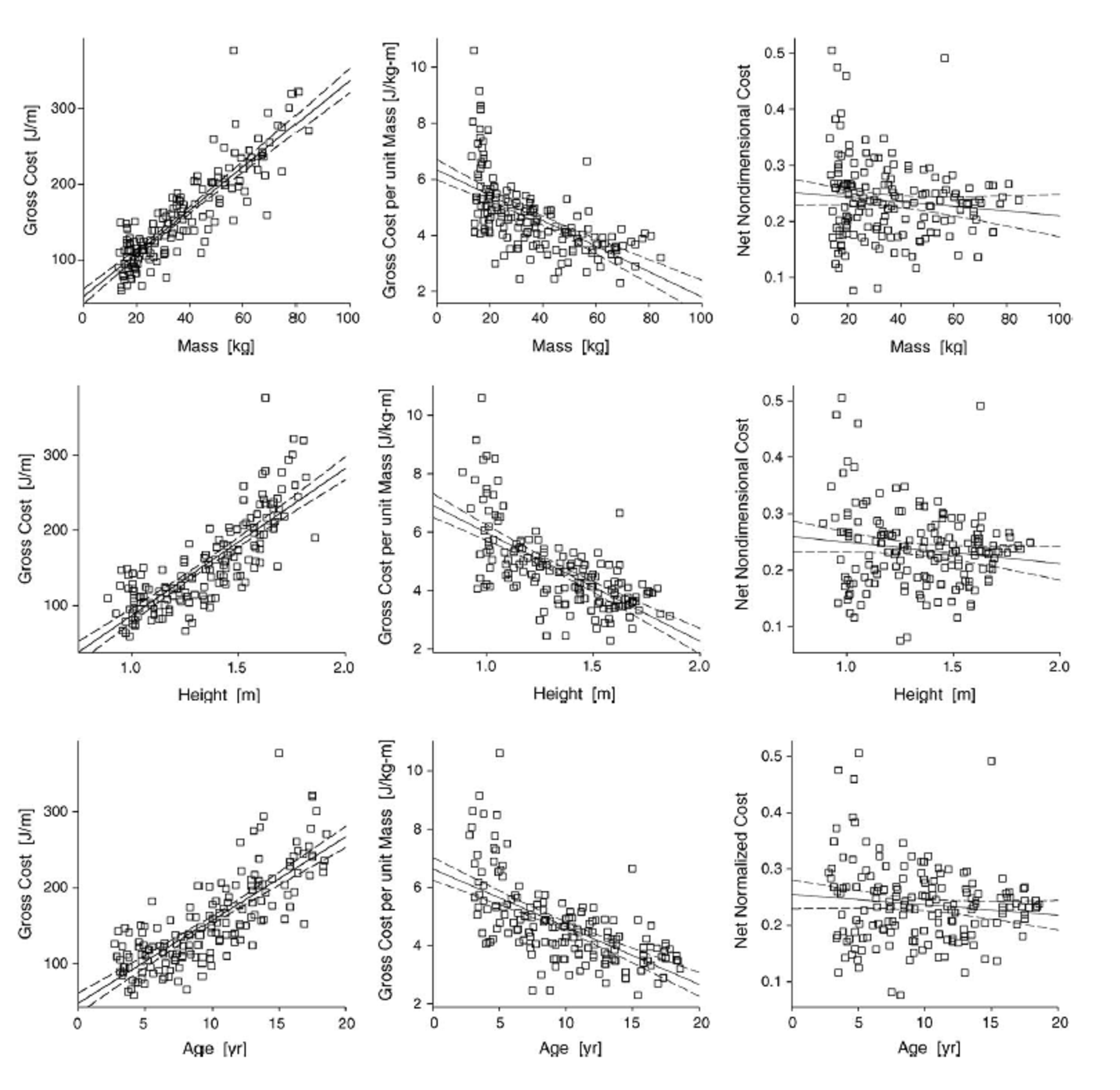
Oxygen normalisation

Adapted from Schwartz et al., 2006

Mike Schwartz and I (Schwartz et al., 2006) adopted the approach for normalising oxygen cost and rate/consumption. The traditional approach was simply to divide Oxygen cost by mass and when we tested this we found that the data was over-normalised. Raw measurements (mmO2/m) increase with increasing weight. Measures normalised by bodymass (mmO2/kg-m) actually decrease with increasing mass (see Figure below). Deriving a non-dimensional equivalent results in data that show no systematic variation with mass, height or age. When we did this paper I think we assumed that other people might investigate other normalisation schemes in a similar manner but, to my knowledge there have been no such studies.

Two obvious candidates for such studies are joint moments and powers. Dividing either by mass alone (as is almost universal practice in clinical gait analysis) only partially normalises the data. Hof recommends that moment should be normalised by leg length as well as mass (and this is common practice in some strands of research particularly studies of the knee adduction moment). It really is quite amazing that over three decades after David Winter popularised the use of joint moments in clinical gait analysis (Winter & Robertson, 1978) no-one yet has performed a definitive study to identify the optimum normalisation scheme for the data.

Hof, A. (1996). Scaling gait data to body size. Gait and Posture, 4, 222-223.

Schwartz, M. H., Koop, S. E., Bourke, J. L., & Baker, R. (2006). A nondimensional normalization scheme for oxygen utilization data. Gait Posture, 24(1), 14-22.

Stansfield, B. W., Hillman, S. J., Hazlewood, M. E., Lawson, A. M., Mann, A. M., Loudon, I. R., & Robb, J. E. (2003). Normalisation of gait data in children. Gait Posture, 17(1), 81-87.

Winter, D., & Robertson, D. (1978). Joint torque and energy patterns in normal gait. Biological Cybernetics, 29, 137-142.
What’s in a name?

We’ve recently advertised for a “Clinical Gait Analyst”. Perhaps I shouldn’t have been surprised but we’ve had expressions of interest from all sorts of people that obviously have quite a different idea of what clinical gait analysis is to the one that I’ve got. To me a clinical gait analyst is someone who works in a clinical gait analysis service. They capture data using a 3-d optoelectronic measuring system (or equivalent) which may incorporate synchronous force plate or EMG measurements. Many also provide an interpretation of this, generally drawing on additional information from a quantitative physical examination. If clinically qualified they may provide clinical recommendations based on the analysis.

“Gait analysis” is, quite appropriately, used in many other contexts. Google up “gait analysis” and there is a good chance that the first hits will refer to a combination of video recording of running and expert advice to help you choose an expensive pair of running shoes. Another group of gait analysts will look at your running and suggests ways of improving your style to improve your times or prevent injury. Getting more clinical many orthotists, prosthetists, podiatrists and physiotherapists base much of their working lives on observational gait analysis. Some will take video recordings but many will simply look at how their patients are walking as a basis for clinical recommendations. On the more technical side there are a number of people interested in gait for a variety of reasons with little or know interest in clinical applications. There is another group of people who perform gait analysis for clinical research. They perform a variety of analyses on grouped data to try and learn more about a disease condition or intervention but don’t offer any results or interpretation for individual patients.  Gait analysis is also proposed as a biometric technique for security purposes. It’s not restricted to humans – Google up “canine” or “equine gait analysis” and you might be surprised by the number of hits.

None of us has a monopoly of such a generic term as “gait analysis” or even “clinical gait analysis” but I do think there is a need for something that refers specifically to what I do (perhaps as far as most readers of this blog are concerned to what we do). Trying to claim that only someone that does what I do is involved in gait analysis is ridiculous and mildly insulting to other practitioners. Perhaps we need a more specific term for what we do.

Some people use “3-d gait analysis” but taking a coronal and sagittal plane video, or even just watching someone walk from different angles is three dimensional. “Instrumented gait analysis” has also been used  but there are a wide range of instruments – a single force plate for example. The best I can come up with while writing this article is “Comprehensive Clinical Gait Analysis” (CCGA). To me this captures the aim of getting a reasonably complete picture of the way someone is walking (even if its rare that anything like a complete picture actually emerges!). Anyone have any other ideas?

What is an inverted pendulum?

“Inverted pendulum” is one of those terms that seems to have crept up on me over my time in biomechanics. I don’t remember it being commonly used or taught when I was a student but now it seems to be everywhere. I suspect it is one of those terms that is not understood anywhere nearly as well as it should be. I’m not aware, for instance, of any biomechanics text book that properly explains what an inverted pendulum is or what its mechanical characteristics are. This is particularly important because in mechanics the “inverted pendulum” is more often studied as a classic example of dynamics and control theory (see the Wikipedia article for example). Anyone looking at these descriptions but wanting insight into the biomechanics of walking is going to end up very confused.

An ordinary pendulum is one with the pivot at the top and the mass at the bottom. An inverted pendulum is the opposite way round. The pivot is at the bottom and the mass is on top. Fierljeppen (canal vaulting) is the best example I’ve got of an inverted pendulum (see video below). The pole rotates about its foot (at the bottom of the canal) and transports the vaulter from one side of the canal to the other. “Transports” is the key word here. The inverted pendulum is a mechanism for carrying an object form one place to another and this is how it functions during walking. The “passenger unit” as Perry would call it is carried forward by the outstretched leg as it pivots over the foot.

It should be noted that there are important differences between the two types of pendulum. The inverted pendulum only carries an object in one direction, it doesn’t swing backward and forward like the ordinary pendulum. Another difference is that the inverted pendulum does not have a characteristic frequency like an ordinary pendulum – it would be absolutely useless inside a grandfather clock.

The earliest use of the term as a model of the stance phase of walking that I am aware of was by Cavagna et al. (1976). Earlier workers have used different terms for essentially the same concept. The “compass gait” of the much aligned Saunders, Inman and Eberhart (1953) is essentially a description of the inverted pendulum. A decade later Elftman (1966) suggested that “the body moves forwards as if vaulting on a pole” and a further decade on Alexander used the term “stiff-legged gait” (1976). It is probably the more recent work of the dynamic walking group (best summarised by Kuo, 2007) that has really popularised the use of the term.

Some papers refer to Cavagna as having tested the hypothesis that the leg behaves like an inverted pendulum (e.g. Kuo, 2007, page 619). I’ve never found any evidence of this in Cavagna’s writing or anywhere else. He certainly commented that changes in kinetic and potential energy of the centre of mass correlate so that the total energy remains approximately constant throughout the gait cycle but there are an infinite number of ways this can occur without requiring an inverted pendulum mechanism (I might write more about this in a later post).

“Proving” that walking is based on the inverted pendulum is problematic in that at a very broad level it is obvious that walking involves a similar mechanism. The foot is clearly planted and the passenger unit is carried over it by the outstretched leg. On the other hand it is equally clear that the mechanism is not a simple inverted pendulum. The trunk remains upright, there is stance phase knee flexion and the pivot with the floor changes position and anatomical location through stance (Perry’s rockers). Any study attempting to establish whether stance is like an inverted pendulum will inevitably conclude that it is a bit like one but not exactly. Forming a sensible research question to “prove” the importance of this mechanism is quite a challenge.

Anderson and Pandy (2003) reported briefly on the dynamics of the inverted pendulum as a model of stance phase and Buczek and his team in more detail (2006). Both these papers are worth reading and held a couple of surprises for me but I’ll keep those for a later post.

Alexander, M. (1976). Mechanics of bipedal locomotion. In P. Davis (Ed.), Perspectives in experimental biology (pp. 493-504). Oxford: Pergamon.

Anderson, F. C., & Pandy, M. G. (2003). Individual muscle contributions to support in normal walking. Gait Posture, 17(2), 159-169.

Buczek, F. L., Cooney, K. M., Walker, M. R., Rainbow, M. J., Concha, M. C., & Sanders, J. O. (2006). Performance of an inverted pendulum model directly applied to normal human gait. Clin Biomech (Bristol, Avon), 21(3), 288-296.

Cavagna, G. A., Thys, H., & Zamboni, A. (1976). The sources of external work in level walking and running. J Physiol, 262(3), 639-657.

Elftman, H. (1966). Biomechanics of muscle with particular application to studies of gait. J Bone Joint Surg Am, 48(2), 363-377.

Kuo, A. D. (2007). The six determinants of gait and the inverted pendulum analogy: A dynamic walking perspective. Hum Mov Sci, 26(4), 617-656.

Saunders, J. D. M., Inman, V. T., & Eberhart, H. D. (1953). The major determinants in normal and pathological gait. Journal of Bone and Joint Surgery, 35A(3), 543-728.

GPS and/or GDI? Part 3 – A decision?

In the last two posts I’ve looked at the differences between the GDI (Schwartz & Rozumalski, 2008) and GPS (Baker et al., 2009). The broad conclusion is that they are very minor. Much less important than I thought when we published the GPS paper in 2009. The derivation of the GPS is much simpler than that of the GDI and this is what I really like about it (but takes no less time to calculate once you’ve got the software). I prefer the way the GPS is scaled but now accept that this is simply personal preference and the requirement to log transform data before performing statistical tests is clumsy (and I suspect is being ignored in many applications). On balance we should probably have published an alternative derivation of the GDI rather than proposing an alternative index.

The other issue, of course, is the Movement Analysis Profile. This is an obvious and extremely useful extension of the GPS. There are technical reasons why an equivalent doesn’t flow from the derivation of the GDI. If we’d published an alternative derivation of the GDI in 2009 as opposed to a different index, however,  then it would have been the easiest thing in the world to define similarly scaled variables for the different joints and different planes. We’d then have a MAP that was equivalent to the GDI.

In conclusion what we should have done in 2009 was to propose an alternative derivation of the GDI and extended that to develop a MAPGDI. Hindsight is a wonderful thing – we didn’t. We’re thus stuck with two indices that are very much the same but different. Some research groups have understood the subtleties of the differences and opted for one or the other for a good reason. Others may have tossed a coin. Other groups have chosen to report both.  There is an argument that we should try and roll back the clock by proposing MAPGDI now but I don’t know what stomach there is for even more new indices in the community. It might be interested see what comments this post prompts from you. Should we try and tidy this up by doing what we should have done in 2009 or will this just cause even more confusion?

What is clear is that there is little point any study reporting the results of both GPS and GDI (they are too similar for this to be useful). There is absolutely no point performing statistical tests on both because they should give identical results (as long as the log transform is applied to the GPS). People should choose which they prefer and report that. Mike and I have submitted a joint paper to GCMAS next year which includes the formulae required to convert one index to the other.

Perhaps even more important – research should not focus solely on either measure. Whilst the indices provide a simple number that describes how different the kinematics are from normal there is a lot more to walking than looking like everyone else. Gait speed is an extremely important measure of gait function and how this depends on cadence and step length provides basic clinical insight. Simply taking the rather poorly defined “self-selected” walking speed used in most gait analysis tests may be the easiest measure of speed but it is not necessarily the best. Endurance is also important and the 6-minute walk test that is becoming standard in other areas of exercise physiology is combines elements of speed and endurance that have considerable face validity. In many cases it is also important to assess dependence on walking aids (as in the FMS, Graham, Harvey, Rodda, Nattrass, & Pirpiris, 2004) and orthoses. Whilst GDI and GPS greatly enhance our ability to characterise gait kinematics they should not be used to the exclusion of other measures.

Graham, H. K., Harvey, A., Rodda, J., Nattrass, G. R., & Pirpiris, M. (2004). The Functional Mobility Scale (FMS). J Pediatr Orthop, 24(5), 514-520.

Schwartz, M. H., & Rozumalski, A. (2008). The gait deviation index: A new comprehensive index of gait pathology. Gait Posture, 28(3), 351-357.

Baker, R., McGinley, J. L., Schwartz, M. H., Beynon, S., Rozumalski, A., Graham, H. K., & Tirosh, O. (2009). The gait profile score and movement analysis profile. Gait Posture, 30(3), 265-269.

GPS and/or GDI? Part 2 – Scaling the result

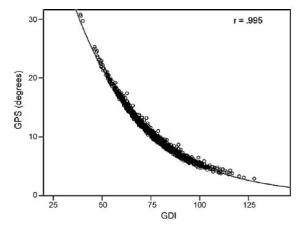
In the last post we looked at the different mathematical approaches that the GDI (Schwartz & Rozumalski, 2008) and GPS (Baker et al., 2009) use to derive the underlying measure of difference. These result in the scatter of data about the trend line in the graph below. In this post we’re going to look at the difference in scaling between the two measures which explains the characteristic shape of this curve.  There are two major differences.

GDI-GPS

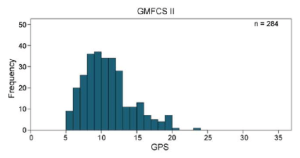
First is the logarithmic transform. When you look at the distribution of the GPS across either a GMFCS category (Wood & Rosenbaum, 2000)) or FAQ level (Novacheck, Stout, & Tervo, 2000) you find a skewed distribution.  The figure below illustrates this for GMFCS II kids. It is clear that the data is not normally distributed and should be log transformed before subjecting to any parametric statistical tests. I’ve got a hunch that the skewing in the data is telling us something useful and would prefer to leave the index as it is (but recommend the transform as an additional step before performing the stats). Mike is less convinced and thinks incorporating the log transform in the derivation of the index is a lot tidier.

GMFCS 2

It is this log transform that gives the curve in the first figure its characteristic shape. The graph is steeper to the left which means that GPS will tend to record proportionally greater changes between people with more abnormal gait patterns than the GDI. It is flatter to the right meaning that this will be reversed in people with less abnormal gait patterns. Having said this most patients have a GDI of between 50 and 80 (GPS between 8° and 20°) and the relationship is reasonably linear within this range.

The second difference in the scaling is the way the GDI is transformed so that a normal score is 100 and for each standard deviation away from this the score drops by 10 points. It is this that leads to the quite different magnitudes of the two indices. Again there is logic to both approaches. Scoring this way gives a number that can be interpreted without any understanding of the underlying measure. On the other hand some people who do understand that the measure derives from angular measurements might be interested in the actually size of this which is lost in the GDI.

After several years’ experience using the GPS I’ve become less convinced of the usefulness of this. The averaging of the deviations over the gait cycle and different joint angles tends to make the absolute value of the score less meaningful. Having said this it is often appropriately sobering to find that differences that appear highly significant can represent average changes of just a couple of degrees.

In summary there is little to choose between the two scaling options. I used to think there were strong reasons for preferring the GPS scaling but the older I get the more I see this as essentially a matter to personal preference. The GDI was published first and maybe that should give it the edge.


Schwartz, M. H., & Rozumalski, A. (2008). The gait deviation index: A new comprehensive index of gait pathology. Gait Posture, 28(3), 351-357.

Baker, R., McGinley, J. L., Schwartz, M. H., Beynon, S., Rozumalski, A., Graham, H. K., & Tirosh, O. (2009). The gait profile score and movement analysis profile. Gait Posture, 30(3), 265-269.

Wood, E., & Rosenbaum, P. (2000). The gross motor function classification system for cerebral palsy: a study of reliability and stability over time. [Research Support, Non-U.S. Gov’t]. Dev Med Child Neurol, 42(5), 292-296.

Novacheck, T. F., Stout, J. L., & Tervo, R. (2000). Reliability and validity of the Gillette Functional Assessment Questionnaire as an outcome measure in children with walking disabilities. Journal of Pediatric Orthopaedics, 20(1), 75-81.