A check on Scopus shows that our original article on the GPS (Baker et al., 2009) has now been cited 33 times and Mike’s paper on the GDI 53 times (Schwartz & Rozumalski, 2008). 20 of these cite both papers – although I haven’t had the time to look to see whether both indices were used. So should we use one or the other or both?
There are basically two differences – doing the maths and scaling the result. I’ll break this blog into two parts in the hope that this makes things clearer.
Computing the GDI is based on an analysis of a very large dataset including examples of all the different gait patterns you are likely to come across. From this a number of gait features are identified. The first feature represents the average gait trace amongst the whole population (not just people without pathology). All the other features represent different deviations from that average. You can represent any individual’s gait pattern as a combination of the different features. Mike showed that just using the 15 most common features allowed you to get very close to any given measured gait pattern. This actually means that any individual’s entire kinematic gait pattern can be represented by just 15 numbers which is kind of cool and could save a huge amount of computer storage. Having gone through this process you can take the root mean square (RMS) difference of the 15 numbers that represent your patient and those that represent healthy individuals with no gait pathology of a measure of how different your abnormal your patient’s gait is.
The GPS is just computed as the root mean square difference of the individual’s kinematic data from the “normal” reference data across relevant kinematic variables and the whole gait cycle. It can be visualised as representing the total area contained between the traces representing your patient and those for the reference dataset (see Figure below). Clearly the larger the difference between the traces, the bigger this area becomes.

This sounds radically different to the GDI but Mike did some work (which has been lodged as an electronic appendix to the GPS article) which shows that actually the two are very nearly identical and would be exactly the same if the GDI analysis was extended to include all 459 features and not just the first 15. This subtle difference leads to the scatter on the graph of GPS plotted against GDI (reproduced from the GPS article below). You can see from this that the differences are certainly small and probably random. There doesn’t seem any particular reason to claim that one is superior to the other.
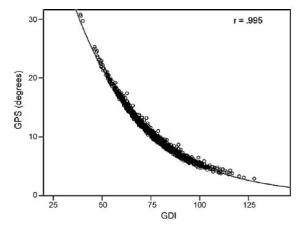
Now that Mike has done all the hard work in the feature analysis the computation of the GDI isn’t much more complicated than that of the GPS and there are a number of spreadsheets in circulation that allow the calculation of one or the other or both. The main advantage of the on which the GDI is based is the data compression but this isn’t particularly relevant if all you want to do is calculate a gait index. The derivation of the GPS is more straight forward and easier to explain and understand. Following Ockham’s razor that the simplest explanation is generally the best, then the GPS maths probably wins out.
The advantages of the GPS derivation are perhaps clearest if analogous indices are to be produced for other variables. Deriving an equivalent of the GDI would require data from a population big enough to contain examples of all possible different gait patterns. Deriving an equivalent of the GPS only requires a population big enough to establish the average pattern for the healthy population reasonably accurately.
Baker, R., McGinley, J. L., Schwartz, M. H., Beynon, S., Rozumalski, A., Graham, H. K., & Tirosh, O. (2009). The gait profile score and movement analysis profile. Gait Posture, 30(3), 265-269.
Schwartz, M. H., & Rozumalski, A. (2008). The gait deviation index: A new comprehensive index of gait pathology. Gait Posture, 28(3), 351-357.

 Walking with Richard