history

60 years of the determinants of gait: a misconception

The month of July 2013 marks the 60th anniversary of the publication of The Major Determinants of Normal and Pathological Gait by J B dec M Saunders, Verne Inman and Howard Eberhart.  This is a seminal paper in the history of gait analysis which was revered for many years and is the foundation of the description of normal walking in many text books.  More recently, however, it has come in for substantial criticism.

three determinants

The first named author, John Bertrand deCusance Morant Saunders, was a medically trained Professor of Anatomy at the University of California who was born in South Africa of Scottish descent. The story is that he needed his name on a paper to justify a trip to the Joint Meeting of the Orthopaedic Associations in London in 1952 and Inman and Eberhart obliged. There is little doubt that the ideas were those of Inman, a pioneering Orthopaedic Surgeon, and Eberhart,  an engineer. (Inman first met Eberhart when amputating his leg after a wartime accident at the time when he had been asked to establish the National Research Council Advisory Committee on Artificial Limbs. He invited Eberhart, originally a civil engineer, to join him and the partnership continued for the next thirty years).

Over the month I intend to write a series of posts celebrating this anniversary by looking at different aspects of the paper.  In this post I’d like to dispel one of the myths about the paper which is that it states that the aim of walking is to minimise the excursion of the centre of mass. In a significant review article, for example, Art Kuo (2007) writes “The six determinants of gait theory proposes that a set of kinematic features help to reduce the displacement of the centre of mass. It is based on the premise that the horizontal and vertical displacements are energetically costly”. 

An earlier paper by Ortega and Farley (2005) starts with an almost identical quote which drove the authors to train participants to walk with a nearly flat trajectory of the centre of mass. They then showed that it took nearly twice as much energy (oxygen) to walk a given distance with the flattened trajectory than with the normal trajectory. Gordon, Ferris and Kuo (2009 – who I think did the work earlier but published it considerably later than Ortega and Farley) conducted a very similar study and came up with essentially the same results. The introduction of that paper is interesting in describing how “at least a dozen text books have interpreted [Inman’s] work as meaning it is desirable to minimise or reduce COM movement during walking” and giving an overview of how the ideas have developed through these.

What is interesting though is that nowhere in the original paper (nor in the extended versions that have appeared in the three editions of the book Human Walking) can I find any statement by the  authors that minimisation of the COM movement is the aim of walking. What thy actually said was this:

Translation of a body in straight line with the least expenditure of energy may be achieved mechanically by the use of a wheel, but it is quite impossible by means of bipedal gait. The next most economical method would be the translation of the body through a sinusoidal pathway of low amplitude in which the deflections are gradual. Since force is equal to mass times acceleration and acceleration is a function of time, abrupt changes in the direction of the centre of motion compel a high expenditure of energy. In translating the centre of gravity through a smooth undulating pathway of low amplitude the human body conserves energy; and, as we shall see in considering pathological gait, the body will make every attempt to continue to conserve energy.

What they are proposing is that the body acts to ensure a smooth trajectory not necessarily one of minimal vertical displacement. They start off by describing compass gait, moving with fixed knee with no foot and the problem that they identify with this is that “at the point of intersection with the arcs, the abrupt change in the direction of the forward acceleration [I think they actually mean vertical component of velocity – RB] would require the application of a force of considerable magnitude”. This is actually extremely close to the hypothesis of the Dynamic Walking Group that one of the principal energy costs of walking is the requirement to redirect the centre of mass velocity during step to step transitions (Kuo et al. 2005) despite a contention that  their approach is the antithesis of Inman and Eberhart’s (see Kuo  2007). The six determinants proposed in the original paper are then strategies to smooth the trajectory of the COM but not necessarily to reduce it.

So where did the original and perfectly sensible views of Inman and Eberhart get distorted? Gordon et al. (2009) quote Perry (1992) as saying “minimising the amount that the centre of gravity is displaced from the line of progression is the major mechanism for reducing the muscular effort of walking, and consequently, saving energy”. Perry, of course, trained under Inman, and it may be that like so many pupils it is she that has misrepresented the ideas of her teacher. As an engineer myself, however, I’d take the personal side out. I’d see the original and valid ideas as indicative of the potential for progress when clinicians and engineers come together to address the challenges of clinical biomechanics. The misrepresented and invalid ideas appear when clinicians think they can go it alone!

That’s it for this post. I’ve emphasised one particular aspect in which I think the work has been unfairly criticised. In later posts I’ll look at some aspects where criticism may have been more justified as well as examining the popular appeal of the approach

.

Gordon, K. E., Ferris, D. P., & Kuo, A. D. (2009). Metabolic and mechanical energy costs of reducing vertical center of mass movement during gait. Arch Phys Med Rehabil, 90(1), 136-144.

Kuo, A. D., Donelan, J. M., & Ruina, A. (2005). Energetic consequences of walking like an inverted pendulum: step-to-step transitions. Exerc Sport Sci Rev, 33(2), 88-97.

Kuo, A. D. (2007). The six determinants of gait and the inverted pendulum analogy: A dynamic walking perspective. Hum Mov Sci, 26(4), 617-656.

Ortega, J. D., & Farley, C. T. (2005). Minimizing center of mass vertical movement increases metabolic cost in walking. J Appl Physiol, 99(6), 2099-2107.

Perry, J. (1992). Gait Analysis. Thorofare: SLACK.

Saunders, J. D. M., Inman, V. T., & Eberhart, H. D. (1953). The major determinants in normal and pathological gait. Journal of Bone and Joint Surgery, 35A(3), 543-728.

Who first thought of a gait graph?

Quite out of the blue Jenny Kent from Headley Court asks if I know where the gait graphs we know today come from. She was particularly interested in where the idea of time normalising data to the gait cycle originated. I have to admit I just don’t know.

Braune and Fischer, working at the end of the 19th century, certainly plotted a number of gait variables against time, most for swing but a few for more than a gait cycle. All the graphs I can see though plot these against time rather than a percentage of the gait cycle and the data for more than a gait cycle doesn’t appear to be plotted in relation to the gait events at all.

The first group that I can find that present variables on graphs with the time axis labelled as % gait cycle is Inman’s group working in Berkeley in the early 1950s.

Inman time normalisation

Data scanned a long time ago from one of the outputs of the Berkeley group – not sure which.

Can anyone provide any earlier examples?

.

This made me think about other features of our standard gait graphs. Who first proposed plotting data from a patient against normative reference data depicted as a mean and range based on the standard deviation?

I remember that when the Vicon Clinical Manager software came out in 1992 that it assumed that all data was normalised to the gait cycle (the data was actually stored in a .gcd file on this assumption). The software only allowed three traces to be plotted on any graph so the common practice was to plot the mean of the reference data along as one right and one left side trace for each patient. I think the practice of plotting several (three!) traces from each side separately to assess measurement variability probably dated to this time as well. I don’t remember the standard deviations being plotted but this may just be my memory (the standard deviation values could certainly be stored in the .gcd file).

I also remember being impressed by teaching material from Newington and Gillette Hospitals (Gage, Davis and Ounpuu) which plotted the standard deviation ranges from quite an early stage. Looking up some of their early papers I find that  Sylvia’s 1995 paper contains sample patient data plotted against the standard deviation ranges. (Unfortunately the quality of this figure in the .pdf file I have is too poor to be worth reproducing here).

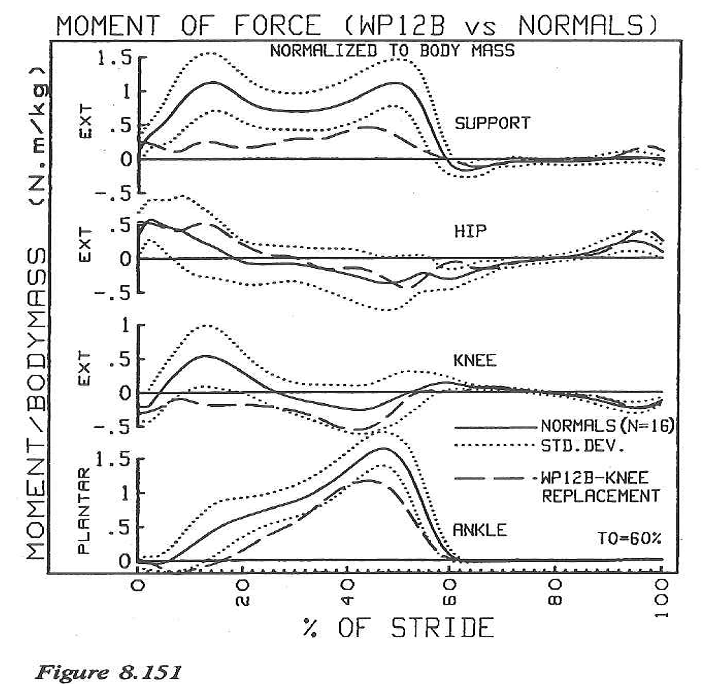
Sylvia moved to Newington from Waterloo so I wondered how David Winter had plotted his data. Sure enough in the final chapter of The Biomechanics and Motor Control of Human Walking (1991) entitled “Assessment of pathological gait” are a series of graphs showing gait variables from a patient with a knee replacement plotted against the mean and standard deviation from a reference population. (This book was an adaptation of an earlier one form 1987 which I don’t have access to and I’d be interested to know if these graphs were included in that as well).

 winter gait graphs

I’d like to suggest that this might be the earliest example of gait graph as we use them today – or has anyone got any earlier examples?

Of course tracing ideas back like this is a slightly ridiculous activity because such graphs  often appear in publications only after having been used more generally for a considerable period. Just because they first appear in print from one team does not necessarily mean that they originated there!

.

Braune, W., & Fischer, O. (1987). The Human Gait (P. Maquet & R. Furlong, Trans.). Berlin ; New York: Springer-Verlag.

Klopsteg, P. E., & Wilson, P. D. (1954). Human Limbs and their Substitutes. New York: McGraw-Hill.

Ounpuu, O., Davis, R., & Deluca, P. (1996). Joint kinetics: Methods, interpretation and treatment decision-making in children with cerebral palsy and myelomeningocele. Gait and Posture, 4, 62-78.

Winter, D. (1991). The biomechanics and motor control of human gait: Normal, Elderly and Pathological (2nd ed.). Waterloo:: Waterloo Biomechanics.

What is an inverted pendulum?

“Inverted pendulum” is one of those terms that seems to have crept up on me over my time in biomechanics. I don’t remember it being commonly used or taught when I was a student but now it seems to be everywhere. I suspect it is one of those terms that is not understood anywhere nearly as well as it should be. I’m not aware, for instance, of any biomechanics text book that properly explains what an inverted pendulum is or what its mechanical characteristics are. This is particularly important because in mechanics the “inverted pendulum” is more often studied as a classic example of dynamics and control theory (see the Wikipedia article for example). Anyone looking at these descriptions but wanting insight into the biomechanics of walking is going to end up very confused.

An ordinary pendulum is one with the pivot at the top and the mass at the bottom. An inverted pendulum is the opposite way round. The pivot is at the bottom and the mass is on top. Fierljeppen (canal vaulting) is the best example I’ve got of an inverted pendulum (see video below). The pole rotates about its foot (at the bottom of the canal) and transports the vaulter from one side of the canal to the other. “Transports” is the key word here. The inverted pendulum is a mechanism for carrying an object form one place to another and this is how it functions during walking. The “passenger unit” as Perry would call it is carried forward by the outstretched leg as it pivots over the foot.

It should be noted that there are important differences between the two types of pendulum. The inverted pendulum only carries an object in one direction, it doesn’t swing backward and forward like the ordinary pendulum. Another difference is that the inverted pendulum does not have a characteristic frequency like an ordinary pendulum – it would be absolutely useless inside a grandfather clock.

The earliest use of the term as a model of the stance phase of walking that I am aware of was by Cavagna et al. (1976). Earlier workers have used different terms for essentially the same concept. The “compass gait” of the much aligned Saunders, Inman and Eberhart (1953) is essentially a description of the inverted pendulum. A decade later Elftman (1966) suggested that “the body moves forwards as if vaulting on a pole” and a further decade on Alexander used the term “stiff-legged gait” (1976). It is probably the more recent work of the dynamic walking group (best summarised by Kuo, 2007) that has really popularised the use of the term.

Some papers refer to Cavagna as having tested the hypothesis that the leg behaves like an inverted pendulum (e.g. Kuo, 2007, page 619). I’ve never found any evidence of this in Cavagna’s writing or anywhere else. He certainly commented that changes in kinetic and potential energy of the centre of mass correlate so that the total energy remains approximately constant throughout the gait cycle but there are an infinite number of ways this can occur without requiring an inverted pendulum mechanism (I might write more about this in a later post).

“Proving” that walking is based on the inverted pendulum is problematic in that at a very broad level it is obvious that walking involves a similar mechanism. The foot is clearly planted and the passenger unit is carried over it by the outstretched leg. On the other hand it is equally clear that the mechanism is not a simple inverted pendulum. The trunk remains upright, there is stance phase knee flexion and the pivot with the floor changes position and anatomical location through stance (Perry’s rockers). Any study attempting to establish whether stance is like an inverted pendulum will inevitably conclude that it is a bit like one but not exactly. Forming a sensible research question to “prove” the importance of this mechanism is quite a challenge.

Anderson and Pandy (2003) reported briefly on the dynamics of the inverted pendulum as a model of stance phase and Buczek and his team in more detail (2006). Both these papers are worth reading and held a couple of surprises for me but I’ll keep those for a later post.

Alexander, M. (1976). Mechanics of bipedal locomotion. In P. Davis (Ed.), Perspectives in experimental biology (pp. 493-504). Oxford: Pergamon.

Anderson, F. C., & Pandy, M. G. (2003). Individual muscle contributions to support in normal walking. Gait Posture, 17(2), 159-169.

Buczek, F. L., Cooney, K. M., Walker, M. R., Rainbow, M. J., Concha, M. C., & Sanders, J. O. (2006). Performance of an inverted pendulum model directly applied to normal human gait. Clin Biomech (Bristol, Avon), 21(3), 288-296.

Cavagna, G. A., Thys, H., & Zamboni, A. (1976). The sources of external work in level walking and running. J Physiol, 262(3), 639-657.

Elftman, H. (1966). Biomechanics of muscle with particular application to studies of gait. J Bone Joint Surg Am, 48(2), 363-377.

Kuo, A. D. (2007). The six determinants of gait and the inverted pendulum analogy: A dynamic walking perspective. Hum Mov Sci, 26(4), 617-656.

Saunders, J. D. M., Inman, V. T., & Eberhart, H. D. (1953). The major determinants in normal and pathological gait. Journal of Bone and Joint Surgery, 35A(3), 543-728.