Why we walk the way we do

This isn’t really a proper post. It’s just a notification that I’ve finally recorded the last screencast in the current Why we walk the way we do series. This series of videos now forms what I see as a complete and biomechanically rigorous explanation of healthy human walking (at least for kinematics in the sagittal plane – adding kinetics, muscle activation and the other planes is a future project). In thinking these through over the last four years I’ve turned up a few surprises and I’m now convinced that there are serious flaws in most of the published explanations of walking. This latest video is no exception. It looks at the nature of the transition from swing to stance and argues that David Winter’s early view (1992) that the foot is placed “gently” is more appropriate than more recent theories that view foot contact more as a “collision”. Please leave a comment if you find the video useful or equally if you want to argue against my ideas – they are just ideas.

I’ve now tidied up the videos page on this blog-site so the videos are much easier to view from there. Alternatively you can find them on my YouTube channel.

Over the weekend I’ve also added tidied up the Resources page and made a GPS/MAP calculating spreadsheet available as well as the muscle length modelling software (for Vicon systems only) that is already there.

.

Winter, D. A. (1992). Foot trajectory in human gait: a precise and multifactorial motor control task. Phys Ther, 72(1), 45-53; discussion 54-46.
The advantages of crouch gait?

Thought I’d try a video blog for a change to show you how I’ve been using e-Verne to explore the kinematics of crouch gait with some counter-intuitive findings.

If you want to learn more you can skip to my YouTube screencast on what determines adequate step length and another one on how clearance is achieved (or go to my YouTube channel).

Shear pedantry

I criticised a colleague the other day for using “shear force” to refer to the horizontal component of force measured by a force plate. He asked me “why?”  Apart from me being a miserable old pedant who’s got nothing better to do than be annoying, the simple answer is that someone did the same to me a long time ago (it might have been Chris Kirtley, but then again it might not).

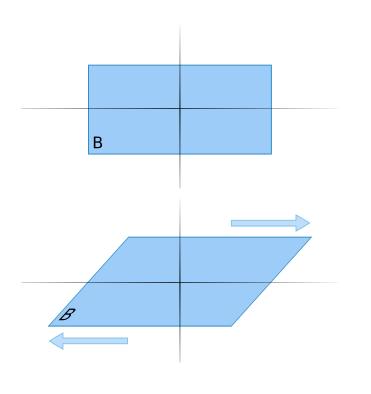
I don’t always trust Wikipedia but think it is quite good in distinguishing between shear forces which occur when forces are unaligned and cause a shear deformation (see figure above) and compressive forces when they are aligned and lead to pure compression or elongation.  To distinguish between these you need to know how and where the balancing force is applied. The force plate only measures the ground reaction and I’d argue can’t therefore distinguish between shear and compressive forces. What it can do is resolve the overall force into components in different directions. I’d thus prefer to describe the components in terms of the direction in which they are acting rather than the assumed effect they are having on tissue.

If I was being really really pedantic I’d probably say that shear forces exist within a material rather than being applied to it. In most biomechanics it is actually the shear and compressive  stresses and strains that are more important. These are caused by the external forces exerted on the material but are conceptually quite different being within the material. Generally speaking the vertical component of the ground reaction will give rise to compressive stresses. Given the complex arrangements of soft tissues in the foot and the irregular shape of the bones, however, it will also cause some some shear stress. Similarly although horizontal forces will result primarily in shear they will exert some compressive (and occasionally tensile) stresses as well.

Or am I being too pedantic? Anyone like to defend the use of shear force to describe what a force plate measures? It’s certainly very common usage.

Gait graphs for beginners

I’m teaching about gait to the undergraduate physios next week. Its the first lecture I’ve given at this level trying to emphasise the approach I’ve developed in the Why we walk the way we do videos. The colleague who’s delivering the previous lecture – which included a first introduction to gait graphs – wanted to use the same format as I use which started a conversation about what aspects of walking we’d like those graphs to emphasize.

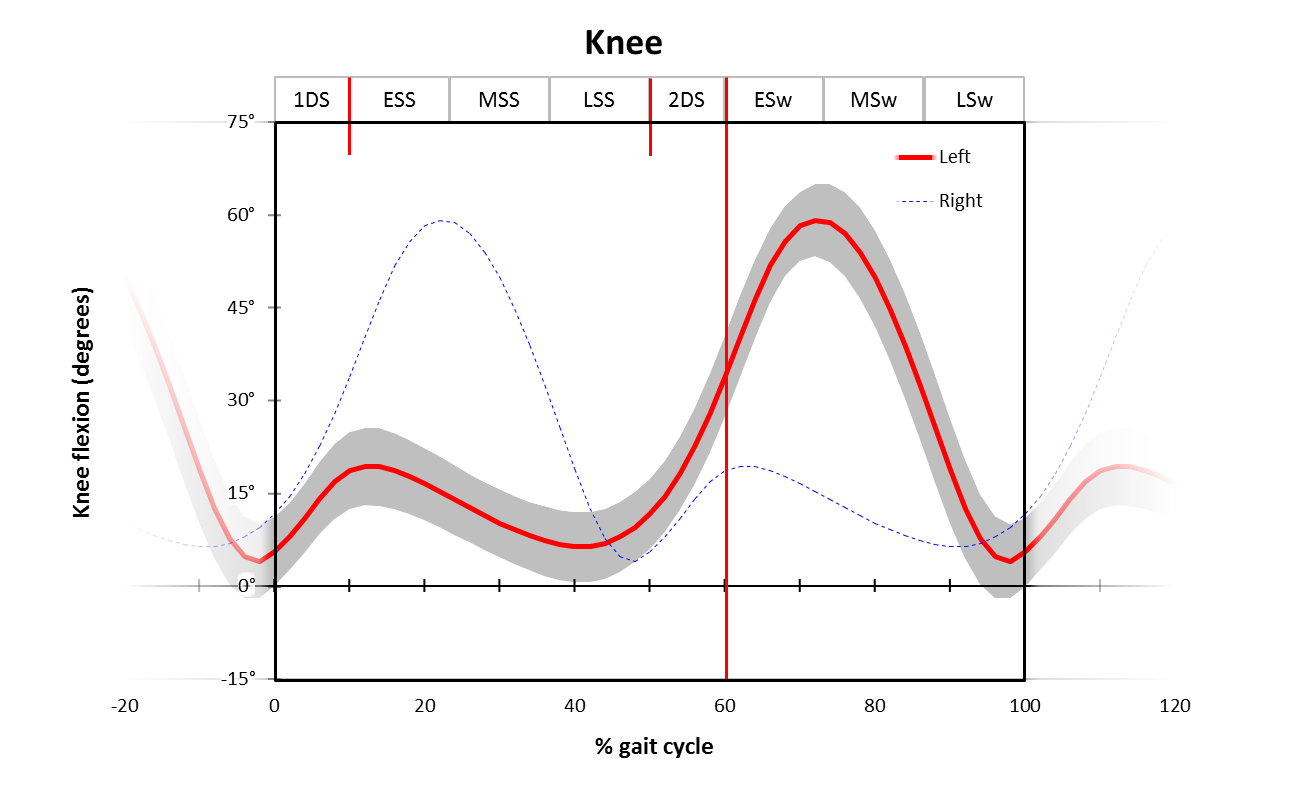
Knee graph

I’m pretty keen on fixed aspect ratios and scaling so that you can forget about those issues when you are actually looking at data – so we’ve fixed that.  We wanted also wanted to reinforce the terminology for different phases that I’ve described in a previous post – so we’ve put those abbreviated names across the top.

I also like to represent the continuity of the gait cycle – it amazes me how many people I come across who don’t seem to realise that point on the far left of the graph is the same as the point on the far right hand side (give or take a little stride to stride variability). It’s also not uncommon to spot data in the literature where values of gait variables at 0% and 100% are different but not commented upon. Various people in the past have tried plotting more than a single stride to try and emphasize continuity. I know Jurg Baumann was an advocate of this but can’t find easily get my hands on a sample. At Hof also used it – his 2002 paper on the speed dependence of EMG profiles is an example – but it has never really caught on. In this format I’ve tried to capture the point by allowing the gait curves to fade away to nothing outside the graph. It’s a bit messy if you’ve got a whole array of graphs but I kind of like it in the context of an introduction at this level.

I’m also very keen on getting students to appreciate what the right leg is doing plotted on the same time scale as the left leg. I know this insenses people who are paranoid about the importance of symmetry in gait but it’s a hell of a lot easier to explain the biomechanics if you look at the data this way. It’s unconventional of course so I’ve chosen to represent this as a much fainter line.

There was another question mark over the hip angle. As gait analysts most of us assume that this should be measured relative to a pelvic axis represented by the line from PSIS to ASIS and thus biasing the hip graph towards flexion. In assessing gait by observation, however, physios almost always consider the angle with the vertical which might be more relevant for daily practice. In the end we decided to stick with the gait analysis approach and just make sure we explain this very clearly.

Anyone got any additional features they like to add?

.

Hof, A. L., Elzinga, H., Grimmius, W., & Halbertsma, J. P. (2002). Speed dependence of averaged EMG profiles in walking. Gait Posture, 16(1), 78-86.

Keeping things straight

An early unit of our Masters Programme in Clinical Gait Analysis has focused on how best to capture clinical video. One of the things we talked about was parallax and I was surprised at how little awareness there was of this as an issue. Parallax describes a number of phenomena associated with how what you see changes with your line of sight. Wikipedia is filled with examples from astrophysics. The video below shows some fairly gentle examples of how the relationship of foreground and background objects changes as your point of view moves.

In clinical gait analysis the main effect we are concerned with is that how we perceive a given angle depends on the position we are viewing it from. Thus if the knee is flexed to 90° in the sagittal plane and we are looking from a position perpendicular to that plane then we will perceive the angle to be 90° but if we are looking from either a little in front or a little behind then we will perceive the knee to be more extended. More than that, if the thigh is internally rotated so that the knee is not flexing in the true sagittal plane then we will under-estimate knee flexion even if we are square on to the person. We perhaps understand this best in relation to the coronal plane where most of us know that if the knee is flexed then we will see what appears to be varus or valgus if either we are not looking straight on at the person or if the thigh is internally (or externally) rotated.

To help understand and also to quantify effects I’ve prepared the little Flash animation below. Imagine there is an object in the centre of your gait lab composed of two red rods set exactly at right angles. As you first see the animation the camera is rotating around the object and you can see how the view seen by the camera changes. You can see that even though the object in the lab is entirely stationary the angle read off the computer screen varies from 0° to 90°. If you click on the pause button the animation will stop and you’ll then be able to drag the camera to whatever position you want. Play around with this and see how the perceived angle changes with the camera angle.

What you should find is that the effects are relatively small in the sagittal plane. If you have the camera within +/-13° to the true perpendicular then you will perceive an error of less than 1°. You need to be more than 24° off true to be more than 5° out. Positioning the camera to get a true coronal plane view, however, is much more critical. Being just 5° out in camera alignment will result in an erroneous reading of either 10° of knee varus or valgus (depending on which side of the walkway the camera is viewing from). For those concerned with symmetry of gait remember you get a double whammy as you’ll see an apparent 10° of valgus on one side and of varus on the other side. I must admit than in constructing the animation the effects in the coronal plane are quite a lot bigger than I was expecting. (For the geeks the animation is based on an isometric projection – perspective effects with a camera close to the person could exaggerate the effects even further.)

Of course this varus-valgus thing is the cause of all those huge coronal plane knee artefacts that we all get in swing when we are doing gait analysis. If your don’t identify the coronal plane of the thigh properly from the markers you place for your static calibration you are effectively causing your gait analysis system to look at the knee from the wrong angle and all that knee flexion that occurs in mid-swing will appear as varus or valgus on your knee traces. If you see this happening a lot in the gait data then its worth reviewing how you place these markers.

For those  of you not at ESMAC Eric Desailly presented quite a nice paper (page 33) showing that although this effect is a significant factor contributing to those dodgy looking knee trace it may not be the only one.