biomechanics

Mind your language

I’m here in Cincinnati for the Gait and Clinical Movement Analysis Society Annual Meeting. Lovely sunshine makes a change from damp old Manchester.

Anyway today was pre-conference tutorial day and started with a really interesting session with  Art Kuo trying to help us understand induced acceleration analysis. He was particularly concerned to try and demystify the subject using a number of worked examples to show it is possible to get a qualitative feel for the accelerating effect that different joint torques will have on different segments.  He used these to help us understand the sometimes counter-intuitive conclusions that these analyses can lead us to. I found the approach fascinating and will go away and work through some examples myself. I’ll need to think a bit more before I commit any reflections to this blog.

Right at the end he volunteered some fascinating thoughts on terminology that I think are worth passing on immediately. He commented on how some of the terminology we use for accelerations tends to have inappropriate positive and negative connotations and that we need to be very careful that this doesn’t lead us to inappropriate conclusions.

One pair of phrases was “propulsion” and “braking”. We tend to think that propulsion is good and braking is bad but in cyclic walking this is not the case. If  we haven’t changed our speed over a complete gait cycle then, following Newton’s laws, we will have propulsive and braking forces that match exactly (or  more technically propulsive and braking impulses match). All that increasing the propulsive forces does is require an increased demand for braking forces to be applied. To understand how we walk the way we do we really need to have a more nuanced understanding of why braking and propulsive forces are required at all. I agree with Art that using words that suggest that one is beneficial and the other detrimental is not useful.

The other pair was “support” and “falling” (or equivalent ). Again joint torques that apply an upwards (supporting) force to the centre of mass are generally considered to be good whereas those that accelerate the body downwards are considered bad. Again, however, if walking is cyclic then there is no net acceleration of the centre of mass in either direction. I’m less sold on this argument as there is a requirement for the upward forces to average bodyweight over the gait cycle and thus I think there is a sense in which the support mechanisms are more important than those that allow downward accelerations – but I do agree with Art again that if the body accelerates upwards in one part of the gait cycle it must fall in another. Considering one of these as good and the other as bad is not likely to help our understanding.

What Art didn’t propose was alternative words that don’t have these associations. Anyone any ideas?

Where’s the foot?

foot pitch

Another comment from CMAS. I think it was Alison Richardson who was presenting at one point and remarked, “but of course we can’t tell where the foot is from the graphs”. How true? and why not? Conventionally in clinical gait analysis we plot where the pelvis is in relation to the lab, then the hip, knee and ankle joints. In theory if you know all this information you can work out the orientation of the foot. I don’t know anyone, however, who has developed the knack of adding all those angles up in their head to work this out. In understanding how the foot is contributing to that pattern I think Perry’s concept of foot rockers is key – is the limb pivoting primarily around the heel, the ankle or the MTP joint? Yet, despite what you hear in many discussions about gait data, it’s virtually impossible to tell from the graphs which rocker is active at  any given time.

So why don’t we plot out foot orientation? We calculate the equivalent in the transverse plane and call it foot progression. I think it would make all our lives considerably easier if we added an extra graph at the foot of the sagittal plane data. Given that the pitch of a shoe is how much it tilts the foot forwards perhaps we should refer to this a “foot pitch”.

I’ve shown you what the sagittal graphs would then look like. I don’t suggest using the colours on the foot pitch graph – they are only there to show you how easily you can pick out the three rockers. During the red phase of stance the foot is pivoting about the heel – first rocker. During the white phase the foot is flat on the ground – second rocker. During the blue phase the foot is pivoting about the MTP joint (or toe) – third rocker (or third and fourth rockers if you want to use Perry and Burnfield’s most recent terminology (2010). Notice that end of first rocker does not coincide with opposite foot off but is completed appreciably earlier. Many people don’t appreciate just how early third rocker starts either.
.

.
Perry, J., & Burnfield, J. M. (2010). Gait analysis: normal and pathological function (2nd ed.). Pomona, California: Slack.

Which bump does what?

There was some discussion at the CMAS meeting in Glasgow last week about what causes the characteristic bumps in the vertical component of the ground reaction. Before you read on it might be worth just stopping to think this through for yourself. Working from the premise that Newton declared that if there is a net force acting on an object then it must be accelerating – which acceleration does the first bump represent and which bump does the second represent?

Several of us admitted to believing that the prevailing wisdom (“what the textbooks say”) is that the first bump represents a deceleration of the centre of mass as it’s downwards movement is arrested and that the second bump is the upwards acceleration as we push off. This is not the correct explanation as Barry Meadows made clear in his presentation.

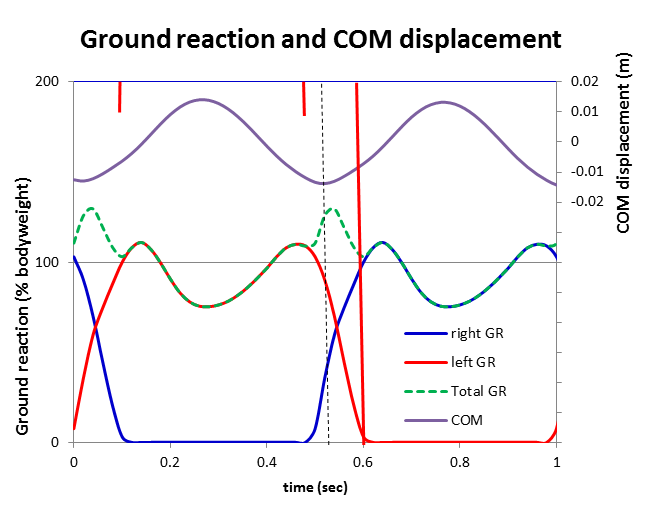
I’ve plotted some idealised data below to illustrate what is actually happening. The ground reaction under the left limb is represented in red and that under the right limb in right. One thing we  should do more often is to plot the sum of these which of course is the total force acting on the body (Chris Kirtley does do this in his book, 2006). The first interesting thing to note is that the peak total ground reaction actually occurs just before the middle of double support where two relatively modest forces from the different limbs superimpose.

GR and COM

I’ve also plotted the trajectory of the centre of mass (calculated from a double integration of the total ground reaction). It is at its highest in middle single support and lowest in early double support. The dotted black line shows its minimum value. Before this point the COM is travelling downwards and being decelerated and afterwards it is travelling upwards and being accelerated. Thus the first bump of the ground reaction is acting to accelerate the body upwards and the second bump is acting to decelerate as it falls from its peak height during middle single support. This is the opposite to “what the text books say”.

Or are we being unfair to the text books? I’ve gone back to see.

Whittle (2012) and Kaufman and Davis (writing in Rose and Gamble, 2006) get the explanation spot on.

Gage(2009, p54), on the other hand, states that the “body has been accelerating by gravity as it fell from its zenith at mid-stance to its nadir at loading response. As  a result the total force on the limb as it impacts the floor is about 120% of body weight“. This is a bit vague but essentially wrong. The body has actually been decelerating for half of its fall from zenith to nadir such that the vertical component of its speed is virtually zero at foot contact. The first peak of the ground reaction occurs well after the limb impacts the floor and is a result of the centre of mass being accelerated upwards.

Perry (2010, p459) writes that “the first peak (F1) … is increased above bodyweight by the acceleration of the rapid drop of the body mass”. This is also wrong-  the deceleration of the body mass is almost complete by initial contact and has occurred as a consequence of the GR under the trailing limb. The description of the second peak is even more confused – “the second peak (F3) … is modified by the push of the ankle plantar flexor muscles against the floor in addition to the downward acceleration of the COG as the bodyweight falls forwards over the forefoot rocker“.

So there we have it on a random sample of four books that happen to be on my shelf this afternoon two have the explanation correct and two have it essentially wrong.

There is some additional confusion because the fore-aft component of the ground reaction actually has the opposite effect.  In the first half of stance the GR is acting to decelerate the body in a horizontal direction (at the same time as accelerating it in an upwards direction). In the second half of stance the opposite is occurring as the GR is accelerating the body forwards (at the same time as it is decelerating it as it falls vertically).

.

Kirtley, C. (2006). Clinical gait analysis (1st ed.). Edinburgh: Elsevier

Levine, D., Richards, J., & Whittle, M. W. (2012). Whittle’s Gait Analysis (5th ed.): Churchill Livingstone.

Rose, J., & Gamble, J. (Eds.). (2006). Human Walking (3rd ed.). Philadelphia: Lippincott Williams and Wilkins.

Perry, J., & Burnfield, J. M. (2010). Gait analysis: normal and pathological function (2nd ed.). Pomona, California: Slack.

Gage, J. R., Schwartz, M. H., Koop, S. E., & Novacheck, T. F. (2009). The identification and treatment of gait problems in cerebral palsy (1st ed.). London: Mac Keith Press.

Goldilocks Biomechanics

I’m working on a variety of learning materials to teach clinical gait analysis at the moment. Our masters programme in clinical gait analysis should start in 8 months time. One thing I find really depressing is how little of our clinical reasoning for individual patients is based on biomechanics. Most of the interpretation we do is essentially learned and largely subjective pattern recognition. We don’t really understand the data in a way that approaches science.

goldilocks

There are numerous reasons for this but one of the issues is that the biomechanics of walking is not being developed at the right level. On the one hand we have a group of researchers, coalescing under the Dynamic Walking Group, who are developing extremely simple and often non-physiological models to explore very basic principles. On the other hand are researchers typified by (but not restricted to) the OpenSim project who are developing really complex computer models. Neither group, as far as I can see is having a significant impact on the clinical understanding of gait or affecting how we manage our patient’s conditions.

To my mind the simple models are just too simple – how do you use a model without muscles to understand the consequences of a spastic gasttrocnemius? Equally the complex models are too complex- it’s impractical to perform a full CMC analysis for every patient. Even if we did we wouldn’t know which results are robust indications of the biomechanics of the patient and which are consequences of modelling assumptions and parameters.

What we really need is models that are neither too simple nor too complex – borrowing from modern astrophysics we need them to inhabit the Goldilocks zone – Goldilocks biomechanics.

What is an inverted pendulum?

“Inverted pendulum” is one of those terms that seems to have crept up on me over my time in biomechanics. I don’t remember it being commonly used or taught when I was a student but now it seems to be everywhere. I suspect it is one of those terms that is not understood anywhere nearly as well as it should be. I’m not aware, for instance, of any biomechanics text book that properly explains what an inverted pendulum is or what its mechanical characteristics are. This is particularly important because in mechanics the “inverted pendulum” is more often studied as a classic example of dynamics and control theory (see the Wikipedia article for example). Anyone looking at these descriptions but wanting insight into the biomechanics of walking is going to end up very confused.

An ordinary pendulum is one with the pivot at the top and the mass at the bottom. An inverted pendulum is the opposite way round. The pivot is at the bottom and the mass is on top. Fierljeppen (canal vaulting) is the best example I’ve got of an inverted pendulum (see video below). The pole rotates about its foot (at the bottom of the canal) and transports the vaulter from one side of the canal to the other. “Transports” is the key word here. The inverted pendulum is a mechanism for carrying an object form one place to another and this is how it functions during walking. The “passenger unit” as Perry would call it is carried forward by the outstretched leg as it pivots over the foot.

It should be noted that there are important differences between the two types of pendulum. The inverted pendulum only carries an object in one direction, it doesn’t swing backward and forward like the ordinary pendulum. Another difference is that the inverted pendulum does not have a characteristic frequency like an ordinary pendulum – it would be absolutely useless inside a grandfather clock.

The earliest use of the term as a model of the stance phase of walking that I am aware of was by Cavagna et al. (1976). Earlier workers have used different terms for essentially the same concept. The “compass gait” of the much aligned Saunders, Inman and Eberhart (1953) is essentially a description of the inverted pendulum. A decade later Elftman (1966) suggested that “the body moves forwards as if vaulting on a pole” and a further decade on Alexander used the term “stiff-legged gait” (1976). It is probably the more recent work of the dynamic walking group (best summarised by Kuo, 2007) that has really popularised the use of the term.

Some papers refer to Cavagna as having tested the hypothesis that the leg behaves like an inverted pendulum (e.g. Kuo, 2007, page 619). I’ve never found any evidence of this in Cavagna’s writing or anywhere else. He certainly commented that changes in kinetic and potential energy of the centre of mass correlate so that the total energy remains approximately constant throughout the gait cycle but there are an infinite number of ways this can occur without requiring an inverted pendulum mechanism (I might write more about this in a later post).

“Proving” that walking is based on the inverted pendulum is problematic in that at a very broad level it is obvious that walking involves a similar mechanism. The foot is clearly planted and the passenger unit is carried over it by the outstretched leg. On the other hand it is equally clear that the mechanism is not a simple inverted pendulum. The trunk remains upright, there is stance phase knee flexion and the pivot with the floor changes position and anatomical location through stance (Perry’s rockers). Any study attempting to establish whether stance is like an inverted pendulum will inevitably conclude that it is a bit like one but not exactly. Forming a sensible research question to “prove” the importance of this mechanism is quite a challenge.

Anderson and Pandy (2003) reported briefly on the dynamics of the inverted pendulum as a model of stance phase and Buczek and his team in more detail (2006). Both these papers are worth reading and held a couple of surprises for me but I’ll keep those for a later post.

Alexander, M. (1976). Mechanics of bipedal locomotion. In P. Davis (Ed.), Perspectives in experimental biology (pp. 493-504). Oxford: Pergamon.

Anderson, F. C., & Pandy, M. G. (2003). Individual muscle contributions to support in normal walking. Gait Posture, 17(2), 159-169.

Buczek, F. L., Cooney, K. M., Walker, M. R., Rainbow, M. J., Concha, M. C., & Sanders, J. O. (2006). Performance of an inverted pendulum model directly applied to normal human gait. Clin Biomech (Bristol, Avon), 21(3), 288-296.

Cavagna, G. A., Thys, H., & Zamboni, A. (1976). The sources of external work in level walking and running. J Physiol, 262(3), 639-657.

Elftman, H. (1966). Biomechanics of muscle with particular application to studies of gait. J Bone Joint Surg Am, 48(2), 363-377.

Kuo, A. D. (2007). The six determinants of gait and the inverted pendulum analogy: A dynamic walking perspective. Hum Mov Sci, 26(4), 617-656.

Saunders, J. D. M., Inman, V. T., & Eberhart, H. D. (1953). The major determinants in normal and pathological gait. Journal of Bone and Joint Surgery, 35A(3), 543-728.