gait analysis

Who first thought of a gait graph?

Quite out of the blue Jenny Kent from Headley Court asks if I know where the gait graphs we know today come from. She was particularly interested in where the idea of time normalising data to the gait cycle originated. I have to admit I just don’t know.

Braune and Fischer, working at the end of the 19th century, certainly plotted a number of gait variables against time, most for swing but a few for more than a gait cycle. All the graphs I can see though plot these against time rather than a percentage of the gait cycle and the data for more than a gait cycle doesn’t appear to be plotted in relation to the gait events at all.

The first group that I can find that present variables on graphs with the time axis labelled as % gait cycle is Inman’s group working in Berkeley in the early 1950s.

Inman time normalisation

Data scanned a long time ago from one of the outputs of the Berkeley group – not sure which.

Can anyone provide any earlier examples?

.

This made me think about other features of our standard gait graphs. Who first proposed plotting data from a patient against normative reference data depicted as a mean and range based on the standard deviation?

I remember that when the Vicon Clinical Manager software came out in 1992 that it assumed that all data was normalised to the gait cycle (the data was actually stored in a .gcd file on this assumption). The software only allowed three traces to be plotted on any graph so the common practice was to plot the mean of the reference data along as one right and one left side trace for each patient. I think the practice of plotting several (three!) traces from each side separately to assess measurement variability probably dated to this time as well. I don’t remember the standard deviations being plotted but this may just be my memory (the standard deviation values could certainly be stored in the .gcd file).

I also remember being impressed by teaching material from Newington and Gillette Hospitals (Gage, Davis and Ounpuu) which plotted the standard deviation ranges from quite an early stage. Looking up some of their early papers I find that  Sylvia’s 1995 paper contains sample patient data plotted against the standard deviation ranges. (Unfortunately the quality of this figure in the .pdf file I have is too poor to be worth reproducing here).

Sylvia moved to Newington from Waterloo so I wondered how David Winter had plotted his data. Sure enough in the final chapter of The Biomechanics and Motor Control of Human Walking (1991) entitled “Assessment of pathological gait” are a series of graphs showing gait variables from a patient with a knee replacement plotted against the mean and standard deviation from a reference population. (This book was an adaptation of an earlier one form 1987 which I don’t have access to and I’d be interested to know if these graphs were included in that as well).
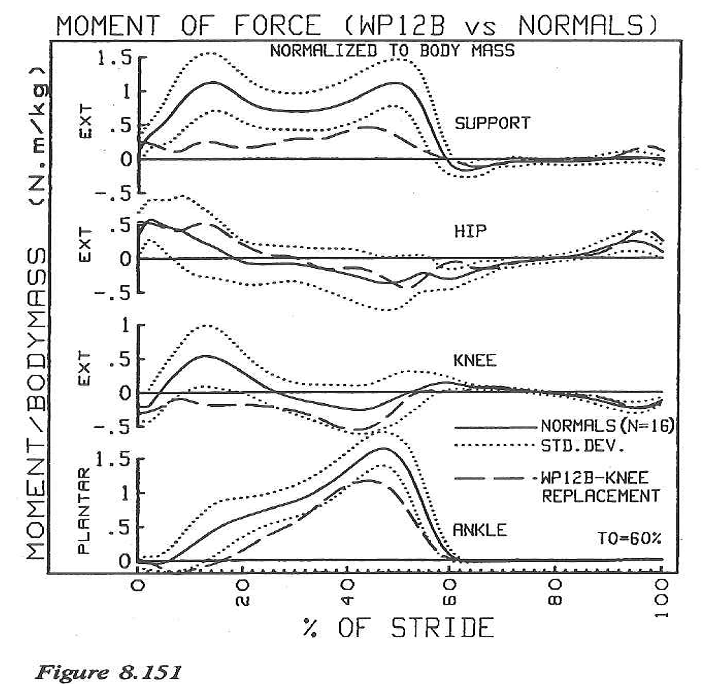
 winter gait graphs

I’d like to suggest that this might be the earliest example of gait graph as we use them today – or has anyone got any earlier examples?

Of course tracing ideas back like this is a slightly ridiculous activity because such graphs  often appear in publications only after having been used more generally for a considerable period. Just because they first appear in print from one team does not necessarily mean that they originated there!

.

Braune, W., & Fischer, O. (1987). The Human Gait (P. Maquet & R. Furlong, Trans.). Berlin ; New York: Springer-Verlag.

Klopsteg, P. E., & Wilson, P. D. (1954). Human Limbs and their Substitutes. New York: McGraw-Hill.

Ounpuu, O., Davis, R., & Deluca, P. (1996). Joint kinetics: Methods, interpretation and treatment decision-making in children with cerebral palsy and myelomeningocele. Gait and Posture, 4, 62-78.

Winter, D. (1991). The biomechanics and motor control of human gait: Normal, Elderly and Pathological (2nd ed.). Waterloo:: Waterloo Biomechanics.
Why bother with gait classification?

There is a sector of our community that sees classification as the holy grail of gait analysis. If only we could divide our patients into neat little categories then our problems will be solved. But why do we want to classify patients?

The most obvious reason for categorising patients into groups would be if genuinely different groups existed. But do they? In an earlier blog I’ve written about the GMFCS and pointed out that there is absolutely no reason to believe that children with cerebral palsy fall into distinct categories of severity – they almost certainly lie on a continuous spectrum.  I suspect that the same is true of gait patterns. Indeed in work that Fiona Dobson completed for her PhD thesis but never published we used a technique called multi-dimensional scaling to look for evidence of clustering of gait patterns in children with hemiplegic cerebral palsy. We couldn’t find any. Whichever way we looked at the data it looked like a random scatterplot.

So if there is so little evidence that gait patterns fall into distinct categories why are we so obsessed by it?

I suspect that classification systems are assumed to help clinicians – particularly less specialist ones than are employed in our gait analysis services. If we can simplify understanding of gait to a small number of discrete categories then we’ll be able to teach people to recognise these. If we can describe management plans for the different categories then maybe we can even teach people to treat the patients.

There are problems though.  The first one is that the classification systems don’t seem to work – clinicians can’t agree on what category a gait pattern should be placed in. Fiona Dobson, in one of the few studies to assess reliability of a classification in a centre outside that in which it was developed (Dobson et al,2007), looked at the agreement of 16 clinicians in rating gait patterns of 34 children with hemiplegic cerebral palsy . On the basis of video data, only one pattern was put in the same category by all clinicians and in over a third there was less than 50% agreement. An important feature of this study was that the 16 clinicians were all specialists in gait analysis of children with cerebral palsy. What would the results have been like if the non-specialist clinicians, who presumably have most to gain from classification systems, had been recruited to the study? Results were a little better when gait analysis data was used as a basis for classification, but then the clinicians for whom classification is likely to be most useful don’t generally have access to gait analysis.

Another issue is that gait patterns are almost certainly a combination of characteristics of the child and of how they have been managed previously. The Winters, Gage and Hicks (1987) classification of hemiplegia intentionally excluded children who had had previous surgery but the classification of diplegia by Rodda et al. (2004) included children with prior calf surgery (because there were so many of them). We never quantified it but it appeared to us that fewer and fewer children in Melbourne fell into the Rodda “crouch” category over time which we attributed to more conservative early surgical management and the wider use of Botulinum toxin. If this is the case then classifications schemes will have to be sufficiently generalizable to cover the effects of different management practices or maybe we need a number of different classification schemes depending on different management practices in different parts of the world.

Developing and validating classification schemes is a considerable undertaking. Earlier schemes were generally based on the enlightened but essentially subjective opinions of leading clinicians. In an era of evidence-based practice this is no longer satisfactory and widespread consultative processes (such as a Delphi process) would now be needed to convince the clinical community of any new scheme.  Similarly were existing schemes have been validated this has tended to be on the basis of repeatability studies based within the teams who developed the scales and typically using gait analysis techniques that may not be available to those who are most likely to benefit from the classification. Convincing validation of new schemes will need to be more comprehensive. Such an investment of time and effort would be perfectly justified if we are certain that the schemes will be useful – but we do need to be certain.

Validation is made considerably more complex by the fact that the classification systems do not fit the underlying reality. How can you interpret reliability studies designed to test the competence of clinicians to ascribe gait patterns to categories when there is genuine ambiguity in whether any individual child actually fits a particular category? A similar issue arises with the usefulness of the scheme for less experienced clinicians. Many children will either be on the borderline of categories or may not fit cleanly into categories at all. Explaining how to deal with such exceptions to generalist staff may lead to more confusion not less.

So is there an alternative? Well I’d like to float the potential of what I call profiling. Rather than select a number of discrete groups into which gait patterns can be assigned we define aspects of the gait pattern that vary across the patient population. We can then score or grade the different aspects separately. This allows us to accept that there is a continuous distribution of gait patterns and that also that gait might vary independently across the different aspects rather than suggesting that there is necessarily grouping of the aspects as is required by classification schemes.

We presented a paper proposing this for the gait of children with hemiplegic cerebral palsy at the Sydney CP meeting in 2008 (Tirosh, Dobson et al.) but never took the ideas any further. A factor analysis based on movement analysis profile scores suggested that 85% of the variability could be explained by 5 factors which reflected:

  • distal sagittal plane features (knee flexion and ankle plantarflexion combined),
  • leg length discrepancy (anatomical and functional),
  • hip rotation,
  • hip flexion
  • foot alignment.

These factors all make clinical sense as does the idea that hemiplegic gait should be categorised by assessing how far each of these different aspects contributes to the gait pattern of an individual child rather than trying to assign the gait pattern to one of a small number of categories. Perhaps more importantly it appears to me (and I admit this is a subjective opinion) that the underlying model of gait patterns varying along a continuum in a number of different dimensions matches reality more closer than a model assuming that gait patterns fall into distinct and recognisable categories.

.

Dobson, F., Morris, M. E., Baker, R., & Graham, H. K. (2007). Gait classification in children with cerebral palsy: a systematic review. Gait and Posture, 25(1), 140-152.

Rodda, J. M., Graham, H. K., Carson, L., Galea, M. P., & Wolfe, R. (2004). Sagittal gait patterns in spastic diplegia. Journal of Bone and Joint Surgery. British Volume, 86(2), 251-258.

Winters, T. F., Jr., Gage, J. R., & Hicks, R. (1987). Gait patterns in spastic hemiplegia in children and young adults. Journal of bone and Joint Surgery – American, 69(3), 437-441.

Why do we collect normative data?

The sun is still shining in Cincinnati although many of us in the conference hotel are seeing very little of it. Thought I’d share the podium presentation I’ve just made which reflects on why it is that we collect service specific normative reference data. It’s my feeling  that this should be to allow us to compare data between services in order to develop consistent practices rather than as a way to allow us to continue to tolerate differences in the way different services make measurements. Anyway if you want to you can listen to the screen cast below.

There was an interesting technical extension to the work which I was unable to include in the presentation because of tht time limit. This is covered in the screen cast below.

Mind your language

I’m here in Cincinnati for the Gait and Clinical Movement Analysis Society Annual Meeting. Lovely sunshine makes a change from damp old Manchester.

Anyway today was pre-conference tutorial day and started with a really interesting session with  Art Kuo trying to help us understand induced acceleration analysis. He was particularly concerned to try and demystify the subject using a number of worked examples to show it is possible to get a qualitative feel for the accelerating effect that different joint torques will have on different segments.  He used these to help us understand the sometimes counter-intuitive conclusions that these analyses can lead us to. I found the approach fascinating and will go away and work through some examples myself. I’ll need to think a bit more before I commit any reflections to this blog.

Right at the end he volunteered some fascinating thoughts on terminology that I think are worth passing on immediately. He commented on how some of the terminology we use for accelerations tends to have inappropriate positive and negative connotations and that we need to be very careful that this doesn’t lead us to inappropriate conclusions.

One pair of phrases was “propulsion” and “braking”. We tend to think that propulsion is good and braking is bad but in cyclic walking this is not the case. If  we haven’t changed our speed over a complete gait cycle then, following Newton’s laws, we will have propulsive and braking forces that match exactly (or  more technically propulsive and braking impulses match). All that increasing the propulsive forces does is require an increased demand for braking forces to be applied. To understand how we walk the way we do we really need to have a more nuanced understanding of why braking and propulsive forces are required at all. I agree with Art that using words that suggest that one is beneficial and the other detrimental is not useful.

The other pair was “support” and “falling” (or equivalent ). Again joint torques that apply an upwards (supporting) force to the centre of mass are generally considered to be good whereas those that accelerate the body downwards are considered bad. Again, however, if walking is cyclic then there is no net acceleration of the centre of mass in either direction. I’m less sold on this argument as there is a requirement for the upward forces to average bodyweight over the gait cycle and thus I think there is a sense in which the support mechanisms are more important than those that allow downward accelerations – but I do agree with Art again that if the body accelerates upwards in one part of the gait cycle it must fall in another. Considering one of these as good and the other as bad is not likely to help our understanding.

What Art didn’t propose was alternative words that don’t have these associations. Anyone any ideas?

Stretching time

Here’s something I’ve meant to share for some time.

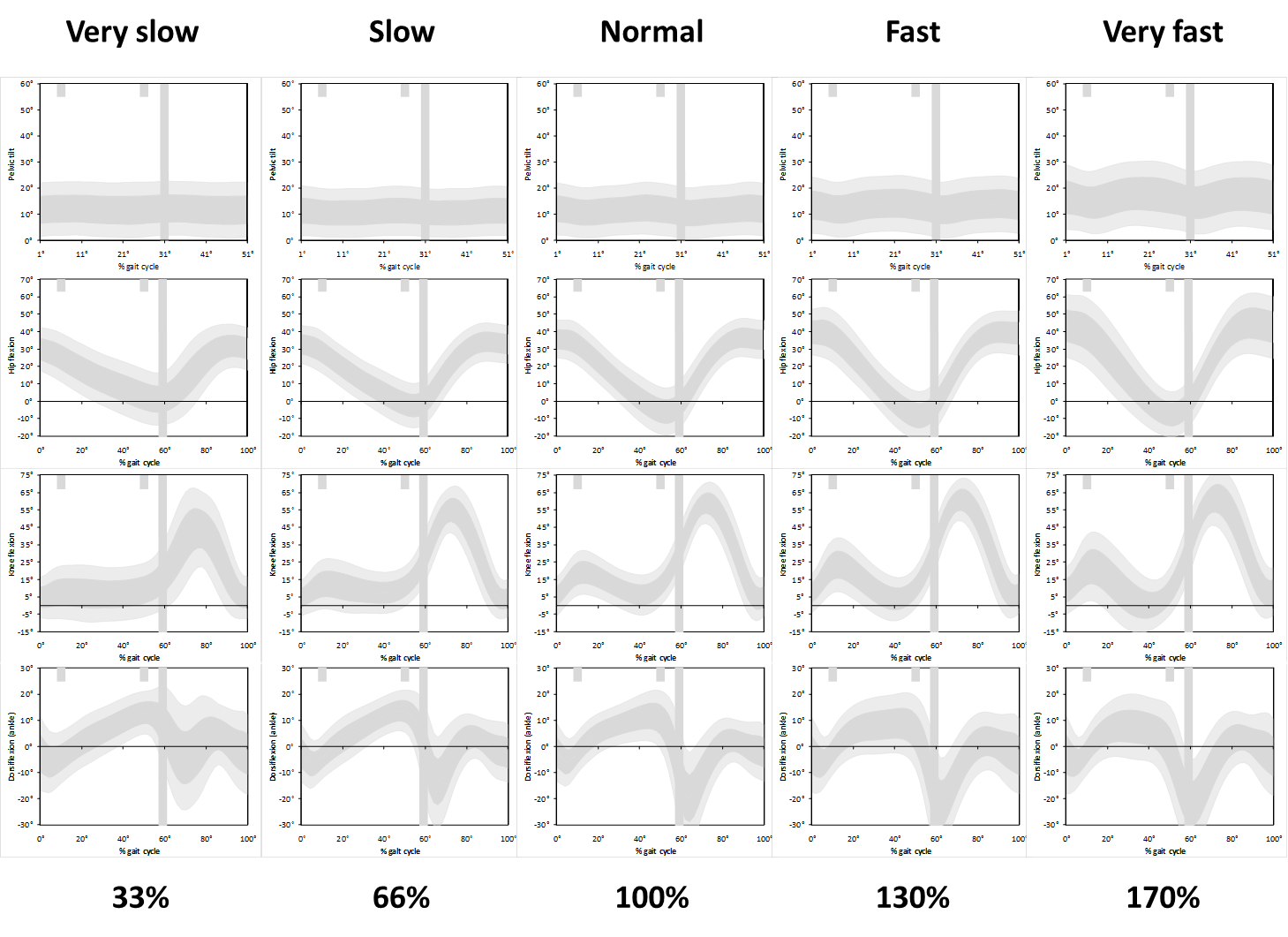
Below are two graphs that I prepared for some teaching I was doing in Melbourne last August. I downloaded the data that Mike Schwartz has been so kind as to make available from his study looking at the changes in gait pattern of children when they walk at different speeds (Schwartz et al., 2008). I then formatted the sagittal plane graphs as we normally do (except that I’ve started plotting the two standard deviation range in a different shade of grey to the one standard deviation range to remind us that we often under-estimate the spread of our reference data). Data is time normalised to the gait cycle and plotted on graphs of fixed aspect ratio (3:4 in this case). All looks quite unremarkable with fairly modest changes in kinematics with walking speed.

Different speeds time normalised

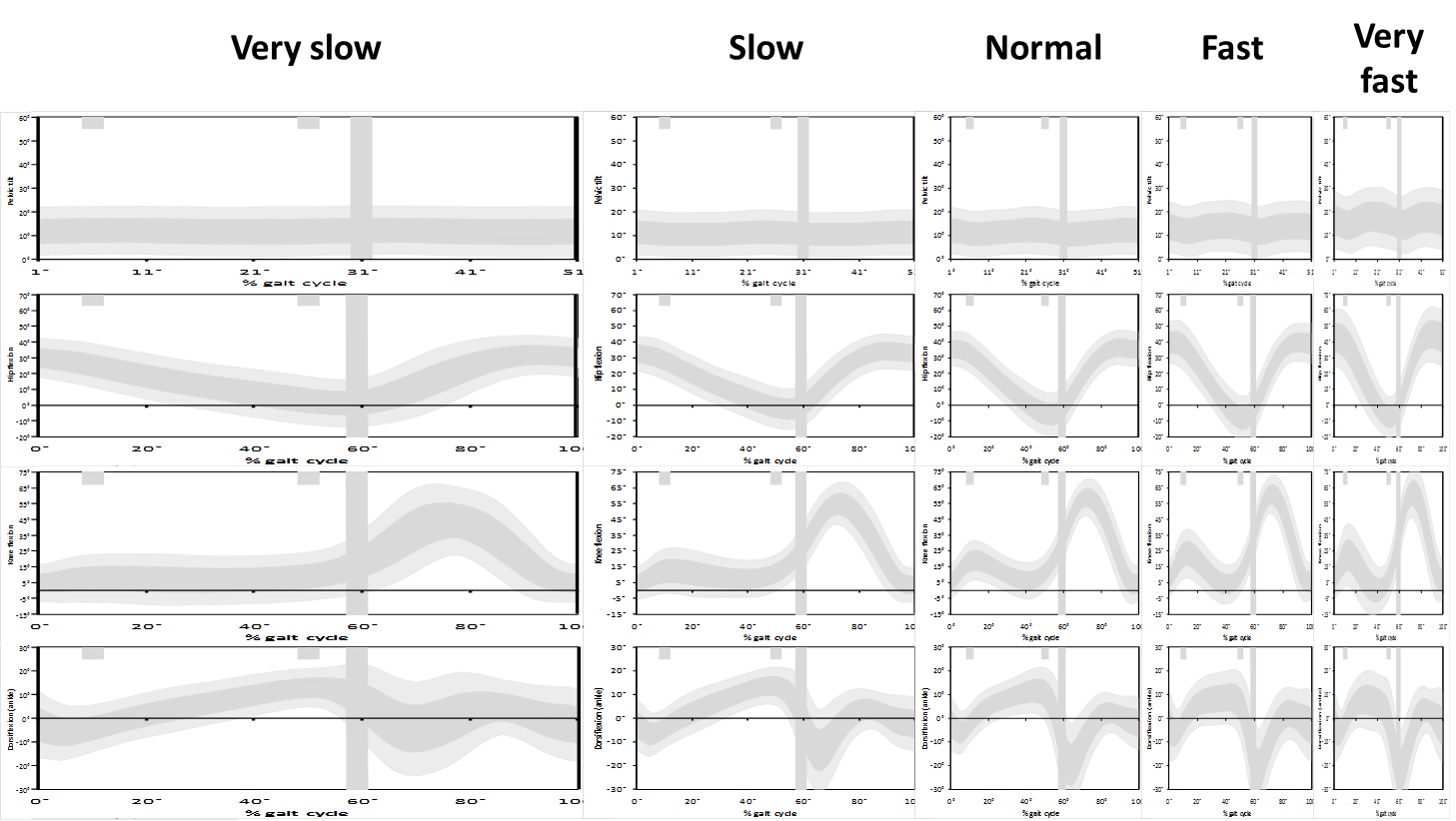
But then I realised that the slower walkers have a longer cycle time and the data should really be stretched to make comparisons as to how children are waking in real time. Slow walkers take a lot longer to complete a gait cycle than fast walkers and the data should really be plotted on wider graphs to allow comparison of  what is happening over the same time period.

Different speeds not time normalised

If we plot the data like this we see just how different the data really are. I’ve not absorbed the full effect or implications of this but think about the slope of the knee flexion curve in second double support and toe off which many clinicians associate with rectus femoris (mal)function. If the rectus is inhibiting knee flexion then they expect the slope to be reduced.  But look at the difference between the real gradient in the lower graphs and the apparent gradient in the conventional (upper graphs). How can we possibly interpret this phenomenon from the conventional graphs?

It ‘s not clear what we can do about this. Plotting the graphs the way we do allows comparison of like with like (even if we might lose something by forcing the comparison). We often use graphs to compare outcome after intervention. How would we do this sensibly if the graphs are different shapes?

Anyone got any ideas how we can properly represent the slope data without losing the power of the straight forward comparisons we get from sticking to the tried and tested conventions for plotting data?

.

Schwartz, M. H., Rozumalski, A., & Trost, J. P. (2008). The effect of walking speed on the gait of typically developing children. J Biomech, 41(8), 1639-1650.