Terminology

Gait graphs for beginners

I’m teaching about gait to the undergraduate physios next week. Its the first lecture I’ve given at this level trying to emphasise the approach I’ve developed in the Why we walk the way we do videos. The colleague who’s delivering the previous lecture – which included a first introduction to gait graphs – wanted to use the same format as I use which started a conversation about what aspects of walking we’d like those graphs to emphasize.
Knee graph

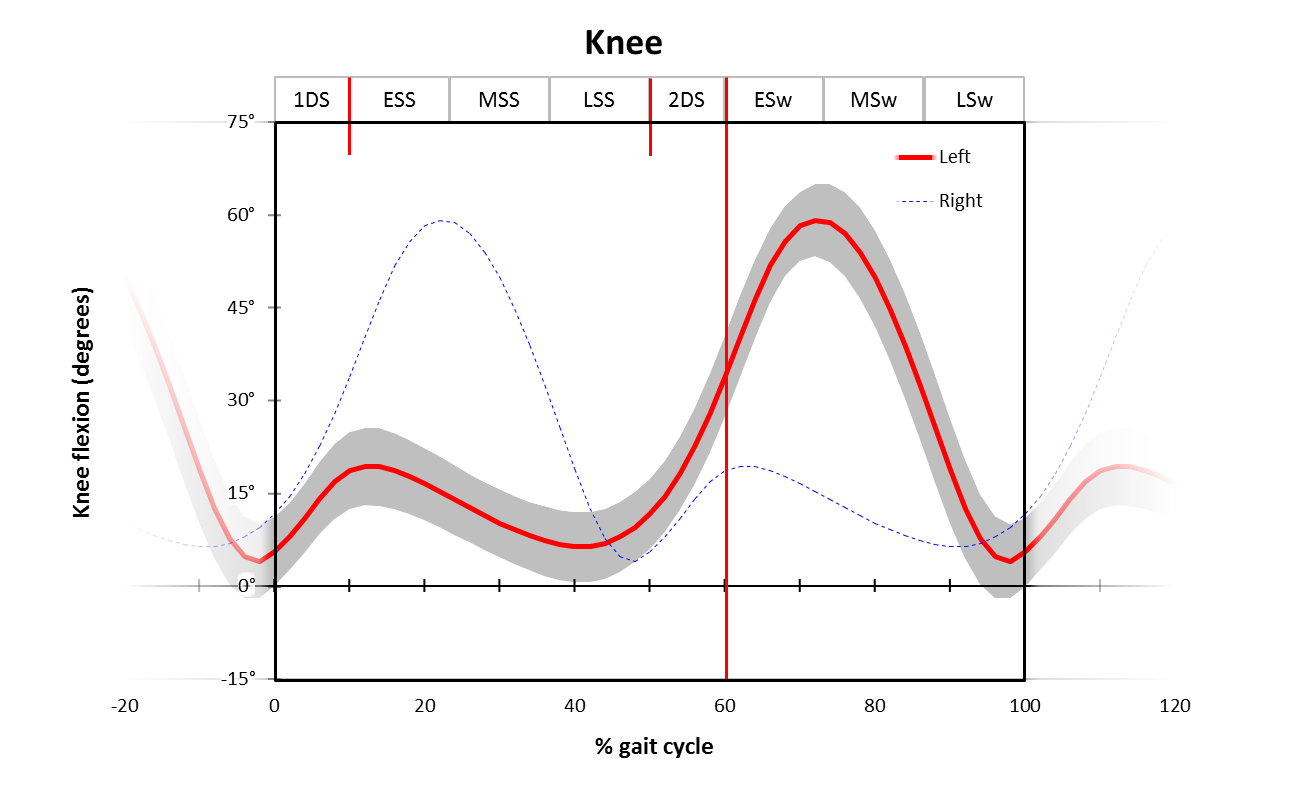
I’m pretty keen on fixed aspect ratios and scaling so that you can forget about those issues when you are actually looking at data – so we’ve fixed that.  We wanted also wanted to reinforce the terminology for different phases that I’ve described in a previous post – so we’ve put those abbreviated names across the top.

I also like to represent the continuity of the gait cycle – it amazes me how many people I come across who don’t seem to realise that point on the far left of the graph is the same as the point on the far right hand side (give or take a little stride to stride variability). It’s also not uncommon to spot data in the literature where values of gait variables at 0% and 100% are different but not commented upon. Various people in the past have tried plotting more than a single stride to try and emphasize continuity. I know Jurg Baumann was an advocate of this but can’t find easily get my hands on a sample. At Hof also used it – his 2002 paper on the speed dependence of EMG profiles is an example – but it has never really caught on. In this format I’ve tried to capture the point by allowing the gait curves to fade away to nothing outside the graph. It’s a bit messy if you’ve got a whole array of graphs but I kind of like it in the context of an introduction at this level.

I’m also very keen on getting students to appreciate what the right leg is doing plotted on the same time scale as the left leg. I know this insenses people who are paranoid about the importance of symmetry in gait but it’s a hell of a lot easier to explain the biomechanics if you look at the data this way. It’s unconventional of course so I’ve chosen to represent this as a much fainter line.

There was another question mark over the hip angle. As gait analysts most of us assume that this should be measured relative to a pelvic axis represented by the line from PSIS to ASIS and thus biasing the hip graph towards flexion. In assessing gait by observation, however, physios almost always consider the angle with the vertical which might be more relevant for daily practice. In the end we decided to stick with the gait analysis approach and just make sure we explain this very clearly.

Anyone got any additional features they like to add?

.

Hof, A. L., Elzinga, H., Grimmius, W., & Halbertsma, J. P. (2002). Speed dependence of averaged EMG profiles in walking. Gait Posture, 16(1), 78-86.

Analysing analysis

What do we mean by clinical gait analysis? Most of you reading this blog will assume it requires a kinematic measurement system, a couple of force plates and possibly an EMG system. For the vast majority of clinicians across the world, however, it means looking at how their patients walk without even the benefit of a video camera. In my book I suggest that what we call clinical gait analysis should really be called instrumented clinical gait analysis. I then pointed out that this is rather cumbersome and that I’d use the term clinical gait analysis anyway!

OGA Rancho

The team at Rancho Los Amigos used the term Observational Gait Analysis as long ago 1989 when they published their Handbook. The photo below is the cover of the 4th edition from 2001. The most recent edition is an app for the iPhone which you can get download from iTunes (doesn’t seem to be any Android equivalent yet unfortunately). Brigitte Toro picked up on observational gait analysis (OGA) and introduced video-based observational gait analysis (VOGA) in a review article a few years ago now (2003). If we used these terms carefully there would be clear ground between them and clinical gait analysis which could be reserved for the instrumented approach.

I was, however, interested by the comments of Professor Phil Rowe from Strathclyde University speaking at one of the satellite events orbiting ESMAC in Glasgow this year and focussing on the word analysis. His point was that analysis is a process of thinking which requires some data.  It is thus not possible to perform a clinical gait analysis without some sort of instrumentation to provide those data. On this basis it would be inappropriate to refer to clinical observation of walking (either direct or through video recordings) as analysis. Perhaps clinical or observational gait assessment  are more appropriate terms (although we then end up with the same acronym, CGA). The surgeons in Melbourne also used to talk about gait by observation which seems another sensible alternative. As an engineer I quite like Phil’s line of reasoning and think a distinction between a true analysis of data and an observation of patterns is useful.

But maybe things aren’t so clear cut. Wikipedia defines analysis as the process of breaking down a complex topic into smaller parts to gain a better understanding of it. This definition doesn’t actually require any data.  It’s also true that whenever I’ve heard observational gait assessment being taught the focus has been on breaking down the overall gait pattern into smaller parts, either by plane or level, or both, to aid understanding. Maybe I’m being over-protective in trying to restrict the term analysis to instrumented processes. Any comments?

.

Toro, B., Nester, C., & Farren, P. (2003). A review of observational gait assessment in clinical practice. Physiotherapy Theory and Practice, 19(3), 137-149.

Who first thought of a gait graph?

Quite out of the blue Jenny Kent from Headley Court asks if I know where the gait graphs we know today come from. She was particularly interested in where the idea of time normalising data to the gait cycle originated. I have to admit I just don’t know.

Braune and Fischer, working at the end of the 19th century, certainly plotted a number of gait variables against time, most for swing but a few for more than a gait cycle. All the graphs I can see though plot these against time rather than a percentage of the gait cycle and the data for more than a gait cycle doesn’t appear to be plotted in relation to the gait events at all.

The first group that I can find that present variables on graphs with the time axis labelled as % gait cycle is Inman’s group working in Berkeley in the early 1950s.

Inman time normalisation

Data scanned a long time ago from one of the outputs of the Berkeley group – not sure which.

Can anyone provide any earlier examples?

.

This made me think about other features of our standard gait graphs. Who first proposed plotting data from a patient against normative reference data depicted as a mean and range based on the standard deviation?

I remember that when the Vicon Clinical Manager software came out in 1992 that it assumed that all data was normalised to the gait cycle (the data was actually stored in a .gcd file on this assumption). The software only allowed three traces to be plotted on any graph so the common practice was to plot the mean of the reference data along as one right and one left side trace for each patient. I think the practice of plotting several (three!) traces from each side separately to assess measurement variability probably dated to this time as well. I don’t remember the standard deviations being plotted but this may just be my memory (the standard deviation values could certainly be stored in the .gcd file).

I also remember being impressed by teaching material from Newington and Gillette Hospitals (Gage, Davis and Ounpuu) which plotted the standard deviation ranges from quite an early stage. Looking up some of their early papers I find that  Sylvia’s 1995 paper contains sample patient data plotted against the standard deviation ranges. (Unfortunately the quality of this figure in the .pdf file I have is too poor to be worth reproducing here).

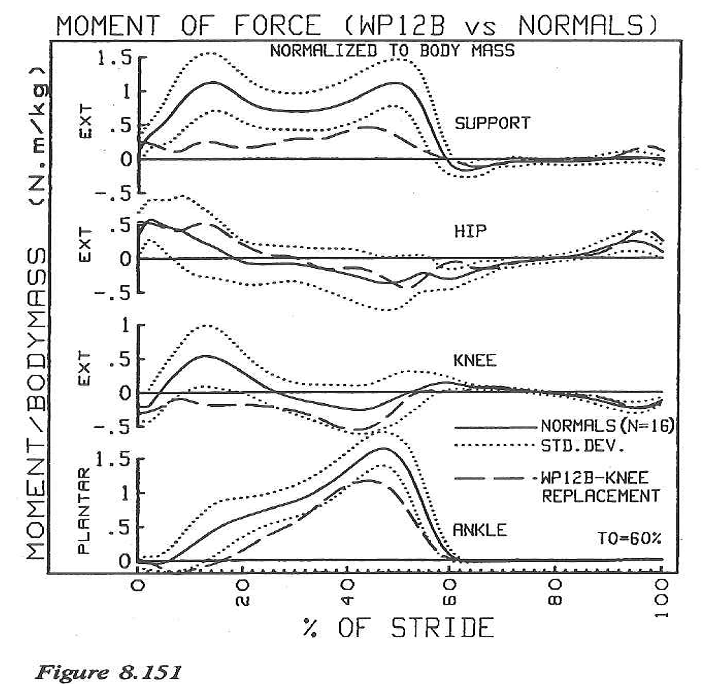
Sylvia moved to Newington from Waterloo so I wondered how David Winter had plotted his data. Sure enough in the final chapter of The Biomechanics and Motor Control of Human Walking (1991) entitled “Assessment of pathological gait” are a series of graphs showing gait variables from a patient with a knee replacement plotted against the mean and standard deviation from a reference population. (This book was an adaptation of an earlier one form 1987 which I don’t have access to and I’d be interested to know if these graphs were included in that as well).

 winter gait graphs

I’d like to suggest that this might be the earliest example of gait graph as we use them today – or has anyone got any earlier examples?

Of course tracing ideas back like this is a slightly ridiculous activity because such graphs  often appear in publications only after having been used more generally for a considerable period. Just because they first appear in print from one team does not necessarily mean that they originated there!

.

Braune, W., & Fischer, O. (1987). The Human Gait (P. Maquet & R. Furlong, Trans.). Berlin ; New York: Springer-Verlag.

Klopsteg, P. E., & Wilson, P. D. (1954). Human Limbs and their Substitutes. New York: McGraw-Hill.

Ounpuu, O., Davis, R., & Deluca, P. (1996). Joint kinetics: Methods, interpretation and treatment decision-making in children with cerebral palsy and myelomeningocele. Gait and Posture, 4, 62-78.

Winter, D. (1991). The biomechanics and motor control of human gait: Normal, Elderly and Pathological (2nd ed.). Waterloo:: Waterloo Biomechanics.

Mind your language

I’m here in Cincinnati for the Gait and Clinical Movement Analysis Society Annual Meeting. Lovely sunshine makes a change from damp old Manchester.

Anyway today was pre-conference tutorial day and started with a really interesting session with  Art Kuo trying to help us understand induced acceleration analysis. He was particularly concerned to try and demystify the subject using a number of worked examples to show it is possible to get a qualitative feel for the accelerating effect that different joint torques will have on different segments.  He used these to help us understand the sometimes counter-intuitive conclusions that these analyses can lead us to. I found the approach fascinating and will go away and work through some examples myself. I’ll need to think a bit more before I commit any reflections to this blog.

Right at the end he volunteered some fascinating thoughts on terminology that I think are worth passing on immediately. He commented on how some of the terminology we use for accelerations tends to have inappropriate positive and negative connotations and that we need to be very careful that this doesn’t lead us to inappropriate conclusions.

One pair of phrases was “propulsion” and “braking”. We tend to think that propulsion is good and braking is bad but in cyclic walking this is not the case. If  we haven’t changed our speed over a complete gait cycle then, following Newton’s laws, we will have propulsive and braking forces that match exactly (or  more technically propulsive and braking impulses match). All that increasing the propulsive forces does is require an increased demand for braking forces to be applied. To understand how we walk the way we do we really need to have a more nuanced understanding of why braking and propulsive forces are required at all. I agree with Art that using words that suggest that one is beneficial and the other detrimental is not useful.

The other pair was “support” and “falling” (or equivalent ). Again joint torques that apply an upwards (supporting) force to the centre of mass are generally considered to be good whereas those that accelerate the body downwards are considered bad. Again, however, if walking is cyclic then there is no net acceleration of the centre of mass in either direction. I’m less sold on this argument as there is a requirement for the upward forces to average bodyweight over the gait cycle and thus I think there is a sense in which the support mechanisms are more important than those that allow downward accelerations – but I do agree with Art again that if the body accelerates upwards in one part of the gait cycle it must fall in another. Considering one of these as good and the other as bad is not likely to help our understanding.

What Art didn’t propose was alternative words that don’t have these associations. Anyone any ideas?

Re recycling terminology

My second post on this blog was a suggestion that, when you think about it in detail, there are some problems with the conventional terminology that clinical gait analysts use to divide the gait cycle into phases and that a very simple scheme based upon simple division of the gait cycle into single support, double support and swing might have some advantages. Here is a video I’ve developed to help gait analysts reflect on the issues.