What is normal?

A couple of months ago I wrote a post entitled normative data capture Part 1. No-one has yet demanded Part II but I’ll give it anyway. The earlier post concentrated on what sort of numbers were required to determine normative ranges for any data assuming we want a reasonable estimate of both the average and the standard deviation.

Once we’ve got the numbers sorted out then the question arises “What is normal?” It might be worth starting with a paragraph addressing the political dimension here. The word “normal” is considered inappropriate in some circles because of the connotation that anyone else, our patient for example, is “abnormal” which is considered a negative term. The response from some researchers (particularly Americans?) working with children has thus been to prefer the term typically developing. This presumable implies that our patients our atypical and I’m not sure that that is any better or worse than abnormal.  What I do appreciate is that we are all abnormal in some regard. The question should not be whether the person is normal or abnormal but whether their gait pattern is. I think normative stresses this emphasis that it is the data or the pattern that is abnormal rather than the individual (but others may think differently).

But then what is a normal gait pattern?  In my dictionary there are various definitions of normal and the closest to the sense in which we are using it is not deviating from the standard. Even this though is not particularly close. I suspect that what we really mean is representative of the population. This raises the questions of how we consider people, with conditions such as  cerebral palsy  in relation to this population?  I think that conceptually they should be considered as part of the population. Thus the normal population includes people with cerebral palsy (and other gait disorders). In childhood and early adulthood at least, these conditions are quite rare (approximately 1 in 500 people is born with CP, one of the more common conditions affecting walking) so true normative ranges (calculated over a wide enough sample) would be very little affected by including or excluding them.

Of course we most often collect normative data from much smaller samples (my previous post suggested that 30 might be regarded as a reasonable number). In this case it makes sense to specifically exclude people with obvious neuromusculoskeletal pathology not because we regard them as abnormal in principle but because the statistics of the situation dictate that the normative data that we obtain by excluding them will be closer to normative data for the entire population than the data we would obtain if they were included. (Including one person with CP in a sample of 30 runs the risk of obtaining normative data that is quite different from that which would result from the one person in 500 in the general population)

A more common problem is a number of anatomical and physiological characteristics which have a wide range within the general population such as in and out-toeing, tibial torsion, femoral anteversion, flat-feet and high arches. Some health professionals will want to define an arbitrary and often subjective cut-off beyond which the individual is labelled as having an impairment and exclude them from the normative dataset. I remember hearing one story of a gait analysis service that was interested in providing normative data for a foot model and simply collected a group of individuals who, to them, had no obvious neuromusculoskeletal impairment and were entirely asymptomatic. The team was later joined by another health professional who looked at the dataset and concluded that quite a large proportion of the cohort had either flat feet or raised arches and wanted these abnormal people deleted from the dataset.

This of course raises the prospect of self-fulfilling prophecy. People with flat feet are considered as abnormal because they have data that falls outside the range of those who have been assessed as not having flat feet. This is clearly daft. Normative data ranges should ideally be generated with randomly sampled datasets from the whole population. In practical situations random sampling is extremely rare but it is inappropriate to select participants on the basis of some pre-supposition of what normal is (unless the abnormality is so rare and severe that the inclusion in a small sample risks skewing the data as described above).

There is another problem when we start to look at older populations. Iezzoni et al. (2001) suggest that over 10% of the entire population have some difficulty walking as little as 400m, rising to nearly 50% if we look at the population aged 80 and over. There is considerably potential for inclusion or exclusion of these individuals to affect normative data. If we are concerned with what data to use for comparative purposes in older populations, however, then I think the goal posts have shifted.  What we really require is not normative reference data but reference data from healthy people within a particular age range or more specifically those without any specific neuromusculoskeletal pathology. If we want a convenient shorthand then perhaps we should refer to a healthy gait pattern in these circumstances rather than a normal one.

There are the same risks here of subjective decisions as to where the healthy range ends and pathology starts which are largely unavoidable. These can be addressed to a certain extent by defining explicit and objective inclusion criteria. We might not agree with definitions but at least we will know what they are. Even these are problematic however because it is very easy to introduce sampling bias when recruiting. When selecting healthy controls for a study there will be a tendency to select the healthiest available.  All will fulfil the inclusion criteria but they may not be representative of the population of all people who fulfil those criteria.  The solution here may be to specify the characteristics of the sample that were actually recruited rather than the inclusion criteria for the study.

.

Iezzoni, L. I., McCarthy, E. P., Davis, R. B., & Siebens, H. (2001). Mobility difficulties are not only a problem of old age. Journal of General Internal Medicine, 16(4), 235-243.

Do it yourself normative data comparison (free download!)

Hi, I’ve had a bit of a break over the summer but I’m hoping to start posting again regularly form now on. Just a reminder that we are running another gait course in November (this one focussing on measurement issues rather than clinical interpretation). Click on the image to the right for more details. There is also just about time to register to start our Masters in Clinical Gait Analysis by distance learning (you don’t need to come to Salford at all). Click on the other image to the right for more details of it.

Enough of the ads, this blog following on from one I wrote just after the GCMAS meeting last year. It had a video link to the presentation I’d just delivered arguing that the reason we collect normative data should be so that we can compare it with other people’s normative data. I presented data showing that if we did that for the normative data from the Royal Children’s Hospital in Melbourne and Gillette Children’s Speciality Healthcare then we get quite remarkable agreement. You can see the comparative kinematic data in the figure below.

compare norms

The paper based on that presentation has finally got published in Gait and Posture (if you don’t have access to the journal you can find a pre-publication version here). We’ve also prepared an Excel file that contains the data in a format that allows you to add your own normative data (mean and standard deviation) to allow comparison with the data from Melbourne and Gillette. Just cut and paste your data into the spreadsheet and look at the graphs to see how you compare. Remember that differences in the mean traces suggest that there are systematic differences in how you apply markers, differences in standard deviations are likely to reflect how consistently you apply them within your own lab.

Do let me know how well your data compares. It might be interesting to post some examples of how various clinical centres compare on this blog-site somewhere.

Virtual Open Day

Virtual open day banner

A brief note to publicise the Virtual Open Day for our Masters in Clinical Gait Analysis which we are holding on   Thursday 17th July at 7:00pm (UK time). This is obviously most relevant to potential students who might like to study with us but it will also be useful to  service managers who are thinking about this as a pathway for staff development. This is a three year part-time course delivered entirely by distance learning (it doesn’t require any travel to Salford at all). It is designed for staff from a technical or clinical background who are already employed within a gait analysis service and are enrolling with the support of their employer.

We’d also welcome any others who are just interested to know what a modern work-based distance learning masters programme is like.

The Open Day will be held over the Internet in a Collaborate® virtual classroom. I’ll  talk about aims of the programme, give an introduction to our virtual learning environment, Blackboard, and an overview of the learning activities that are set for students. After that you’ll have a chance to chat in small groups to a number of our other teaching staff.

To attend the Open Day please reply to our Admissions Tutor using this link

The course starts in late September 2014, for full course details please see our website  which also includes a link to our online application system.

If you want to talk to our Admissions Tutor about the programme and how it will benefit you please use this link to e-mail or phone on +44 (0)161 295 6536.

salford unit logo


Feeling the pressure

I’ve been quite techie in my posts recently so maybe its time for something more clinical. I received a request from a journalist with the popular science magazine “New Scientist” to comment on an article (Mukherjee et al, 2014) reporting on research purporting to provide evidence of the efficacy of hyperbaric oxygen therapy for children with cerebral palsy.

Such articles “discovering” new treatments for cerebral palsy appear every so often. The last time hyperbaric oxygen was discovered was just over a decade ago. At the time a number of centres throughout the UK, Europe and Australia started offering the treatment and many parents sought these out. The fact that this interest appears to have largely died away I think speaks for itself.

Despite its claims the article is published in Undersea and Hyperbaric Medicine Journal. This suggests to me that it has either been rejected from mainstream journals in the cerebral palsy field or that the authors have chosen not to submit it for the rigorous peer review that this would entail. Assuming that it has been reviewed and assessed as lacking credibility I looked at the article myself.

The article is actually well written with the authors being particularly honest in highlighting several limitations. The most obvious is that this is not a randomised trial. The control group were those children with parents who did not want hyperbaric treatment for some reason.  This group is much smaller than the other groups and contains a higher proportion of more severely involved children (quadriplegia) than two of the other groups. The authors also accept that there was no blinding of clinicians, families or assessors.

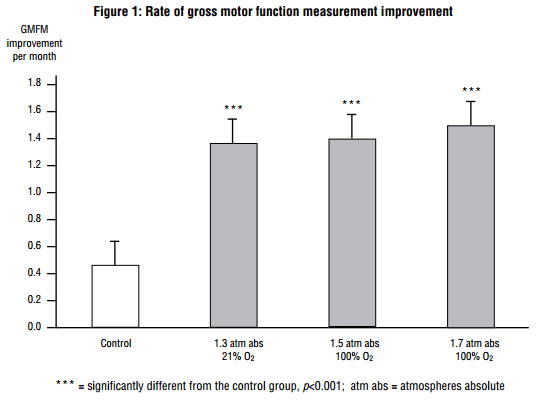
The other obvious issue is that all children were also undergoing an intense rehabilitation programme over a six month period of the study whereas the hyperbaric oxygen was only offered over the first two months. The similarity between the three treatment groups is remarkable despite marked differences in the hyperbaric oxygen regime. The lowest dose of hyperbaric oxygen is actually one of hyperbaric air. The other doses are of pure oxygen (5 x more oxygen) at considerably higher pressures. I’m no expert in hyperbaric medicine but if the hyperbaric regime is the important factor here I’m surprised that such marked differences between regimes make so little difference to the results (summarised in Figure 1).

Mukherjee Fig 1

The improvement appears to continue throughout the treatment period and not just over the early period when hyperbaric oxygen was being used.  Given that the differences between control and hyperbaric oxygen might be attributed to some inherent bias in selecting the controls, the most direct explanation of the data would appear to me to be that the common rehabilitation programme is responsible for change rather than the different hyperbaric oxygen regimes.

Mukherjee Fig 2

The improvements in GMFM appear large particularly as plotted against the GMFM “growth curves” in Figure 2. There are, however, also issues here. Comparison of the age range and means of all treatment groups suggests a highly skewed distribution with a large number of very young children and a small number of adolescents. The mean value is almost certainly a poor indicator of central tendency and the median should have been used which will almost certainly be considerably lower. You can see that if the age at which the lines in Figure 2 are plotted where reduced by just one year then the improvements over six months would be much closer to those expected on the basis of the growth curves. The early years of childhood are a time of rapid development of motor function in all children, including those with cerebral palsy, and particular care is needed to take this into account while quantifying the effect of specific interventions at this age.

The other issue here is that the growth curves are based on data from Canadian children attending established ambulatory rehabilitation programmes on an on-going basis. If the children in the hyperbaric oxygen study had been less well managed before being recruited then the rapid gains on starting such a comprehensive rehabilitation programme for the first time may not be that surprising.

The acknowledgements list also makes interesting reading in that it is suggests that there are a considerable number of stakeholders in this project. I could imagine that providing evidence for the efficacy of this treatment could be extremely important for its future. In the light of this I’m not convinced by the final statement that “the authors report that no conflict of interest exists with this submission”. (Of course this merely highlights implicit conflicts of interest in almost everything that is published in the scientific literature and it may be a little unfair to make this criticism of this study and not of others).

In summary it appears quite clear to me why mainstream journals might have been reluctant to publish such a study and I’d think it extremely unlikely that this is the break through that it might appear at first site.

If the paper has been declined by the mainstream CP journals then it is interesting to reflect on whether this has been “successful” or not. The paper is well written and appears to report results of an observational study that has been conducted at least as rigorously as many others that are routinely accepted by such journals. The authors have been particularly honest in reporting the limitations of the study. The explanations as to why the results may not be as sensational as first appears are quite subtle and I’m not particularly surprised that they have been over-looked by authors who (like most of us when we publish) want to place a particular spin on their results.

If the article had been accepted then the journal editors could have asked the authors to revise their manuscript to draw more balanced conclusions or could have included an editorial emphasizing an alternative point of view. I think it unlikely that the popular scientific press would have raised an eyebrow.  Instead the article has appeared in a journal dedicated to hyperbaric medicine with an editorial written by protagonists for this “new” therapy who conclude that it “could be the coveted neurotherapeutic method for children suffering from neurological dysfunctions due to CP”. I’m not convinced that this is a good result for the CP community who I think have enough to contend without the publicity that occasional reports of such “wonder cures” gives rise to.

.

Mukherjee A, Raison M, Sahni T, Arya A, Lambert J, Marois P, James PB, Parent A, Ballaz L (2014). Intensive rehabilitation combined with HBO2 therapy in children with cerebral palsy: a controlled longitudinal study. Undersea and Hyperbaric Medicine Journal 41(2):77-85.


Push off push-off

Sheila from Dundee dropped me an e-mail: 

In your meanderings around the subject of gait have you come across any definitive descriptions of push-off i.e. at what time in the cycle does it start? Or do you have any thoughts on the matter yourself?

Having replied it struck me that others may be interested in this topic.

As far as I’m aware “push-off” is only used loosely to describe a phase of the gait cycle. I’ve never seen a definition in terms of where it starts and where it ends. My preference is to describe the phases based on single and double support and swing (with single support and swing divided into three equal parts). This intentionally avoids labelling any particular phase as having any particular function (push-off, shock-absorption etc.) partly because people often get these functions wrong when describing walking and partly because patients may not achieve such functions at the same phase of the gait cycle as the able-bodied.

“Push-off” is particularly problematic. How usefully it describes the late stance phase depends both on whether you are considering the whole body or just the leg and the direction you are talking about. During late stance the centre of mass is moving downwards and forwards. The downward motion is being resisted. From this perspective late stance is a phase of deceleration and the term “push-off” is inappropriate. The segments in the limb however are moving in different directions, the foot, ankle and tibia are being “pushed up” whereas the femur is actually moving downwards with the centre of mass.

Looking in the horizontal direction both the centre of mass and the limb are being accelerated forwards. There is a relatively small acceleration of the centre of mass (but this affects a large mass) and a rapid acceleration of the limb (which has a much smaller mass). In this context “push-off”  does appear an appropriate descriptor at first.

Focussing first on the centre of mass movement though – if you model the whole body as an inverted pendulum with mass and leg length matching the human body you find that the entirely passive mechanism (no muscle activity) develops an anterior component of a ground reaction in late stance that is very similar in magnitude to that of the ground reaction at this phase of healthy walking. This force arises because of the relative alignment of the centre of mass, limb and foot and suggests that the muscles need only preserve this alignment to generate it. “Push-off” suggests something much more active and may be misleading.

If we focus on the limb – there has been a debate for nearly 200 years about whether it is being pushed forwards by the action of the plantarflexors pushing against the ground or pulled forwards by the hip flexors. I think it very likely that both are important. It’s tempting to think that some insight into this can be gained from looking as the joint power graphs. They show power generation at both hip and ankle which tends to confirm that both are important. Power, however, is a scalar quantity (it is not associated with any particular direction) representing the rate at which energy is supplied to or removed from the whole body by the muscles acting across a particular joint. Given this it is very difficult to come to any rigorous conclusions about the relationship between the power generated at the joints and the movement in a particular direction of the segments of the limb being “pushed-off”  (to say nothing of complications when power may actually be being generated by muscles spanning more than one joint). To answer the problem categorically would require some form of induced acceleration analysis as to what particular muscles are acting to accelerate the segments during late stance. I’m not aware of anyone having done this (perhaps readers can let me know if they are).

Going back to the original question. I’d maintain my suggestion that we avoid “push-off” as a term. It’s an easy label to apply that makes us think we understand something that many of us don’t (and I’d include myself in this).