What’s in a name?

We’ve recently advertised for a “Clinical Gait Analyst”. Perhaps I shouldn’t have been surprised but we’ve had expressions of interest from all sorts of people that obviously have quite a different idea of what clinical gait analysis is to the one that I’ve got. To me a clinical gait analyst is someone who works in a clinical gait analysis service. They capture data using a 3-d optoelectronic measuring system (or equivalent) which may incorporate synchronous force plate or EMG measurements. Many also provide an interpretation of this, generally drawing on additional information from a quantitative physical examination. If clinically qualified they may provide clinical recommendations based on the analysis.

“Gait analysis” is, quite appropriately, used in many other contexts. Google up “gait analysis” and there is a good chance that the first hits will refer to a combination of video recording of running and expert advice to help you choose an expensive pair of running shoes. Another group of gait analysts will look at your running and suggests ways of improving your style to improve your times or prevent injury. Getting more clinical many orthotists, prosthetists, podiatrists and physiotherapists base much of their working lives on observational gait analysis. Some will take video recordings but many will simply look at how their patients are walking as a basis for clinical recommendations. On the more technical side there are a number of people interested in gait for a variety of reasons with little or know interest in clinical applications. There is another group of people who perform gait analysis for clinical research. They perform a variety of analyses on grouped data to try and learn more about a disease condition or intervention but don’t offer any results or interpretation for individual patients.  Gait analysis is also proposed as a biometric technique for security purposes. It’s not restricted to humans – Google up “canine” or “equine gait analysis” and you might be surprised by the number of hits.

None of us has a monopoly of such a generic term as “gait analysis” or even “clinical gait analysis” but I do think there is a need for something that refers specifically to what I do (perhaps as far as most readers of this blog are concerned to what we do). Trying to claim that only someone that does what I do is involved in gait analysis is ridiculous and mildly insulting to other practitioners. Perhaps we need a more specific term for what we do.

Some people use “3-d gait analysis” but taking a coronal and sagittal plane video, or even just watching someone walk from different angles is three dimensional. “Instrumented gait analysis” has also been used  but there are a wide range of instruments – a single force plate for example. The best I can come up with while writing this article is “Comprehensive Clinical Gait Analysis” (CCGA). To me this captures the aim of getting a reasonably complete picture of the way someone is walking (even if its rare that anything like a complete picture actually emerges!). Anyone have any other ideas?

What is an inverted pendulum?

“Inverted pendulum” is one of those terms that seems to have crept up on me over my time in biomechanics. I don’t remember it being commonly used or taught when I was a student but now it seems to be everywhere. I suspect it is one of those terms that is not understood anywhere nearly as well as it should be. I’m not aware, for instance, of any biomechanics text book that properly explains what an inverted pendulum is or what its mechanical characteristics are. This is particularly important because in mechanics the “inverted pendulum” is more often studied as a classic example of dynamics and control theory (see the Wikipedia article for example). Anyone looking at these descriptions but wanting insight into the biomechanics of walking is going to end up very confused.

An ordinary pendulum is one with the pivot at the top and the mass at the bottom. An inverted pendulum is the opposite way round. The pivot is at the bottom and the mass is on top. Fierljeppen (canal vaulting) is the best example I’ve got of an inverted pendulum (see video below). The pole rotates about its foot (at the bottom of the canal) and transports the vaulter from one side of the canal to the other. “Transports” is the key word here. The inverted pendulum is a mechanism for carrying an object form one place to another and this is how it functions during walking. The “passenger unit” as Perry would call it is carried forward by the outstretched leg as it pivots over the foot.

It should be noted that there are important differences between the two types of pendulum. The inverted pendulum only carries an object in one direction, it doesn’t swing backward and forward like the ordinary pendulum. Another difference is that the inverted pendulum does not have a characteristic frequency like an ordinary pendulum – it would be absolutely useless inside a grandfather clock.

The earliest use of the term as a model of the stance phase of walking that I am aware of was by Cavagna et al. (1976). Earlier workers have used different terms for essentially the same concept. The “compass gait” of the much aligned Saunders, Inman and Eberhart (1953) is essentially a description of the inverted pendulum. A decade later Elftman (1966) suggested that “the body moves forwards as if vaulting on a pole” and a further decade on Alexander used the term “stiff-legged gait” (1976). It is probably the more recent work of the dynamic walking group (best summarised by Kuo, 2007) that has really popularised the use of the term.

Some papers refer to Cavagna as having tested the hypothesis that the leg behaves like an inverted pendulum (e.g. Kuo, 2007, page 619). I’ve never found any evidence of this in Cavagna’s writing or anywhere else. He certainly commented that changes in kinetic and potential energy of the centre of mass correlate so that the total energy remains approximately constant throughout the gait cycle but there are an infinite number of ways this can occur without requiring an inverted pendulum mechanism (I might write more about this in a later post).

“Proving” that walking is based on the inverted pendulum is problematic in that at a very broad level it is obvious that walking involves a similar mechanism. The foot is clearly planted and the passenger unit is carried over it by the outstretched leg. On the other hand it is equally clear that the mechanism is not a simple inverted pendulum. The trunk remains upright, there is stance phase knee flexion and the pivot with the floor changes position and anatomical location through stance (Perry’s rockers). Any study attempting to establish whether stance is like an inverted pendulum will inevitably conclude that it is a bit like one but not exactly. Forming a sensible research question to “prove” the importance of this mechanism is quite a challenge.

Anderson and Pandy (2003) reported briefly on the dynamics of the inverted pendulum as a model of stance phase and Buczek and his team in more detail (2006). Both these papers are worth reading and held a couple of surprises for me but I’ll keep those for a later post.

Alexander, M. (1976). Mechanics of bipedal locomotion. In P. Davis (Ed.), Perspectives in experimental biology (pp. 493-504). Oxford: Pergamon.

Anderson, F. C., & Pandy, M. G. (2003). Individual muscle contributions to support in normal walking. Gait Posture, 17(2), 159-169.

Buczek, F. L., Cooney, K. M., Walker, M. R., Rainbow, M. J., Concha, M. C., & Sanders, J. O. (2006). Performance of an inverted pendulum model directly applied to normal human gait. Clin Biomech (Bristol, Avon), 21(3), 288-296.

Cavagna, G. A., Thys, H., & Zamboni, A. (1976). The sources of external work in level walking and running. J Physiol, 262(3), 639-657.

Elftman, H. (1966). Biomechanics of muscle with particular application to studies of gait. J Bone Joint Surg Am, 48(2), 363-377.

Kuo, A. D. (2007). The six determinants of gait and the inverted pendulum analogy: A dynamic walking perspective. Hum Mov Sci, 26(4), 617-656.

Saunders, J. D. M., Inman, V. T., & Eberhart, H. D. (1953). The major determinants in normal and pathological gait. Journal of Bone and Joint Surgery, 35A(3), 543-728.

Little boxes

GMFCS  is a categorical scale (Palisano et al., 1997, 2008). Children and adolescents are allocated to one group or another. There’s absolutely no evidence, of course, that there is anything in the condition (or group of conditions) we call cerebral palsy to suggest that children’s gross motor abilities are distributed in such neat little packages. The spectrum of cerebral palsy is almost certainly a continuum and the gross motor abilities are almost certainly distributed along a continuum as well. The categories of the GMFCS do not represent actual discrete groups of children with gross motor abilities that are qualitatively different from those in the other groups. Rather, they are an administrative convenience. Medicine, and life in general, is littered with examples of continuously distributed parameters divided into essentially arbitrary categories simply because this is the easiest thing to do.

Bill Reid's depiction of GMFCS II (ROyal Children's Hospital, Melbourne)

Bill Reid’s depiction of GMFCS II (Royal Children’s Hospital, Melbourne)

Remembering this is important when we engage in discussion about how clearly children can be allocated to the different categories and also how stable that categorisation is over time. If the classification is actually a convenient division of a continuous spectrum then there will be a number of children who fall very close to the border line between these  groups. Some of them will lie sufficiently close to the boundary that they can’t be reliably categorised. One day they will illustrate the characteristics of one group and another day the characteristics of another. Alternatively one assessor will make a subjective decision to put the marginal patient in one group whereas another assessor will put them in the other group. Neither is wrong – it is just a consequence of taking people on a continuum and trying to put them in boxes. Just how many children inhabit this marginal space is unclear but in assessing the reliability of the classification system we should be anticipating at least some borderline children for whom it is not possible to allocate a definitive GMFCS level. I may not have been reading carefully enough but I’ve never seen any discussion of this in the relevant literature.

This also impacts on studies of stability of the GMFCS over time. We should expect that a fairly modest improvement in gross motor function should take a child who has been graded at the top end of one category at one time to lead them to be graded at the lower end of the next category up on a later occasion. Equally we should expect some children at the lower range of ability for any given range to drop a level if they deteriorate quite mildy. Some transition between neighbouring groups is thus an inevitable consequence of how the groups are defined and should be expected.


Palisano, R., Rosenbaum, P., Walter, S., Russell, D., Wood, E., & Galuppi, B. (1997). Development and reliability of a system to classify gross motor function in children with cerebral palsy. Dev Med Child Neurol, 39(4), 214-223.

Palisano, R. J., Rosenbaum, P., Bartlett, D., & Livingston, M. H. (2008). Content validity of the expanded and revised Gross Motor Function Classification System. Dev Med Child Neurol, 50(10), 744-750.

GMFCS based research -are we asking the right questions?

It’s fifteen years since the publication of the first paper on the GMFCS (Palisano et al., 1997). Since then it has become ubiquitous in the field of cerebral palsy. More and more measures are being found that correlate with it. It just seems like magic. But the more things we discover that show this correlation the more I wonder whether this really is magic. Have we missed something? Are we asking the right questions?

Cerebral palsy is an extremely heterogeneous condition affecting some kids extremely severely and others very mildly. In terms of gross motor function the range is from a child with  hemiplegia and a mild foot drop right through to those with severe total body involvement who are essentially immobile. GMFCS allows us to group children (and now adolescents, Palisano et al., 2008) in terms of that function. In other words, GMFCS is essentially a classification of the severity of CP as indicated by gross motor function.

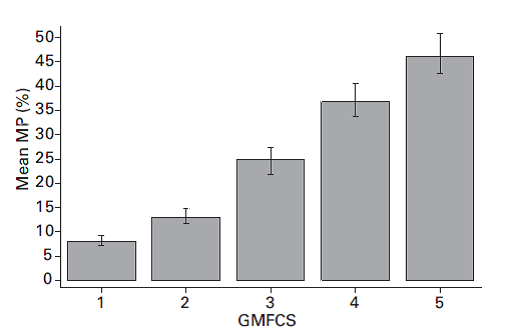
When we think about it most of the other indices, scores and scales we look at can be considered to be measures of the severity of CP as indicated by other aspects of the condition. When we get a correlation between GMFCS and another measure we are thus really saying there is a correlation of the severity of CP indicated on the basis of Gross Motor Function and severity of CP as indicated by hip dysplasia (Robin et al., 2008, see Figure below) , or gait quality (Baker et al., 2009) or physical activity (Bjornson et al., 2007). We shouldn’t really be surprised that there is a correlation – in fact the thing that should really surprise us is if there isn’t.

GMFCS-MP

Correlation of hip dysplasia (migration percentage) with GMFCS (Robin et al., 2008)

A more nuanced approach to research in CP might be to anticipate the underlying correlation between indicators of severity of CP and accept it as unremarkable. Measures that don’t correlate are actually more remarkable and further investigation of these, when they are identified, might be more productive than investigation of those that do. Detailed consideration of individual children that buck the trends may also give important clinical insights.

.

Baker, R., McGinley, J. L., Schwartz, M. H., Beynon, S., Rozumalski, A., Graham, H. K., & Tirosh, O. (2009). The gait profile score and movement analysis profile. Gait Posture, 30(3), 265-269.
Bjornson, K. F., Belza, B., Kartin, D., Logsdon, R., & McLaughlin, J. F. (2007). Ambulatory physical activity performance in youth with cerebral palsy and youth who are developing typically. Phys Ther, 87(3), 248-257.
Palisano, R., Rosenbaum, P., Walter, S., Russell, D., Wood, E., & Galuppi, B. (1997). Development and reliability of a system to classify gross motor function in children with cerebral palsy. Dev Med Child Neurol, 39(4), 214-223.
Palisano, R. J., Rosenbaum, P., Bartlett, D., & Livingston, M. H. (2008). Content validity of the expanded and revised Gross Motor Function Classification System. Dev Med Child Neurol, 50(10), 744-750.

Anteversion – a natural history

“Increased” femoral anteversion is one of the major impairments affecting walking in children with cerebral palsy. De-rotation osteotomies to correct this are a common orthopaedic procedure particularly as a component of single event multi-level surgery.  This post is the first of a series that will look at different aspects of anteversion and will focus on the published natural history data for the general population (i.e. those without CP).

There are several studies in the literature which have surveyed the natural history of femoral anteversion in the general population which together represent measurements of 1792 hips (Crane, 1959; Fabry, MacEwen, & Shands, 1973; Shands & Steele, 1958; von Lanz & Mayet, 1953).  The data from these series is plotted in the graph below. A couple of things are clear. Probably the most obvious is that is a huge range in measurements made at any given age (represented by the standard deviation). There is almost certainly a considerable measurement error but even so the conclusion should probably be that there is a wide range of femoral anteversion within the general population. Historical data from cadaveric specimens would appear to support this (Dunlap, Shands, Hollister, Gaul, & Streit, 1953).

Anteversion

The other consistent finding is that anteversion is high at birth and reduces with age. The data appears to suggest the mean value at birth is about 40° and has reduced to about 15° at age 16. The graph doesn’t appear to have flattened out completely by this time and other studies have suggested that the mean value amongst the general adult population may be less than 10° (Dunlap et al., 1953).

It should be noted that, at the age when children are generally being assessed for femoral derotations (8-10 years old), the average femoral anteversion is over 20° within the general population and a significant number of children (without CP) have anteversion in excess of 30° (remember that by definition 15% of the population have anteversion greater than the mean plus one standard deviation plotted here). Many kids with CP have measured anteversion in this range and for them the clinical question should perhaps not be whether they have high levels of anteversion or not but what it is that this causes them to walk with an intoed gait when many kids without CP have similar levels of anteversion but manage to walk with “normal” mild external foot progression?

It is perhaps worth pointing out that the measurements reported in these series used quite different techniques from the modern clinical measures of anteversion. The general trends are almost certainly valid but the actual values may differ when different measurement techniques are used.

Crane, L. (1959). Femoral torsion and its relation to toeing-in and toeing-out. J Bone Joint Surg Am, 41-A(3), 421-428.

Dunlap, K., Shands, A. R., Jr., Hollister, L. C., Jr., Gaul, J. S., Jr., & Streit, H. A. (1953). A new method for determination of torsion of the femur. J Bone Joint Surg Am, 35-A(2), 289-311.

Fabry, G., MacEwen, G. D., & Shands, A. R., Jr. (1973). Torsion of the femur. A follow-up study in normal and abnormal conditions. Journal of Bone and Joint Surgery, 55(8), 1726-1738.

Shands, A. R., Jr., & Steele, M. K. (1958). Torsion of the femur; a follow-up report on the use of the Dunlap method for its determination. J Bone Joint Surg Am, 40-A(4), 803-816.

von Lanz, T., & Mayet, A. (1953). Die gelenkorper des menschlichen hufge- lenkes in der progredienten phase inherer umweigigen ausformung. Zeitschrift Anatomie, 117, 317-345.