biomechanics

DoG III – a more clinical perspective

The arguments against the Determinants that I described in my last post are largely technical. It is interesting that the latest editions of three mainstream textbooks (Levine, Richards & Whittle, 2012, Kirtley, 2006  and Rose & Gamble, 2006) all print fairly damning critiques of the Determinants but choose to reproduce them anyway. Kirtley dedicates nearly four pages to describing them and then describes them in the last paragraph as “thoroughly discredited”.  Does this mean that despite the technical problems the Determinants are still useful in some way? Might they reveal some clinical truths? Let’s explore some more general issues.

One of the problems I see with the Determinants is that the basic “compass gait” (reciprocal flexion and extension of the hips) often gets overlooked. The original authors describe it quite superficially in a couple of sentences and then move on to much more extensive discussion of the Determinants. Levine, Richards and Whittle skim over it in even less detail and Kirtley doesn’t really describe it at all. The balance should really be the other way round. Reciprocal hip flexion and extension is the most fundamental characteristic (determinant?) of bipedal walking. To a large extent step length is determined by the range of motion you achieve at your hips (modified to a much lesser extent by any knee flexion at initial contact) and cadence by the rate at which you can move through this. The first thing anyone should be doing when assessing someone’s gait is to consider how effectively they are implementing this basic mechanism. If you list the Determinants, however, hip flexion and extension never appear.

Another rather disconcerting issue is how the Determinants lead you to focus on rather small movements of the pelvis in the transverse and coronal planes when there are much more significant movements at the knee and ankle in the sagittal plane. Whilst pelvic movements play an important role in the fine tuning of gait, the major sagittal plane motors acting to control hip, knee and ankle are where the action is. The fine movements of the pelvis get two Determinants to themselves and are described in precise detail whereas the knee and ankle are rolled together in one muddled paragraph (in the original paper).  Any approach to walking that distracts the focus from the hip, knee and ankle is likely to be hindering rather than helping. To this day it amazes me that when I show a video of a person walking with a really bizarre walking pattern, many people start off describing the minor imperfections in the motion of the pelvis, often concentrating on the coronal plane, before moving on to much larger aberrations of hip, knee and ankle movement in the sagittal plane.

Then finally there is the reduction of walking to achieving a single objective (walking at minimum energy cost). As Perry  (1985) and Gage (1991)  have both pointed out in different ways there are multiple objectives in walking (see my screencasts on the subject for more details). We need to support body weight against gravity, achieve toe clearance and adequate step length and achieve a smooth transition from one stride to the next whilst preserving the momentum of the passenger unit.  In pathological walking the requirement to avoid pain or maintain an adequate walking speed given some specific impairment might be more important than minimising energy cost. All of these need to be considered if we want to understand walking.

I better stop before this turns into too much of a rant but (in my opinion) the answer to my original questions are, “No, the Determinants are not useful” and, “No, they are exceedingly unlikely to reveal any further clinical insights”.  The sooner someone comes up with an alternative the better. (I’ve had a go [series of seven screencasts]  but am the first to admit that my approach lacks the elegant simplicity of the determinants even if I’d defend it as more biomechanically rigorous and clinically relevant).

 .

Gage, J. (1991). Gait Analysis in Cerebral Palsy. Oxford: Mac Keith Press.

Kirtley, C. (2006). Clinical gait analysis (1st ed.). Edinburgh: Elsevier.

Levine, D., Richards, J., & Whittle, M. W. (2012). Whittle’s Gait Analysis (5th ed.): Churchill Livingstone.

Perry, J. (1985). Normal and pathological gait. In W. Bunch (Ed.), Atlas of orthotics (pp. 76-111). St Louis: CV Mosby.

Rose, J., & Gamble, J. (Eds.). (2006). Human Walking (3rd ed.). Philadelphia: Lippincott Williams and Wilkins.

DoG II – the evidence

This is a second post “celebrating” the 60th anniversary of the publication of the determinants of gait. I’d intended to start off with something positive in the first post, that the paper has been subjected to some misinterpretation, but Rodger Kram’s comment has made me reconsider that. Perhaps the notion that energy can be conserved by reducing the vertical excursion of the centre of mass is (CoM)  implicit in parts of the paper if never mentioned explicitly. This has even led me to speculate on how that might have arisen.

Anyway I’d tried to start with a positive because at some time we have to deal with the negatives. These are quite significant because there can be no real doubt that the determinants are wrong!

If we accept that a belief that minimising the vertical component of the centre of mass trajectory will reduce energy cost is implicit in the paper then the determinants are clearly wrong right from the start. There are multiple examples throughout dynamics of systems in which potential and kinetic energy are exchanged without requiring any external energy (the simple pendulum is the most obvious example). There is absolutely no reason why minimising CoM movement should necessarily reduce energy consumption. Even if CoM excursion did lead to increased energy expenditure we now know that most of the determinants don’t actually reduce it. Gard and Childress (1997) started off by showing that pelvic list occurs at the wrong time and a little time later (1999) that the same is true of stance phase knee flexion. A short time later Kerrigan et al. showed that pelvic rotation has little effect on CoM height either.

The stance phase determinants (pelvic list, stance phase knee flexion) become even more bewildering if the aim is to smooth the trajectory of the CoM, because the trajectory is smooth already. Compass gait results in the CoM moving along a circular arc and there can be few trajectories that are smoother than that!

The final nail in the coffin was delivered by both the Chicago (Gard and Childress, 2001) and Boston (Kerrigan et al. 2000) groups establishing that Saunders, Inman and Eberhart had missed the most important determinant of CoM movement  which is movement of the foot and ankle and particularly heel rise in late stance.

We thus have a triple whammy:

  • the axioms on which the determinants are inappropriate (either because the trajectory of the CoM in compass gait is already smooth or because there is no particular reason why reducing its vertical excursion should reduce energy cost)
  • three of the major determinants don’t alter gait in the way the authors claimed
  • the authors missed the most important determinant that does!

I’m not the first to outline this of course. Art Kuo made a similar summary in an article in 2007. The most bizarre commentary, however, is that of Childress and Gard published in the third edition of Human Walking (2006). There’s nothing bizarre about the commentary but there is about its location- immediately after a full reproduction of the chapter as published in previous editions. We thus have a “keynote” chapter in a major text-book followed by a two page summary of why the chapter is wrong. How weird is that?

.

Childress, D. S., & Gard, S. A. (2006). Commentary on the six determinants of gait. In J. Rose & J. G. Gamble (Eds.), Human Walking (pp. 19-21). Philadelphia: Lippincott Williams and Wilkins.

Gard, S., & Childress, D. (1997). The effect of pelvic list on the vertical displacement of the trunk during normal walking. Gait and Posture, 5, 233-238.

Gard, S., & Childress, D. (1999). The influence of stance-phase knee flexion on the vertical displacement of the trunk during normal walking. Archives of Physical Medicine and Rehabilitation, 80, 26-32.

Gard, S., & Childress, D. (2001). What determines the vertical displacement of the body during normal walking? Journal of Prosthetics and Orthotics, 13, 64-67.

Kerrigan, D. C., Della Croce, U., Marciello, M., & Riley, P. O. (2000). A refined view of the determinants of gait: significance of heel rise. Archives of Physical Medicine and Rehabilitation, 81(8), 1077-1080.

Kerrigan, D., Riley, P., Lelas, J., & Della Croce, U. (2001). Quantification of pelvic rotation as a determinant of gait. Archives of Physical Medicine and Rehabilitation, 82, 217-220.

Kuo, A. D. (2007). The six determinants of gait and the inverted pendulum analogy: A dynamic walking perspective. Hum Mov Sci, 26(4), 617-656.

Mind your language

I’m here in Cincinnati for the Gait and Clinical Movement Analysis Society Annual Meeting. Lovely sunshine makes a change from damp old Manchester.

Anyway today was pre-conference tutorial day and started with a really interesting session with  Art Kuo trying to help us understand induced acceleration analysis. He was particularly concerned to try and demystify the subject using a number of worked examples to show it is possible to get a qualitative feel for the accelerating effect that different joint torques will have on different segments.  He used these to help us understand the sometimes counter-intuitive conclusions that these analyses can lead us to. I found the approach fascinating and will go away and work through some examples myself. I’ll need to think a bit more before I commit any reflections to this blog.

Right at the end he volunteered some fascinating thoughts on terminology that I think are worth passing on immediately. He commented on how some of the terminology we use for accelerations tends to have inappropriate positive and negative connotations and that we need to be very careful that this doesn’t lead us to inappropriate conclusions.

One pair of phrases was “propulsion” and “braking”. We tend to think that propulsion is good and braking is bad but in cyclic walking this is not the case. If  we haven’t changed our speed over a complete gait cycle then, following Newton’s laws, we will have propulsive and braking forces that match exactly (or  more technically propulsive and braking impulses match). All that increasing the propulsive forces does is require an increased demand for braking forces to be applied. To understand how we walk the way we do we really need to have a more nuanced understanding of why braking and propulsive forces are required at all. I agree with Art that using words that suggest that one is beneficial and the other detrimental is not useful.

The other pair was “support” and “falling” (or equivalent ). Again joint torques that apply an upwards (supporting) force to the centre of mass are generally considered to be good whereas those that accelerate the body downwards are considered bad. Again, however, if walking is cyclic then there is no net acceleration of the centre of mass in either direction. I’m less sold on this argument as there is a requirement for the upward forces to average bodyweight over the gait cycle and thus I think there is a sense in which the support mechanisms are more important than those that allow downward accelerations – but I do agree with Art again that if the body accelerates upwards in one part of the gait cycle it must fall in another. Considering one of these as good and the other as bad is not likely to help our understanding.

What Art didn’t propose was alternative words that don’t have these associations. Anyone any ideas?

Where’s the foot?

foot pitch

Another comment from CMAS. I think it was Alison Richardson who was presenting at one point and remarked, “but of course we can’t tell where the foot is from the graphs”. How true? and why not? Conventionally in clinical gait analysis we plot where the pelvis is in relation to the lab, then the hip, knee and ankle joints. In theory if you know all this information you can work out the orientation of the foot. I don’t know anyone, however, who has developed the knack of adding all those angles up in their head to work this out. In understanding how the foot is contributing to that pattern I think Perry’s concept of foot rockers is key – is the limb pivoting primarily around the heel, the ankle or the MTP joint? Yet, despite what you hear in many discussions about gait data, it’s virtually impossible to tell from the graphs which rocker is active at  any given time.

So why don’t we plot out foot orientation? We calculate the equivalent in the transverse plane and call it foot progression. I think it would make all our lives considerably easier if we added an extra graph at the foot of the sagittal plane data. Given that the pitch of a shoe is how much it tilts the foot forwards perhaps we should refer to this a “foot pitch”.

I’ve shown you what the sagittal graphs would then look like. I don’t suggest using the colours on the foot pitch graph – they are only there to show you how easily you can pick out the three rockers. During the red phase of stance the foot is pivoting about the heel – first rocker. During the white phase the foot is flat on the ground – second rocker. During the blue phase the foot is pivoting about the MTP joint (or toe) – third rocker (or third and fourth rockers if you want to use Perry and Burnfield’s most recent terminology (2010). Notice that end of first rocker does not coincide with opposite foot off but is completed appreciably earlier. Many people don’t appreciate just how early third rocker starts either.
.

.
Perry, J., & Burnfield, J. M. (2010). Gait analysis: normal and pathological function (2nd ed.). Pomona, California: Slack.

Which bump does what?

There was some discussion at the CMAS meeting in Glasgow last week about what causes the characteristic bumps in the vertical component of the ground reaction. Before you read on it might be worth just stopping to think this through for yourself. Working from the premise that Newton declared that if there is a net force acting on an object then it must be accelerating – which acceleration does the first bump represent and which bump does the second represent?

Several of us admitted to believing that the prevailing wisdom (“what the textbooks say”) is that the first bump represents a deceleration of the centre of mass as it’s downwards movement is arrested and that the second bump is the upwards acceleration as we push off. This is not the correct explanation as Barry Meadows made clear in his presentation.

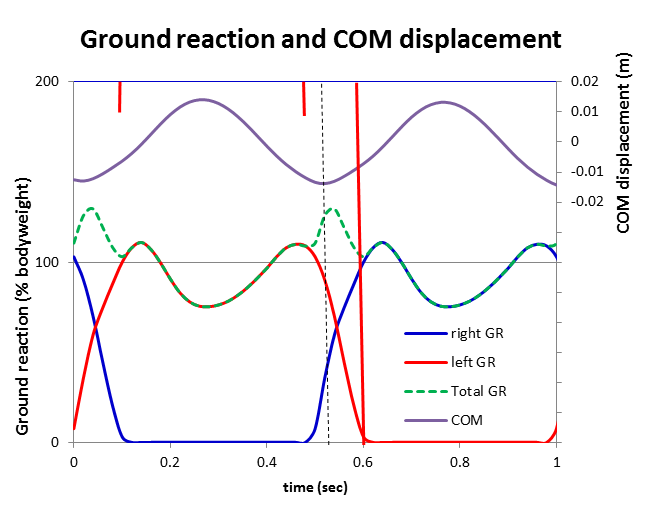
I’ve plotted some idealised data below to illustrate what is actually happening. The ground reaction under the left limb is represented in red and that under the right limb in right. One thing we  should do more often is to plot the sum of these which of course is the total force acting on the body (Chris Kirtley does do this in his book, 2006). The first interesting thing to note is that the peak total ground reaction actually occurs just before the middle of double support where two relatively modest forces from the different limbs superimpose.

GR and COM

I’ve also plotted the trajectory of the centre of mass (calculated from a double integration of the total ground reaction). It is at its highest in middle single support and lowest in early double support. The dotted black line shows its minimum value. Before this point the COM is travelling downwards and being decelerated and afterwards it is travelling upwards and being accelerated. Thus the first bump of the ground reaction is acting to accelerate the body upwards and the second bump is acting to decelerate as it falls from its peak height during middle single support. This is the opposite to “what the text books say”.

Or are we being unfair to the text books? I’ve gone back to see.

Whittle (2012) and Kaufman and Davis (writing in Rose and Gamble, 2006) get the explanation spot on.

Gage(2009, p54), on the other hand, states that the “body has been accelerating by gravity as it fell from its zenith at mid-stance to its nadir at loading response. As  a result the total force on the limb as it impacts the floor is about 120% of body weight“. This is a bit vague but essentially wrong. The body has actually been decelerating for half of its fall from zenith to nadir such that the vertical component of its speed is virtually zero at foot contact. The first peak of the ground reaction occurs well after the limb impacts the floor and is a result of the centre of mass being accelerated upwards.

Perry (2010, p459) writes that “the first peak (F1) … is increased above bodyweight by the acceleration of the rapid drop of the body mass”. This is also wrong-  the deceleration of the body mass is almost complete by initial contact and has occurred as a consequence of the GR under the trailing limb. The description of the second peak is even more confused – “the second peak (F3) … is modified by the push of the ankle plantar flexor muscles against the floor in addition to the downward acceleration of the COG as the bodyweight falls forwards over the forefoot rocker“.

So there we have it on a random sample of four books that happen to be on my shelf this afternoon two have the explanation correct and two have it essentially wrong.

There is some additional confusion because the fore-aft component of the ground reaction actually has the opposite effect.  In the first half of stance the GR is acting to decelerate the body in a horizontal direction (at the same time as accelerating it in an upwards direction). In the second half of stance the opposite is occurring as the GR is accelerating the body forwards (at the same time as it is decelerating it as it falls vertically).

.

Kirtley, C. (2006). Clinical gait analysis (1st ed.). Edinburgh: Elsevier

Levine, D., Richards, J., & Whittle, M. W. (2012). Whittle’s Gait Analysis (5th ed.): Churchill Livingstone.

Rose, J., & Gamble, J. (Eds.). (2006). Human Walking (3rd ed.). Philadelphia: Lippincott Williams and Wilkins.

Perry, J., & Burnfield, J. M. (2010). Gait analysis: normal and pathological function (2nd ed.). Pomona, California: Slack.

Gage, J. R., Schwartz, M. H., Koop, S. E., & Novacheck, T. F. (2009). The identification and treatment of gait problems in cerebral palsy (1st ed.). London: Mac Keith Press.