What do we mean by clinical gait analysis? Most of you reading this blog will assume it requires a kinematic measurement system, a couple of force plates and possibly an EMG system. For the vast majority of clinicians across the world, however, it means looking at how their patients walk without even the benefit of a video camera. In my book I suggest that what we call clinical gait analysis should really be called instrumented clinical gait analysis. I then pointed out that this is rather cumbersome and that I’d use the term clinical gait analysis anyway!
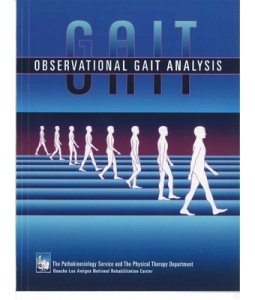
The team at Rancho Los Amigos used the term Observational Gait Analysis as long ago 1989 when they published their Handbook. The photo below is the cover of the 4th edition from 2001. The most recent edition is an app for the iPhone which you can get download from iTunes (doesn’t seem to be any Android equivalent yet unfortunately). Brigitte Toro picked up on observational gait analysis (OGA) and introduced video-based observational gait analysis (VOGA) in a review article a few years ago now (2003). If we used these terms carefully there would be clear ground between them and clinical gait analysis which could be reserved for the instrumented approach.
I was, however, interested by the comments of Professor Phil Rowe from Strathclyde University speaking at one of the satellite events orbiting ESMAC in Glasgow this year and focussing on the word analysis. His point was that analysis is a process of thinking which requires some data. It is thus not possible to perform a clinical gait analysis without some sort of instrumentation to provide those data. On this basis it would be inappropriate to refer to clinical observation of walking (either direct or through video recordings) as analysis. Perhaps clinical or observational gait assessment are more appropriate terms (although we then end up with the same acronym, CGA). The surgeons in Melbourne also used to talk about gait by observation which seems another sensible alternative. As an engineer I quite like Phil’s line of reasoning and think a distinction between a true analysis of data and an observation of patterns is useful.
But maybe things aren’t so clear cut. Wikipedia defines analysis as the process of breaking down a complex topic into smaller parts to gain a better understanding of it. This definition doesn’t actually require any data. It’s also true that whenever I’ve heard observational gait assessment being taught the focus has been on breaking down the overall gait pattern into smaller parts, either by plane or level, or both, to aid understanding. Maybe I’m being over-protective in trying to restrict the term analysis to instrumented processes. Any comments?
.
Toro, B., Nester, C., & Farren, P. (2003). A review of observational gait assessment in clinical practice. Physiotherapy Theory and Practice, 19(3), 137-149.
 Walking with Richard
A running gait analysis examines how your body moves during running and can help identify potential issues related to pain or injury. It assesses how your body handles training load—combining factors like run volume, intensity, and life stress—and whether it exceeds your body’s capacity, which can lead to injury.
A perfect running gait doesn’t exist, as every runner has unique biomechanics influenced by genetics and personal habits. Even elite runners display various gait patterns, proving that bodies adapt to individual needs. Attempting to drastically change a natural gait can sometimes do more harm than good.
The technology used in gait analysis ranges from wearables to video analysis, but the essentials—foot strike, cadence, sound, and swing phases—can often be observed without expensive tech. A skilled professional can use this information to develop a personalized strength training plan that improves performance and reduces injury risk.
Ultimately, a gait analysis is most beneficial if tailored to your specific needs, especially if you’re dealing with pain or looking to fine-tune your running form. It’s not necessary for everyone, but can be a helpful tool for staying healthy and improving your running mechanics.