biomechanics

Swing low

Whenever I give my “Why we walk the way we do” lecture as I did again last week at our gait course (click here to read some of the delegates comments from the Course Evaluation Forms) it makes me think in more detail of some of the biomechanics. This time it made me think more about the swing phase pendulum. In a sense this mechanism is too obvious and we perhaps don’t think enough about it.

There is a historical perspective. The Weber brothers, writing in 1836, assumed a simple pendulum action and came up with a lot of calculations based on elementary physics to support their assumption. Shortly afterwards, however, Guillame Duchenne, noted that he had several patients with isolated flaccid paralysis of the hip flexors who had to walk with circumduction to clear their limb. This suggested an active rather than passive mechanism. It was this question that drove the amazing work of Braune and Fischer in the late 19th century. They confirmed Duchenne’s clinical observation that initiation of swing is an active process.
moments hip

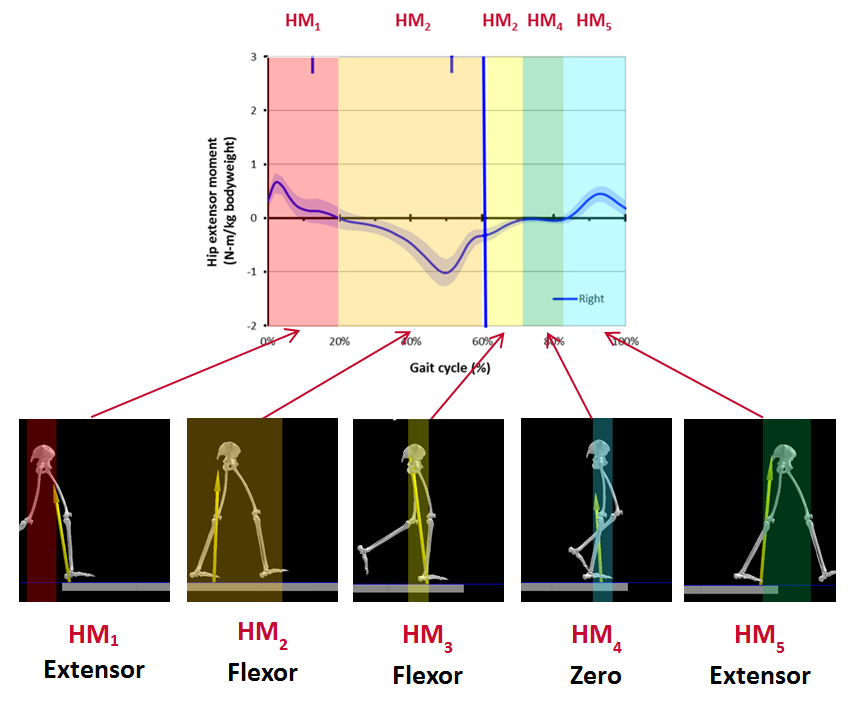
In my lecture I gloss over this a bit leaving the assumption that the pendulum motion during swing is an energy conserving process. It struck me this year that an indication of whether this is the case is to look at the hip moment.  A good definition of a simple, energy conserving pendulum is one in which no moment is exerted at the pivot (hip). Looking at the hip moment  (above, taken from the notes I prepared for the course) it appears to have three phases in swing. In early swing a marked hip flexor moment is exerted accelerating the limb, through middle swing the moment is essentially zero (we do have a simple pendulum movement) and in late swing the hip extensors are active to decelerate the limb.

In a paper that I’ve only just discovered, Holt et al. (1990) do some calculations to estimate natural frequency of the lower extremity and suggest that the actually frequency of swing is about 40% higher. Doke et al. (2005) confirmed this and also showed that if someone just stands and swings their leg then energy consumption is indeed very low at this frequency and considerably higher at frequencies more normally associated with those of self-selected walking speeds.

I also seem to remember that when I’ve seen scaled up passive dynamic walking machines (which genuinely do use minimal energy through using a free pendulum mechanism, see video above) they walk much slower than we do. Given the rigour with which these guys normally do their work I suspect that they’ll have some theoretical calculations that suggest that walking could be even more efficient if we walked closer to this resonant frequency. I think the Dynamic Walking group are meeting in Zurich this week, it would be interesting to see if any of them could comment.

We thus reach the same conclusion as Braune and Fischer, that this is a forced pendulum, i.e. that it is being forced to swing considerably faster than its natural frequency. This takes energy and thus the simplistic assumption that having something that looks like a pendulum gives us movement for free is seen to be misleading. It could but it doesn’t.

It reminds us that whilst minimising energy cost is an important factor in determining how we walk it is not the only factor. Using the language of Jim Gage (2009) there are a number of attributes of walking. Energy efficiency is one of these but the dynamics of the double pendulum are also critical to at least two others, clearance in swing and appropriate step length. To understand walking we need to understand the inter-relationships between all these attributes rather than focussing on just one. Maybe one day I will!

.

PS It is also worth noting that it is only a simple or compound pendulum that has a natural frequency. A double pendulum, which is a better model of the swing limb, does not generally have a cyclic motion and has a period that varies somewhat from cycle to cycle. The inverted pendulum is the mechanism by which the mass of the whole body is moved forward  and is thus probably more important for the energetics of walking. It does not have a natural frequency at all.

.

Doke, J., Donelan, J. M., & Kuo, A. D. (2005). Mechanics and energetics of swinging the human leg. Journal of Experimental Biology, 208, 439-445.

Gage, J. R., Schwartz, M. H., Koop, S. E., & Novacheck, T. F. (2009). The identification and treatment of gait problems in cerebral palsy. London: Mac Keith Press.

Holt KG, Hamill J and Andres RO (1990). The forced harmonic oscillator as a model of human locomotion. Human Movement Science 9:55-58
Plotting to convince

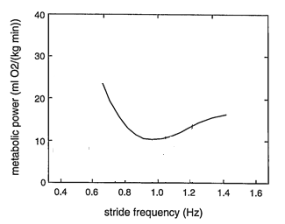
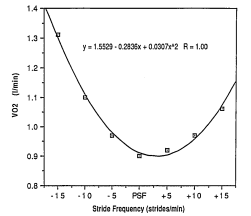
This post has been prompted by Mike’s comment on my last post. He pointed out two papers (Holt et al. 1991 and Minetti et al. 1995)  that have investigated the relationship between stride frequency and oxygen rate (per time) when walking at constant speed on a treadmill. The papers come up with the two graphs which I’ve included below (Holt et al. on the left, Minetti et al. on the right).

Minetti Holt

In many ways I’m more interested in how the data is plotted than by what the results actually are.

Both show a u-shaped realtionship but that on the left gives the impression of a rather broad curve with a poorly defined minimum whereas that on the right tends to suggest a much deeper curve with a well defined minimum. The graphs look very different to me to the extent that I might even interpret the data differently. I might interpret the left hand graph as suggesting that you can vary your stride frequency between about 0.9 and say 1.1 Hz without making much difference to oxygen rate. The message I might take out of the right hand graph is that oxygen rate is highly dependent on frequency with a clear minimum at a little under PSF+5.

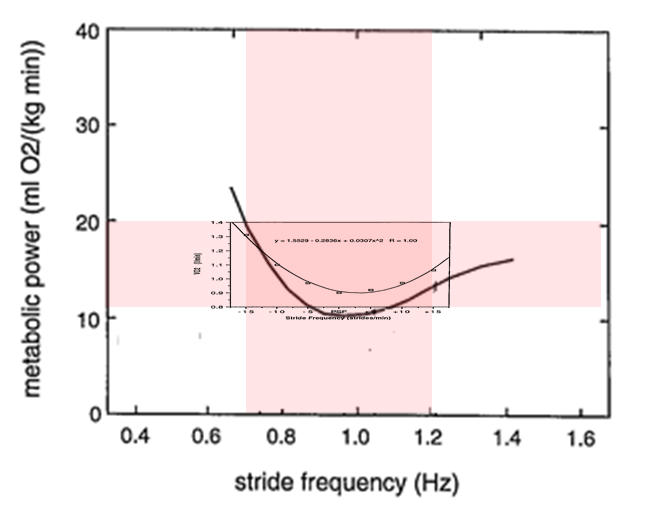
But then I realise that the axes are quite different. From the Holt paper we find that PSF is 57 strides per minute (0.94 Hz) so the range from PSF -15 to PSF+15 is from 0.7 and 1.2 Hz and we also find that the average weight was  70 kg so the range of VO2 (0.8-1.4 l/min) corresponds to about 11.5 – 20 ml/min/kg. We can use this information ot overplot the graph of Holt et al. onto that of Minetti et al.:

Minetti holt

The data shows reasonable agreement given that the studies are not identical (and we have no way of knowing if the walking speeds were similar as this is not even recorded by Holt et al). What interests me is that conclusions are reversed. The data from Holt et al which appeared to show such a well defined minimum is even more broadly distributed than that from Minetti et al.

Conclusion one is that whilst there is a minimum in energy rate at about the preferred cadence this minimum is quite broad and with little change over quite a range of values either side of the minimum. Conclusion two is that choices in how you plot results can have quite a pronounced effect on how they are interpretted.

.

PS. For those of you who didn’t follow the comments yesterday this analysis is of oxygen rate with cadence at fixed speed is related to but different from the question of whether oxygen cost has a minimum value at self-selected walking speed which was the main focus of yesterday’s post.

.

Holt, K. G., Hamill, J., & Andres, R. O. (1991). Predicting the minimal energy costs of human walking. Med Sci Sports Exerc, 23(4), 491-498.

Minetti, A. E., Capelli, C., Zamparo, P., di Prampero, P. E., & Saibene, F. (1995). Effects of stride frequency on mechanical power and energy expenditure of walking. Med Sci Sports Exerc, 27(8), 1194-1202.

Walking in the groove

While I surfing the web doing a bit of background reading for last week’s post I came across this graph.

Ralston HJ (1958) Energy-speed relation and optimal speed during level walking. Int Z angew. Physiol. einschl. Arbeitsphysiol. 17 (8): 273-288.

Ralston HJ (1958) Energy-speed relation and optimal speed during level walking. Int Z angew. Physiol. einschl. Arbeitsphysiol. 17 (8): 273-288.

It’s another of the classic outputs of Verne Inman’s group, from Henry Ralston, and shows data for a healthy subject to support his hypothesis that we select our walking speed to minimise the energy cost of walking (the energy used to travel a certain distance). The hypothesis is so plausible that it has been almost universally accepted.

What interests me is that despite being so widely accepted I’ve never seen any suggestion of the mechanism through which we might achieve this. It’s a fairly basic principle of control theory that if we want to minimise any particular variable (such as distance walked for a given amount of energy) we need some way of measuring it. Thus it is very difficult to drive a car fuel efficiently if you just have a speedometer and a standard fuel gauge. If you add a readout to the dashboard telling you how much fuel you are using per kilometre travelled and the task becomes trivial. They should be compulsory in a fuel challenged world!

I’m not aware of any proprioceptive mechanism that would allow the brain to “know” how much energy it is using per unit distance walked. I can see that there are complex mechanisms regulating cardiac and pulmonary rate based primarily on carbon dioxide concentration in the blood which might allow us to sense how much energy we are using per unit time, but how can we possible sense how much energy we are using per unit distance. I’m not saying it’s impossible – the brain is a marvellous organ and it is possible that it integrates such a measure of energy rate (per unit time) with information about cadence and proprioception of joint angle and in order to derive a measure of energy cost (per unit distance). This is a complex mechanism however and certainly suggests that, as with so much in biology, whilst the basic hypothesis is extremely simple the mechanisms required to achieve this is far more complex than we might have imagined. As Ralston himself put it, “one of the most interesting problems in physiology is to elucidate the built in mechanism by which a person tends to adopt an optimum walking velocity such that energy expenditure per unit distance is a minimum”.

But this also makes me want to question the underlying hypothesis. Going back to the original paper (which you can read here), Ralston only produces data from one healthy subject and one amputee to support his hypothesis. I’m not aware of many others having explored the hypothesis on an individual level (the conclusion that the self-selected walking speed is close to speed of minimum energy cost for a sample does not mean that the relationship holds for individuals within that sample). I’d be interested to hear from readers of papers that have investigated this relationship in more detail.

The other point that Ralston made which is almost always overlooked is that the curve is “almost flat”. The curve only looks so steep because it has been plotted over such a wide range of values (from 0 through to 150m/s). Just looking at the data plotted I’d suggest that the speed can range from about  56 to 84 m/min whilst the energy cost remains within 5% of the minimum energy cost value. This is almost certainly within the range of measurement error for a variable such as energy cost. In other words the really remarkable thing about the energy curve is that it allows us to walk over quite a range of speeds without having a measureable effect on our energy cost. It is interesting that Ralston managed to make this point and suggest that we select walking speed to minimise energy cost in the same paper!

An ideal treadmill?

We’ve recently been measuring the oxygen cost of walking in a group of amputees. The measurements we’ve made seem too good to be true. When we compare our results with those in the literature our amputees appear to be using considerably less oxygen to walk for a given distance. The differences are so substantial that I’ve asked our research fellow to look for possible explanations and one of the differences with those other studies is that we are making measurements with people walking overground whereas all the other studies have examined treadmill walking. This raises the old chestnut as to whether treadmill and overground walking can be considered equivalent or not.

In a sense the answer to this question has been known since 1632. In his Dialogue Concerning the Two Chief World Systems, Galileo Galilei proposed the hypothesis that has since become known as the principle of Galilean relativity that:

any two observers moving at constant speed and direction with respect to one another will obtain the same results for all mechanical experiments

He illustrated this with a thought experiment based on a ship, in the modern world I think the example of a railway carriage is more appropriate. The hypothesis states that if you are in a sealed railway carriage then there is no physical experiment you can perform that will allow you to know whether you are stationary or travelling at constant speed (or the speed at which you are travelling). If, for example, you drop a weight, it will always fall vertically (as you observe it). Galileo stated this as a hypothesis, Newton went a little further and stated it as a principle, Einstein went even further and used this thought experiment for his theory of general relativity. Many experimentalists over the years have sought to disprove it, all have failed (except for those conducting experiments at near the speed of light).

Given that the body acts as a physical system (at least as far as the biomechanics of walking is concerned) we can use this principal to explore treadmill walking. Consider walking up and down that sealed railway carriage. There is no way you can know what speed the train is travelling from how it feels to walk. If you put an oxygen mask on and always walk at the same speed within the carriage you will always make the same measurement (or would if Oxygen consumption measurements were at all reliable!). Now assume that the train is travelling backwards at a speed that is identical to that at which you are walking forwards. Again we can argue that you will be consuming exactly the same amount of oxygen as you would if the train were stationary. From the perspective of someone watching from outside the train however you are walking on the spot. This is effectively a treadmill, a highly impractical treadmill, but a treadmill none the less. Under these circumstances it is clear that the oxygen consumption (or any other biomechanical variable) will be the same as for ordinary overground walking. I’ll refer to this as the ideal treadmill and reiterate that we can use one of the most widely accepted principles in the whole of physics to state quite categorically that walking on an ideal treadmill is biomechanically identical to walking overground.

I don’t go to the gym, I much prefer to run through the Cheshire countryside close to my home if I want some exercise, but those who do tell me that running on a treadmill is quite different to running overground. I think most people feel it is harder to run on a treadmill). Is this proof that Gailieo, Newton and Einstein and every other physicist who has ever tested this hypothesis are wrong – of course not. What it shows is that the treadmills are not ideal as I’ve defined it above. The important feature is that the belt does not continue to move at constant speed. When you land on the belt you exert a forwards direct force on the treadmill that tends to slow the belt down and when you push off you exert a force in the other direction that tends to speed the belt up. You are running on a non-ideal treadmill.

This has important implications for research because how much the belt varies in speed as you run on it will depend on all sorts of characteristics of the treadmill – whether the belt itself can stretch, the characteristics of the motor, whether there is any control system to help regulate speed. We can’t just assume that all treadmills are the same from a biomechanical point of view. Some I would guess, may be quite close to ideal, some, it is obvious, are very far from ideal. Many researchers have published papers comparing treadmill with overground walking but I don’t know of any of them that make the specific point that the results are valid only for the treadmill that they have chosen to perform the experiments on and should not be applied to treadmills in general. Following on from this we should not compare results from different papers on treadmill walking unless we have good reason to believe that the treadmills are equivalent.

One way of protecting against this might be to use comparative measures. We could, for example, report energy cost for amputees as a percentage of that for able-bodied controls walking on the same treadmill. This relative measure may be less dependent on the type of treadmill than the absolute measures. We’ve measured such controls in overground walking and can identify one study from another centre with equivalent data for treadmill based walking. Interestingly the differences are almost as large in the relative measures as in the absolute measures. There could be many reasons for this but one might be that the amputees and able-bodied cohort respond differently to the non-ideal nature of the treadmill. Thus an able-bodied person with intact musculo-skeletal anatomy and full proprioception might be able to adapt more easily to non-ideal treadmill walking than an amputee. As with all other measures this difference may be specific to the particular treadmill and it is dangerous to assume that this as a result applicable to walking on treadmills in general.

In summary the laws of physics dictate that the biomechanics of walking on an ideal treadmill (on in which the belt speed is constant) are the same as the biomechanics of overground walking. Any differences in biomechanical measurements between overground and treadmill walking must thus represent deviations from ideal behaviour (I’m a biomechanist so I’ll completely ignore the possibility of any perceptual or other psychologicl effects of course!) and it is likely that these vary from treadmill to treadmill. It would be interesting to know if anyone has compared results from different treadmills to investigate how significant this effect is.

Shockingly wrong?

Hi, sorry I’ve been away for so long. How very Australian of me to take all of January off!

We’ve started a new semester on the MSc programme its called “Healthy walking” and for this two weeks the students are working through my video series “Why we walk the way we do“. I’ve also been preparing some study material to support this. In doing this I’ve become even more convinced than ever that the conventional understanding of first double support as a phase of shock absorption is wrong.

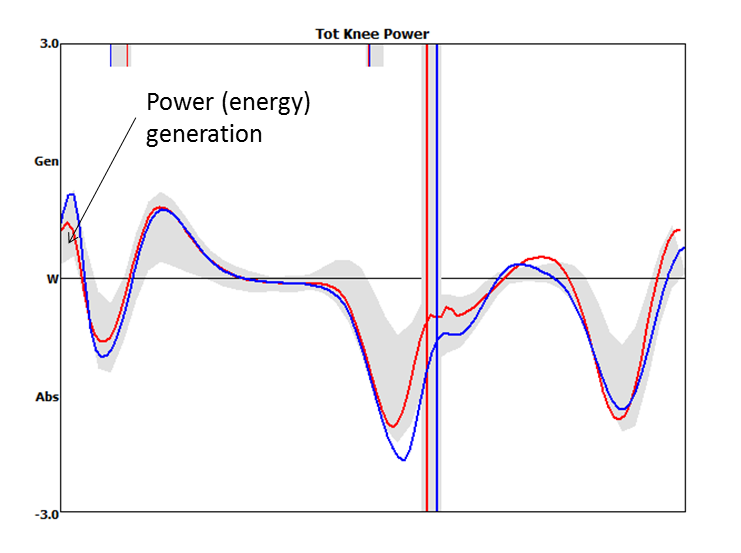
Of course one of the old chestnuts that follow from that theory is that stance phase knee flexion is a mechanism to absorb the shock of impact. I’ve been thinking about this for sometime but it wasn’t until I was preparing this material last week that it struck me that it would be useful to look at the knee power graph. Why? – because if there is one thing that shock absorbers do it is absorb energy. You can make an argument that this is all they do. So if the knee is a shock absorber and we look at the knee power graph immediately after foot contact we should expect to see power absorption.Knee powerIf you look at the graph you’ll see quite the reverse. Immediately after foot contact the knee is generating power – this is not the action of a shock absorber.

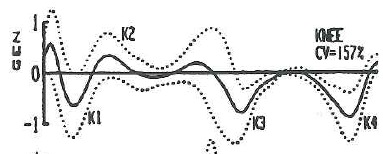
In case anyone thinks this is just my data we can go to David Winter’s book (1991, figure 4.34b):

Winter knee

This is interesting because the early power generation peak is definitely there but Winter seems to ignore it. He starts numbering at the power absorption peak in late double support that extends into early single support (K1). Its almost as if he can’t bring himself to admit that it’s there – perhaps he was a shock absorption theorist and this didn’t fit in with his world view?

Kirtley (2006) admits the peak is there and even labels it Ko. He claims however that it is an artefact of the filtering. This claim is unreferenced but I think refers to the work of Bisseling and Hof (2006) which was drawn into a discussion on K0 on the old CGA web-site. I’m not convinced. I don’t think anyone doubts that the ground reaction is anterior to the knee in the first half of double support and the knee is clearly flexing at this point. The inevitable consequence of the combination of these two observations is that power (moment . joint velocity) must be generated. The knee is not acting as a shock absorber.

Putting it another way the knee moment graph clearly shows that the knee flexors are the dominant muscle group at the knee for the first half of double support whereas the knee extensors would have to be dominant for knee flexion to have the capacity to absorb shock.

Of course from about half-way through double support power is absorbed at the knee but this is about 50msec after foot contact which is too long after contact for this to be a consequence of a mechanical “shock” at the time of contact.

On the balance of evidence I’m more and more convinced that stance phase knee flexion is not a shock absorbing mechanism. But if it’s not to absorb shock – what is it for?

.

Bisseling, R. W., & Hof, A. L. (2006). Handling of impact forces in inverse dynamics. J Biomech, 39(13), 2438-2444.

Kirtley, C. (2006). Clinical gait analysis (1st ed.). Edinburgh: Elsevier.

Winter, D. (1991). The biomechanics and motor control of human gait: Normal, Elderly and Pathological (2nd ed.). Waterloo:: Waterloo Biomechanics.

Winter, D. A. (1992). Foot trajectory in human gait: a precise and multifactorial motor control task. Phys Ther, 72(1), 45-53; discussion 54-46.