biomechanics

DoG III – a more clinical perspective

The arguments against the Determinants that I described in my last post are largely technical. It is interesting that the latest editions of three mainstream textbooks (Levine, Richards & Whittle, 2012, Kirtley, 2006  and Rose & Gamble, 2006) all print fairly damning critiques of the Determinants but choose to reproduce them anyway. Kirtley dedicates nearly four pages to describing them and then describes them in the last paragraph as “thoroughly discredited”.  Does this mean that despite the technical problems the Determinants are still useful in some way? Might they reveal some clinical truths? Let’s explore some more general issues.

One of the problems I see with the Determinants is that the basic “compass gait” (reciprocal flexion and extension of the hips) often gets overlooked. The original authors describe it quite superficially in a couple of sentences and then move on to much more extensive discussion of the Determinants. Levine, Richards and Whittle skim over it in even less detail and Kirtley doesn’t really describe it at all. The balance should really be the other way round. Reciprocal hip flexion and extension is the most fundamental characteristic (determinant?) of bipedal walking. To a large extent step length is determined by the range of motion you achieve at your hips (modified to a much lesser extent by any knee flexion at initial contact) and cadence by the rate at which you can move through this. The first thing anyone should be doing when assessing someone’s gait is to consider how effectively they are implementing this basic mechanism. If you list the Determinants, however, hip flexion and extension never appear.

Another rather disconcerting issue is how the Determinants lead you to focus on rather small movements of the pelvis in the transverse and coronal planes when there are much more significant movements at the knee and ankle in the sagittal plane. Whilst pelvic movements play an important role in the fine tuning of gait, the major sagittal plane motors acting to control hip, knee and ankle are where the action is. The fine movements of the pelvis get two Determinants to themselves and are described in precise detail whereas the knee and ankle are rolled together in one muddled paragraph (in the original paper).  Any approach to walking that distracts the focus from the hip, knee and ankle is likely to be hindering rather than helping. To this day it amazes me that when I show a video of a person walking with a really bizarre walking pattern, many people start off describing the minor imperfections in the motion of the pelvis, often concentrating on the coronal plane, before moving on to much larger aberrations of hip, knee and ankle movement in the sagittal plane.

Then finally there is the reduction of walking to achieving a single objective (walking at minimum energy cost). As Perry  (1985) and Gage (1991)  have both pointed out in different ways there are multiple objectives in walking (see my screencasts on the subject for more details). We need to support body weight against gravity, achieve toe clearance and adequate step length and achieve a smooth transition from one stride to the next whilst preserving the momentum of the passenger unit.  In pathological walking the requirement to avoid pain or maintain an adequate walking speed given some specific impairment might be more important than minimising energy cost. All of these need to be considered if we want to understand walking.

I better stop before this turns into too much of a rant but (in my opinion) the answer to my original questions are, “No, the Determinants are not useful” and, “No, they are exceedingly unlikely to reveal any further clinical insights”.  The sooner someone comes up with an alternative the better. (I’ve had a go [series of seven screencasts]  but am the first to admit that my approach lacks the elegant simplicity of the determinants even if I’d defend it as more biomechanically rigorous and clinically relevant).

 .

Gage, J. (1991). Gait Analysis in Cerebral Palsy. Oxford: Mac Keith Press.

Kirtley, C. (2006). Clinical gait analysis (1st ed.). Edinburgh: Elsevier.

Levine, D., Richards, J., & Whittle, M. W. (2012). Whittle’s Gait Analysis (5th ed.): Churchill Livingstone.

Perry, J. (1985). Normal and pathological gait. In W. Bunch (Ed.), Atlas of orthotics (pp. 76-111). St Louis: CV Mosby.

Rose, J., & Gamble, J. (Eds.). (2006). Human Walking (3rd ed.). Philadelphia: Lippincott Williams and Wilkins.
DoG II – the evidence

This is a second post “celebrating” the 60th anniversary of the publication of the determinants of gait. I’d intended to start off with something positive in the first post, that the paper has been subjected to some misinterpretation, but Rodger Kram’s comment has made me reconsider that. Perhaps the notion that energy can be conserved by reducing the vertical excursion of the centre of mass is (CoM)  implicit in parts of the paper if never mentioned explicitly. This has even led me to speculate on how that might have arisen.

Anyway I’d tried to start with a positive because at some time we have to deal with the negatives. These are quite significant because there can be no real doubt that the determinants are wrong!

If we accept that a belief that minimising the vertical component of the centre of mass trajectory will reduce energy cost is implicit in the paper then the determinants are clearly wrong right from the start. There are multiple examples throughout dynamics of systems in which potential and kinetic energy are exchanged without requiring any external energy (the simple pendulum is the most obvious example). There is absolutely no reason why minimising CoM movement should necessarily reduce energy consumption. Even if CoM excursion did lead to increased energy expenditure we now know that most of the determinants don’t actually reduce it. Gard and Childress (1997) started off by showing that pelvic list occurs at the wrong time and a little time later (1999) that the same is true of stance phase knee flexion. A short time later Kerrigan et al. showed that pelvic rotation has little effect on CoM height either.

The stance phase determinants (pelvic list, stance phase knee flexion) become even more bewildering if the aim is to smooth the trajectory of the CoM, because the trajectory is smooth already. Compass gait results in the CoM moving along a circular arc and there can be few trajectories that are smoother than that!

The final nail in the coffin was delivered by both the Chicago (Gard and Childress, 2001) and Boston (Kerrigan et al. 2000) groups establishing that Saunders, Inman and Eberhart had missed the most important determinant of CoM movement  which is movement of the foot and ankle and particularly heel rise in late stance.

We thus have a triple whammy:

  • the axioms on which the determinants are inappropriate (either because the trajectory of the CoM in compass gait is already smooth or because there is no particular reason why reducing its vertical excursion should reduce energy cost)
  • three of the major determinants don’t alter gait in the way the authors claimed
  • the authors missed the most important determinant that does!

I’m not the first to outline this of course. Art Kuo made a similar summary in an article in 2007. The most bizarre commentary, however, is that of Childress and Gard published in the third edition of Human Walking (2006). There’s nothing bizarre about the commentary but there is about its location- immediately after a full reproduction of the chapter as published in previous editions. We thus have a “keynote” chapter in a major text-book followed by a two page summary of why the chapter is wrong. How weird is that?

.

Childress, D. S., & Gard, S. A. (2006). Commentary on the six determinants of gait. In J. Rose & J. G. Gamble (Eds.), Human Walking (pp. 19-21). Philadelphia: Lippincott Williams and Wilkins.
Gard, S., & Childress, D. (1997). The effect of pelvic list on the vertical displacement of the trunk during normal walking. Gait and Posture, 5, 233-238.

Gard, S., & Childress, D. (1999). The influence of stance-phase knee flexion on the vertical displacement of the trunk during normal walking. Archives of Physical Medicine and Rehabilitation, 80, 26-32.

Gard, S., & Childress, D. (2001). What determines the vertical displacement of the body during normal walking? Journal of Prosthetics and Orthotics, 13, 64-67.

Kerrigan, D. C., Della Croce, U., Marciello, M., & Riley, P. O. (2000). A refined view of the determinants of gait: significance of heel rise. Archives of Physical Medicine and Rehabilitation, 81(8), 1077-1080.

Kerrigan, D., Riley, P., Lelas, J., & Della Croce, U. (2001). Quantification of pelvic rotation as a determinant of gait. Archives of Physical Medicine and Rehabilitation, 82, 217-220.

Kuo, A. D. (2007). The six determinants of gait and the inverted pendulum analogy: A dynamic walking perspective. Hum Mov Sci, 26(4), 617-656.

Publishing one paper to point out faults in another

This post is prompted by a discussion we had internally about a paper co-authored by one of my colleagues at the University (Dall et al. 2013). This was written as a response to an earlier paper (Tudor-Locke et al. 2011) based on data from the National Health and Nutrition Examination Survey (NHANES) for 2005-6 showing how many steps people took in each minute epoch as measured by an activity monitor. They assumed this was a measure of cadence and came up with the conclusion that:

Self-selected walking at 100+ steps/min was a rare phenomenon in this large free-living sample of the U.S. population, but study participants did accumulate 30 min/day at cadences of 60+ steps/min.

This is simply wrong. Whether the number of steps taken during any minute represents cadence or not will depend on whether the patient has been walking for a full minute or not. Take a person who is recorded as taking ten steps in one minute. This could come from someone who has walking difficulties and walked continuously for a minute but took only ten steps at a true cadence of 10 steps per minute. In this case steps per minute epoch is equal to cadence. Equally it could come from someone who had no difficulty walking and who walked ten steps at a cadence of 120 steps per minute but only for five seconds (ten steps) within the minute. In this case, which will be far more common than the first, cadence and steps per minute epoch are quite different. Recordings of 100 steps per whole minute is not rare because people walk with slow cadence but because it is actually very rare that we walk continuously for a whole minute (Orendurff et al. 2008). If you want to define a threshold value for cadence as was the original intention of Tudor-Locke et al. then you actually have to find some way of recording true cadence and not the number of steps per whole minute.

I think the issues are clear cut so far but then what should our response be? Malcolm and his colleagues had access to data collected with their activPAL device that would allow both true cadence and total number of steps per minute (step accumulation as they call it) to be calculated and demonstrated convincingly, but rather unsurprisingly , that the two are quite different. The published paper (Dall et al. 2013) makes a very interesting read – but should we have to go to this effort? Are there more effective ways of just telling people they are wrong!

Writing a letter to a Journal’s editor is one option but it always feels to me as if there is a time window on this – that the letter should really be submitted fairly soon after an article has been published. I’m not very good at keeping up with the current literature but when I’m working on a particular topic I will often read the relevant articles, both recent and not so recent, quite critically. Working like this it is often some time after publication that I read things that concern me.  A combination of my own inertia and the feeling that I am too late prevent me from doing any more about it.

Maybe I’m wrong in this – maybe we should feel free to use this route at any time that a mistake becomes apparent. Certainly this route ensures that the corrective letter is recorded in the same journal and under the same title as the original article and modern databases are becoming better at flagging this. A disadvantage of the approach of Dall et al. is that the new article is in a different journal published under a completely different title. In this case it has been published in a more technical journal (Medicine and Science in Sports and Engineering) which is unlikely to be read (or even searched) by readers of the original article (in the journal Preventive Medicine).

This wouldn’t be a problem if this were an isolated incident but biomechanics is a complex subject and I suspect that there are many more published mistakes and misconceptions than anyone in the field would want to acknowledge. In the worst case (again more common than we’d want to admit) published mistakes and misconceptions are adopted uncritically by other teams and before you know it what started off as an erroneous paper becomes first a series of erroneous papers and then a tried and trusted method (I’d see the use of CMC  (Kadaba et al. 1989) as a useful measure of repeatability of gait data as an example. Buy my book and read the appendix if you want to know more!).

The situation is exacerbated by the number of people who are involved in biomechanics as a secondary discipline. Some readers (and occasionally authors!) are not in a position to judge whether a method is valid or not. Does this increase the onus on those of us within the community who are aware of problems with specific papers to be more proactive in drawing people’s attention to them?

.

Dall, P. M., McCrorie, P. R., Granat, M. H., & Stansfield, B. W. (2013). Step Accumulation per Minute Epoch Is Not the Same as Cadence for Free-Living Adults. Med Sci Sports Exerc.

Kadaba, M. P., Ramakrishnan, H. K., Wootten, M. E., Gainey, J., Gorton, G., & Cochran, G. V. (1989). Repeatability of kinematic, kinetic, and electromyographic data in normal adult gait. J Orthop Res, 7(6), 849-860.

Orendurff, M. S., Schoen, J. A., Bernatz, G. C., Segal, A. D., & Klute, G. K. (2008). How humans walk: bout duration, steps per bout, and rest duration. J Rehabil Res Dev, 45(7), 1077-1089.

Tudor-Locke C, Camhi SM, Leonardi C, Johnson WD, Katzmarzyk PT, Earnest CP, Church TS. Patterns of adult stepping cadence in the 2005-2006 NHANES. Prev Med 2011;53:178-81.

The last post – on the inverted pendulum

I think this will be my last post focussing on the inverted pendulum. In the first I gave a brief overview and in the second I looked at the vertical component of the ground reaction. The anterior component is also very interesting (well at least I think so).

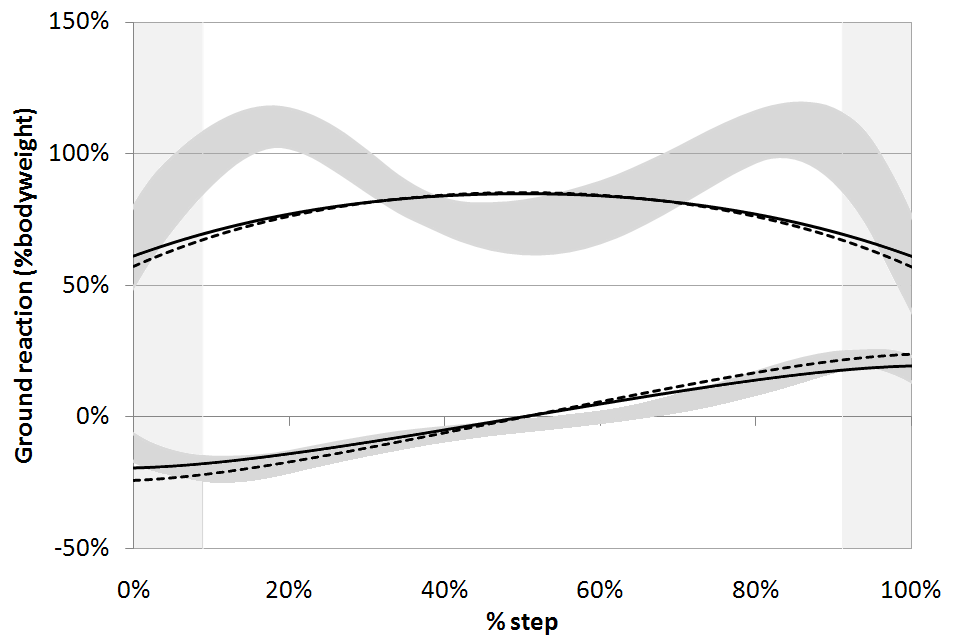
You’ll remember that the inverted pendulum is a mechanism that allows a mass (body) that has some initial kinetic energy to move in a circular arc over the pivot  (foot). Early on the centre of mass is rising, gaining potential energy and thus, in a conservative system, must be slowing down. If it is decelerating in the horizontal direction then a force must be acting in the horizontal direction to cause this. The only force acting on the mechanism in this direction is the ground reaction so it must be directed posteriorly. As the mass approaches its high point it gains height, and thus loses speed, more slowly so this force must reduce and will be zero when the mass is at its high point. After this it starts to descend, loses potential energy and must speed up. If the mass is accelerating in the horizontal direction then a force must be causing this. During this phase the horizontal component of the ground reaction must be anterior. In qualitative terms, therefore, the horizontal component of the ground reaction under a passive inverted pendulum is predicted to be the same as that under the foot during walking.

Inverted pendulum

Curve in top half is vertical component and lower down is the horizontal components

The graph above shows the results of a quantitative analysis using sensible figures for mass (the dashed line shows the effect of a including a non-zero moment of inertia), leg length and initial velocity. I’ve only plotted this from middle of first double support to the middle of second double support as this is the period of the gait cycle that the inverted pendulum models.

Although (as commented on in the previous post) the vertical component of the ground reaction is quite different from the predictions of the inverted pendulum the horizontal component is nearly identical. We thus reach the conclusion that a completely passive mechanism (a stick with a weight on one end) generates almost exactly the same horizontal forces as we do when we are walking.

This is quite interesting in the context of the argument about whether the foot is “lifted off” or “pushed off” in second double support. On the basis of the horizontal component of the ground reaction it is clearly pushed off, but only to the extent that it would be if the leg was a completely passive mechanism.

It’s also interesting to think about this in the context of induced acceleration analysis. Because the underlying skeleton is unstable any induced acceleration analysis (e.g. Liu et al., 2006) will attribute the majority of the ground reaction to muscle forces. Interpreting what each muscle is doing and what clinical implications this has is quite complex. Thinking about the kinetics of the inverted pendulum, however, leads to the conclusion that the muscles are acting primarily to maintain the length of the limb and enable it to perform as an inverted pendulum would. It may be that this understanding leads to clearer clinical interpretation.

It certainly helps with the interpretation of the rather counter –intuitive finding of Liu et al. that the gluteus medius contributes to forward progression. In order for the body to move as an inverted pendulum it is important that trunk is not allowed to fall in relation to the hip and it is the gluteus medius that contributes that stability. The gluteus medius thus contributes to forwards progression by maintaining stability and allowing the passive dynamics of the inverted pendulum to do its business.

At the ankle and knee during late single support and second double support there is the added complexity of preserving the integrity of the inverted pendulum at the same time as allowing knee flexion to start in preparation for swing. Flexing of the knee alone would allow partial collapse of the pendulum but plantarflexing the ankle (reducing dorsiflexion) at the same time allows the overall length of the limb to be maintained. It is the plantarflexors that are required for this and, as might be expected, the induced acceleration shows these muscles as the primary contributors to the anterior component of the ground reaction through this period.

.

Liu, M. Q., Anderson, F. C., Pandy, M. G., & Delp, S. L. (2006). Muscles that support the body also modulate forward progression during walking. J Biomech, 39(14), 2623-2630.

Kinetics of the inverted pendulum

One of my first posts was about the inverted pendulum and in it I promised a follow-up that I never delivered. So here it is. I commented that for all there is a lot of talk about the inverted pendulum there is little understanding of what it is and what it’s characteristics are. I’ll focus on the kinetics today.

The graph below shows the vertical component of the ground reaction under an inverted pendulum (Anderson and Pandy, 2006). You can work out the shape the curve must have from basic physics. Early on the pendulum is rising as it moves towards the vertical. As it is does so it gains potential energy and must be losing kinetic energy. Its upward velocity is thus reducing so it has a downward acceleration (i.e. an upward deceleration). If the overall force is acting downwards then the ground reaction (up) must be less than bodyweight (down). As the pendulum moves towards its highest point along a circular arc it rises less slowly, decelerates less, so the ground reaction must get closer to bodyweight.

inv pen GRF

Once it is over the highest point it starts to lose height, and accelerate downwards. Again this requires a downwards force so again the ground reaction (up) must be less than bodyweight (down). The further the mass goes around the circular arc the more quickly it loses height, the more it accelerates, so the ground reaction must be a decreasing fraction of the ground reaction. Easy eh! Appliance of science and we can predict the curve above.

The interesting thing here is that the vertical component of the ground reaction under an inverted pendulum is always less than its own weight. The inverted pendulum may be an excellent mechanism for carrying a mass from one point to another but its a pretty hopeless one for supporting that mass. On reflection this should be obvious because the vertical component of velocity is upwards at the start and downwards at the end and thus the nett acceleration during the movement is downwards and the average force must be less than bodyweight.

If the average force is less than bodyweight then you can’t possibly have a viable walking pattern simply by stringing a series of inverted pendulums together no matter how good the drawings of the kinematics look.

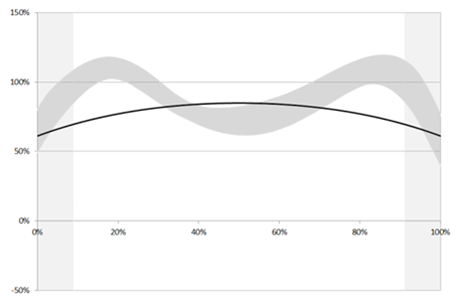
There are two mechanisms by which we get over this. The first is that we use our muscles so that the the ground reaction does not just mimic the mechanics of a passive inverted pendulum. In the figure below the ground reaction is under an inverted pendulum (solid line) is plotted against Winter’s data (1991)  for the vertical component of the ground reaction (grey band) from the middle of one double support phase to the next. The characteristics double bumps of the ground reaction clearly increase the average vertical force (all forces are plotted as % bodyweight).

GRF

This isn’t the whole story however. If you look more critically at this data you will see that the average vertical component of the ground reaction under the body is still considerably less than bodyweight (about 10% less) for most of us. The peaks aren’t much higher than bodyweight and they don’t last that long. How can we walk around and not support out own bodyweight?

The answer lies in two words, “double support”. During double support the forces  under both limbs combine to exceed bodyweight. The largest total vertical component of the ground reaction is actually in mid double support when relatively modest looking ground reactions under both limbs combine (you can see a graph of this in an earlier blog). By allowing the two ground reactions to combine like this we are able to rely on an inverted pendulum like movement to move the body forwards whilst achieving an average total ground reaction equal to bodyweight – a fundamental pre-requisite of cyclic walking.

A double support phase is thus an essential requirement of a gait pattern based on an inverted pendulum. It’s interesting that modelling the body as a simple inverted pendulum leads to a prediction that double support needs to last for 15% of the gait cycle. The actual value is, of course, 10%. That’s not a bad guess for such a simple model.

I put these ideas in a slightly wider context in one of the screencasts in the series “Why we walk the way we do. The whole series is linked to on my Videos page.

.

Anderson, F. C., & Pandy, M. G. (2003). Individual muscle contributions to support in normal walking. Gait Posture, 17(2), 159-169.

Buczek, F. L., Cooney, K. M., Walker, M. R., Rainbow, M. J., Concha, M. C., & Sanders, J. O. (2006). Performance of an inverted pendulum model directly applied to normal human gait. Clin Biomech (Bristol, Avon), 21(3), 288-296.

Winter, D. (1991). The biomechanics and motor control of human gait: Normal, Elderly and Pathological (2nd ed.). Waterloo:: Waterloo Biomechanics.