gait analysis

Normalising kinetics

There were a few things that struck me as odd when I was writing my book. Things that we’ve always done in a particular way in clinical gait analysis but which just don’t make sense. One of these is the way we typically “normalise” kinetic data by dividing through by mass only. Moments are a product of force and length and are thus likely to be influenced both by a person’s weight and their size. It just doesn’t make sense to normalise data by dividing through by weight only. There are similar, but slightly more complex, issues with joint power. Differences in adult height between individuals, expressed as a percentage, tend to be reasonably small (SD < 10%) even disregarding gender, so the effects of not normalising to height in adults are unlikely to be that important. Clinical gait analysis, however, has always had a considerable focus on children where differences in height are much larger. It just seems so obvious that we should normalise to height as well as weight. In my book I see that I actually commented, “Quite why this is not standard practice in gait analysis is unclear.”

A simple explanation may be that no-one has ever tested this assumption. So one of my colleagues (Ornella Pinzone) has performed a comparison of conventional normalisation (dividing moments and powers by mass only) and non-dimensional normalisation (dividing moments by mass and leg length and powers using a slightly more complex formula). We based it on data made available by Mike Schwartz from Gillette as their data are so well formatted for a study like this. The paper has just been published in Gait and Posture and if you use this link before 29th January then you should be able to view and download a copy of the article for free.

Pinzone

Coefficients of determination for relationship between a range of temporal, spatial and kinetic parameters and age amongst children across an age range from 4 to 18 years. Dashed line shows threshold for statistical significance at p<0.05.

The results are quite conclusive. About 80% of the associations between the conventionally normalised parameters and age, height and weight, were statistically significant (p<0.05) and for all of those parameters where the association was significant it was substantially reduced by non-dimensional normalisation (only just over 20% were statistically significant and most only marginally exceeded the p<0.05 threshold). The results have dispelled any lingering doubts in my mind as to the superiority of non-dimensional normalisation and when we next revise our normative dataset we’ll be using this as standard.

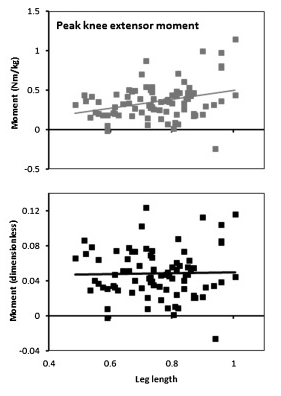
This isn’t quite the whole story, however, because even when you remove the systematic effects of height and weight (this is the primary purpose of normalisation) there is still a lot of scatter in the data. The figure below shows the relationship of peak knee extensor moment with leg length for conventional (top) and non-dimensional (bottom) normalisation. The slope on the line of regression is reduced to almost zero with non-dimensional normalisation but there is minimal effect on the scatter of data points about this line.
Pinzone2

Peak knee extensor moment plotted against leg length for conventional (top) and non-dimensional (bottom) normalisation.

It is difficult to compare this variability with that present in kinematic data because the nature of the data is so different but the impression I get is that the variability in the kinetic data is even greater than that in the kinematic data. I’ve commented in two earlier posts (here and here) that I think the assumption that we all walk similarly, an assumption on which all clinical gait analysis is based, needs to be re-examined. The most obvious conclusion from this dataset is that many of us, even in the absence of pathology, walk very differently.

What is the opposite of compensatory?

I’ve recently been preparing some teaching material for a one day course on observational gait analysis which we are running this Friday. I got to the part where I normally introduce the concept of primary, secondary and tertiary abnormalities of gait. As outlined by Jim Gage (The Identification and Treatment of Gait Problems in Cerebral Palsy, 2009),   primary effects are those regarded as a the direct effects of the original brain injury. He gives loss of selective motor control, balance impairments and abnormal muscle tone as example. Secondary effects are those that are not part of the original brain injury but develop as a consequence of it. Bony torsional malalignment and muscular contractures might be seen as examples. Finally tertiary effects are those resulting from an individual’s efforts to compensate for the consequences of the injury. Vaulting, circumduction and hyperflexion of the hip are all cited as examples of compensations for a foot drop which may be a consequence of weakness of the dorsiflexors or tightness in the plantarflexors.

Although the term effects is used when first introducing these concepts the subsequent sections are headed primary gait abnormalities and secondary gait abnormalities. The terms effects and abnormalities appear to be used interchangeably in this context.

I was struggling to incorporate this into the approach that I’ve called impairment focussed interpretation. This assumes that the aim of clinical gait analysis is to identify the impairments that are most likely to be affecting the patient’s ability to walk by linking them to observed features in the gait data. This follows the WHO definition of an impairment as “a problem in body structures or functions such as significant deviation or loss” (WHO, International classification of functioning, disability and health. 2001) and my own definition of a feature as something of clinical relevance that you can see on a gait graph (or on a video).

How I wondered do my impairments and features relate to Gage’s primary, secondary and tertiary effects or abnormalities?

I’ve come to the conclusion that Gage’s primary and secondary effects are generally impairments (as the WHO has defined them). They are things that are wrong with the underlying body structures and functions and are not necessarily related to gait. His tertiary effects, by contrast, are generally features.  They are changes to the way a person walks.

It also occurs to me that the primary, secondary, tertiary terminology implies a progression from one to the next in sequence. It doesn’t take too long, however, to realise that some tertiary compensations are a direct result of a primary impairment without the requirement for a secondary intermediary.  Thus vaulting might be a direct consequence of plantarflexor spasticity, a primary impairment.

To tidy things up therefore it makes sense to me to preserve the terms primary and secondary but restrict these to impairments, and to drop the term tertiary in favour of compensation whilst restricting its use to the description gait features. The question that is now puzzling me though is, what is the best name for a feature that is the opposite of a compensation? If a compensation is an alteration to of the gait pattern in response to an impairment which makes walking easier, what do you call the an alteration to the gait pattern which is a consequence of an impairment that makes walking more difficult?

Do feel free to leave your answers as comments to this post.

Choosing your moment

Hi, sorry its been so long since I posted but I’ve been reinvigorated by this year’s ESMAC conference here in Heidelberg. Earlier in the week I had the pivilege of sitting in on a session of the ESMAC gait course. Julie Stebbins had arranged a short quiz to start people thinking on Wednesday morning and the last question caught my attention. It’squite simple. There are four sets of kinematics along the top and four of kinetics along the bottom labelled A to D. What order do the kinetic datasets need to be arranged in to match the kinematic graphs (and why)? (You should be able to get a bigger view by double clicking on the picture.

choosing your moment

A bit of a work out

While still reflecting on the way we use terminology so misleadingly within gait analysis it might be worth thinking a little about the concept of external work. It’s a concept that is even older than I am. Although previous workers (notably Fenn and Elftman) had used similar concepts it was Giovanni Cavagna who popularised it with his classic paper from 1963.  (Cavagna et al. 1963). The article starts with the sentence, “The work performed in walking can be considered as being made of two components, the internal work and the external work”. My response to this is that you can consider it like that if you want but you are likely to confuse people if you do!

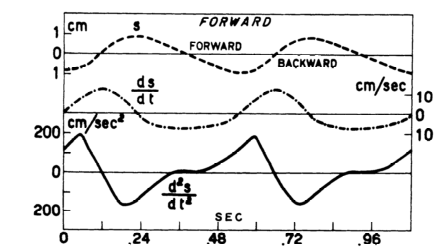
Graphs from Cavagna's 1963 paper showing how horizontal components of speed and displacement are calculated from acceleration data. Note that his data was taken from an accelerometer worn on the body whereas it is more common these days for similar techniques to be used based on forde plate measurements.

Graphs from Cavagna’s 1963 paper showing how horizontal components of speed and displacement are calculated from acceleration data. Note that his data was taken from an accelerometer worn on the body whereas it is more common these days for similar techniques to be used based on force plate measurements.

Let’s be clear that there is no external work in walking. All the work required for walking is generated internally by the muscles. The result of muscles (and ligaments) exerting forces on the skeleton is that the foot exerts a force against the floor and generates the ground reaction (following Newton’s third law) but the ground reaction itself doesn’t do any work. It can’t. In order for a force to do work the point of application needs to move and the ground doesn’t move (well, not very often).

Whether its name is correct of not, the concept is important because it allows an estimate of the energy cost of walking on the basis of force plate measurements alone (cuts out all that nasty kinematics). The theory behind the calculations is generally presented as  straightforward but actually requires some quite subtle reasoning.

Although the ground reaction doesn’t do any work, it is a force applied externally to the body and will result in the centre of mass of the body being accelerated (Newton’s first law). If we measure the ground reaction we can thus calculate this acceleration and thus how the centre of mass is moving (its velocity and displacement).

Now if we wanted to move an equivalent mass through the same trajectory we could do so by applying an external force of the same magnitude and direction as the ground reaction directly to its centre of mass. If we did this then the point of application of this imaginary force would move and it would do work. Knowing the laws of physics it is reasonably easy to calculate what this work would be.

This can be taken as equivalent to the work that the muscles have to do to move the centre of mass, but it should be emphasized that the external force applied at the centre of mass is entirely imaginary, for the purposes of the calculation only. All the work is done internally by the muscles.

Of course this is one of those areas where people who understand the underlying concepts can cope with the fact that the name is wrong and get on with life … but I suspect that the terminology has the potential to be extremely misleading for those who don’t.

Additional note. It may also be worth being explicit that the muscles do other things as well as moving the centre of mass. They also move the segments with respect to the centre of mass and the work required to do this is not captured in the calculation outlined above. The calculation will thus always be an under estimate of the true mechanical cost of walking. It’s interesting that despite the extent to which these techniques have been used there have been very few studies of how much of an under-estimate, either for normal walking or for walking with pathology of different kinds.

Preparing a good looking Movement Analysis Profile (MAP) in Excel

Last week I invited anyone to join our current masters students for a virtual classroom on the subject of gait indices this coming Wednesday (click the link for more details including how to register).

In doing so I thought that it might be useful to prepare a brief video on how to prepare a good looking Movement Analysis Profile in Excel. If you want to download the Excel spreadsheet I used in the demonstration you can  do so here.

The one thing I forgot to add at the end of the video is that because you’ve actually got two charts on top of each other you’ll have to use a screen dump (ALT+PRTSC) to copy and paste it somewhere else as a picture. If you select the chart  and try and copy it then you’ll only copy the top chart.

This video has now been added to the video page for this blog-site.