gait analysis

Making nice gait graphs in Excel

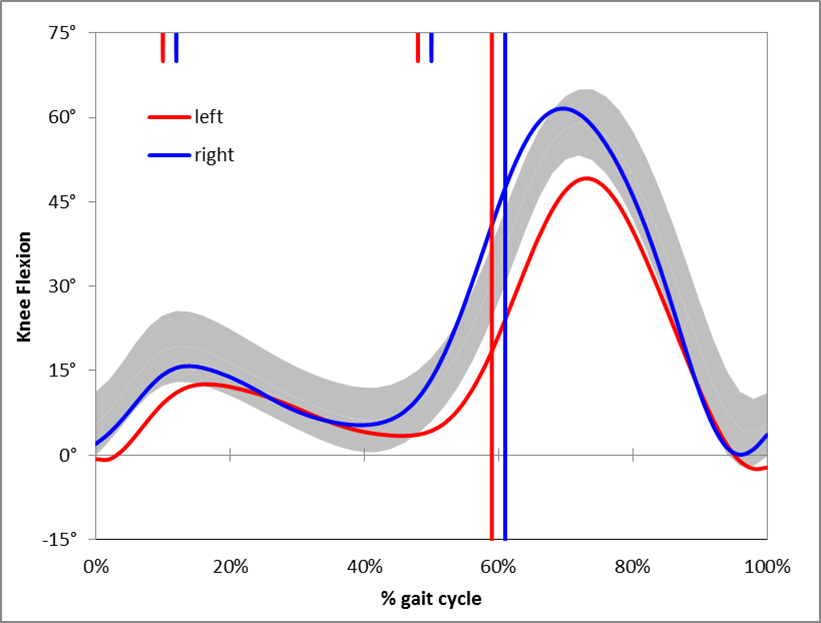
This is quite a simple post with a tutorial screencast of how to format gait graphs nicely in Excel. For a long time I just didn’t think this was possible but you can see from the image below that it is! The screencast is the simplest example of a range of tools we are developing to support students who enrol on ourmaster’s degree programme in clinical gait analysis which starts in September as part of the EU funded CMAster project.

Nice gait graph

The main thing that makes plotting the graphs like this possible is that you can select different series within the same chart to have different chart types. I suspect that this feature may not be available in early versions of Excel but don’t know when it was introduced – this graph was generated in Excel 2010 on a PC. If you are good at working with charts in Excel then this is all you really need to know and watching the screencast will only waste another 20 minutes of your life. If you are not then I suggest you just watch the screencast and I’ll explain things a bit more slowly.

One top tip I’ll offer – if you want to create an array of graphs make sure that your formatting is correct on the first graph before you start copying and pasting. If you find a mistake later on you’ll have to correct it on each graph separately.

I’ve said in the screencast that I’ll produce another one to show how to add in the timing data. The only way I know to do this is a little bit messy. Does anyone know a nice straightforward way?

(Note that the screencast is recorded in reasonably high definition but you may have to use full screen display and increase the resolution with the little cog icon at the bottom left of the video to appreciate this.)

Where’s the foot?

foot pitch

Another comment from CMAS. I think it was Alison Richardson who was presenting at one point and remarked, “but of course we can’t tell where the foot is from the graphs”. How true? and why not? Conventionally in clinical gait analysis we plot where the pelvis is in relation to the lab, then the hip, knee and ankle joints. In theory if you know all this information you can work out the orientation of the foot. I don’t know anyone, however, who has developed the knack of adding all those angles up in their head to work this out. In understanding how the foot is contributing to that pattern I think Perry’s concept of foot rockers is key – is the limb pivoting primarily around the heel, the ankle or the MTP joint? Yet, despite what you hear in many discussions about gait data, it’s virtually impossible to tell from the graphs which rocker is active at  any given time.

So why don’t we plot out foot orientation? We calculate the equivalent in the transverse plane and call it foot progression. I think it would make all our lives considerably easier if we added an extra graph at the foot of the sagittal plane data. Given that the pitch of a shoe is how much it tilts the foot forwards perhaps we should refer to this a “foot pitch”.

I’ve shown you what the sagittal graphs would then look like. I don’t suggest using the colours on the foot pitch graph – they are only there to show you how easily you can pick out the three rockers. During the red phase of stance the foot is pivoting about the heel – first rocker. During the white phase the foot is flat on the ground – second rocker. During the blue phase the foot is pivoting about the MTP joint (or toe) – third rocker (or third and fourth rockers if you want to use Perry and Burnfield’s most recent terminology (2010). Notice that end of first rocker does not coincide with opposite foot off but is completed appreciably earlier. Many people don’t appreciate just how early third rocker starts either.
.

.
Perry, J., & Burnfield, J. M. (2010). Gait analysis: normal and pathological function (2nd ed.). Pomona, California: Slack.

Re recycling terminology

My second post on this blog was a suggestion that, when you think about it in detail, there are some problems with the conventional terminology that clinical gait analysts use to divide the gait cycle into phases and that a very simple scheme based upon simple division of the gait cycle into single support, double support and swing might have some advantages. Here is a video I’ve developed to help gait analysts reflect on the issues.

Averaging up the profits

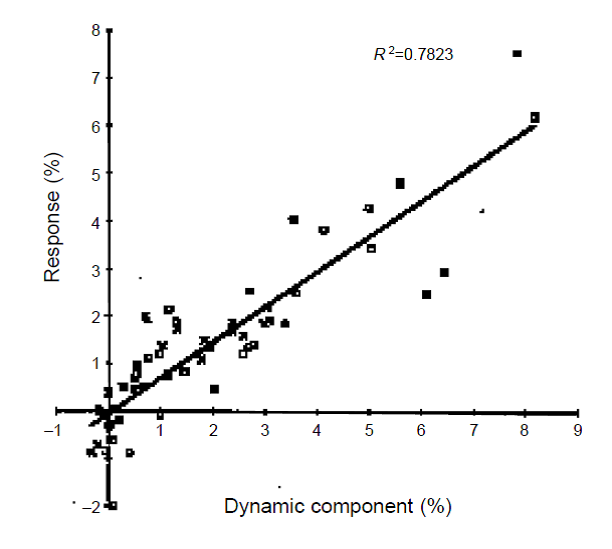
Here are two graphs. The first from very early in my career shows a parameter we called the “dynamic component” of gastrocnemius length. It plots the improvement in this after injection of botulinum toxin in children with cerebral palsy against the baseline score (Eames et al., 1999). I remember when Niall first showed me the graph. We’d captured a  whole load of data on these kids and were wondering what to plot to make sense of it. This was the first suggestion and I can still remember Niall’s excitement when it came up with such a strong relationship.

Eames

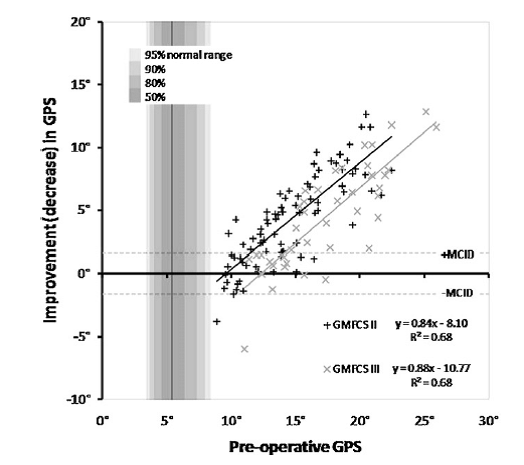
At the other end of my career here’s another graph from a paper that has only just been published electronically in Gait and Posture (Rutz et al. 2013). Here is the improvement in Gait Profile Score (GPS, Baker et al., 2009) for children with cerebral palsy plotted against baseline score (with GMFCS II and III children plotted separately). Again there is a strong correlation. (There are some statistical issues in plotting data this way which might lead to exaggeration of the correlation when measurement error is substantial but I’ve gone to some lengths in the recent paper to show that this is unlikely.)
rutz

When you think about it though the relationship is actually quite unremarkable. What both studies are showing is that kids with the most severe problems to start with are the most likely to show improvements. To a certain extent this is common sense – if two kids both improve by 30% then the child with the biggest problem to start with will show the biggest change in absolute units.

What interests me though is that if we only look at the average changes in each group we will reach the conclusion that the group as a whole have improved. If we are not careful we might conclude that all the group has improved. Thissimply isn’t the case. The full truth is that the kids who have the biggest problems have improved a lot those with milder problems haven’t improved very much (in absolute terms).

The Botulinum toxin study became the basis for an industry sponsored randomised controlled trial (Baker et al. , 2002). In that trial although we included baseline readings as a covariate in the statistical analysis but we only ever reported group results. That is still probably the most rigorous trials of lower limb injection of Botulinum Toxin in the literature. The message that almost everyone has taken out of that study  from the data we presented is that kids with spastic diplegia will benefit form Botulinum toxin. Had we presented the data more carefully the conclusion should have been that the more severely affected kids will benefit from Botulinum Toxin big time, but that  the milder kids may not benefit at all.

As it stands the paper is really convenient for the company because it suggests that a wider group of kids will benefit from an expensive drug than is actually the case. Given that bigger responses to treatment in more severely affected people is likely in almost all conditions that affect people across a range of severity I suspect that a similar phenomena spread across almost all of . I wonder how much profit the drug companies are making as a consequence?

Leave a comment or double click “n comments” link at top of post to view discussion.

Baker, R., Jasinski, M., Maciag-Tymecka, I., Michalowska-Mrozek, J., Bonikowski, M., Carr, L., . . . Cosgrove, A. (2002). Botulinum toxin treatment of spasticity in diplegic cerebral palsy: a randomized, double-blind, placebo-controlled, dose-ranging study. Dev Med Child Neurol, 44(10), 666-675.

Baker, R., McGinley, J. L., Schwartz, M. H., Beynon, S., Rozumalski, A., Graham, H. K., & Tirosh, O. (2009). The gait profile score and movement analysis profile. Gait Posture, 30(3), 265-269.

Eames, N. W. A., Baker, R., Hill, N., Graham, K., Taylor, T., & Cosgrove, A. (1999). The effect of botulinum toxin A on gastrocnemius length: magnitude and duration of response. Dev Med Child Neurol, 41(4), 226-232.

Rutz, E., Donath, S., Tirosh, O., Graham, H.K., Baker, R. (2003). Explaining the variability improvements in gait quality as a result of single event multi-level surgery in cerebral palsy. Gait Posture, published on-line http://dx.doi.org/10.1016/j.gaitpost.2013.01.014
Goldilocks Biomechanics

I’m working on a variety of learning materials to teach clinical gait analysis at the moment. Our masters programme in clinical gait analysis should start in 8 months time. One thing I find really depressing is how little of our clinical reasoning for individual patients is based on biomechanics. Most of the interpretation we do is essentially learned and largely subjective pattern recognition. We don’t really understand the data in a way that approaches science.

goldilocks

There are numerous reasons for this but one of the issues is that the biomechanics of walking is not being developed at the right level. On the one hand we have a group of researchers, coalescing under the Dynamic Walking Group, who are developing extremely simple and often non-physiological models to explore very basic principles. On the other hand are researchers typified by (but not restricted to) the OpenSim project who are developing really complex computer models. Neither group, as far as I can see is having a significant impact on the clinical understanding of gait or affecting how we manage our patient’s conditions.

To my mind the simple models are just too simple – how do you use a model without muscles to understand the consequences of a spastic gasttrocnemius? Equally the complex models are too complex- it’s impractical to perform a full CMC analysis for every patient. Even if we did we wouldn’t know which results are robust indications of the biomechanics of the patient and which are consequences of modelling assumptions and parameters.

What we really need is models that are neither too simple nor too complex – borrowing from modern astrophysics we need them to inhabit the Goldilocks zone – Goldilocks biomechanics.