Normalising kinetics

There were a few things that struck me as odd when I was writing my book. Things that we’ve always done in a particular way in clinical gait analysis but which just don’t make sense. One of these is the way we typically “normalise” kinetic data by dividing through by mass only. Moments are a product of force and length and are thus likely to be influenced both by a person’s weight and their size. It just doesn’t make sense to normalise data by dividing through by weight only. There are similar, but slightly more complex, issues with joint power. Differences in adult height between individuals, expressed as a percentage, tend to be reasonably small (SD < 10%) even disregarding gender, so the effects of not normalising to height in adults are unlikely to be that important. Clinical gait analysis, however, has always had a considerable focus on children where differences in height are much larger. It just seems so obvious that we should normalise to height as well as weight. In my book I see that I actually commented, “Quite why this is not standard practice in gait analysis is unclear.”

A simple explanation may be that no-one has ever tested this assumption. So one of my colleagues (Ornella Pinzone) has performed a comparison of conventional normalisation (dividing moments and powers by mass only) and non-dimensional normalisation (dividing moments by mass and leg length and powers using a slightly more complex formula). We based it on data made available by Mike Schwartz from Gillette as their data are so well formatted for a study like this. The paper has just been published in Gait and Posture and if you use this link before 29th January then you should be able to view and download a copy of the article for free.

Pinzone

Coefficients of determination for relationship between a range of temporal, spatial and kinetic parameters and age amongst children across an age range from 4 to 18 years. Dashed line shows threshold for statistical significance at p<0.05.

The results are quite conclusive. About 80% of the associations between the conventionally normalised parameters and age, height and weight, were statistically significant (p<0.05) and for all of those parameters where the association was significant it was substantially reduced by non-dimensional normalisation (only just over 20% were statistically significant and most only marginally exceeded the p<0.05 threshold). The results have dispelled any lingering doubts in my mind as to the superiority of non-dimensional normalisation and when we next revise our normative dataset we’ll be using this as standard.

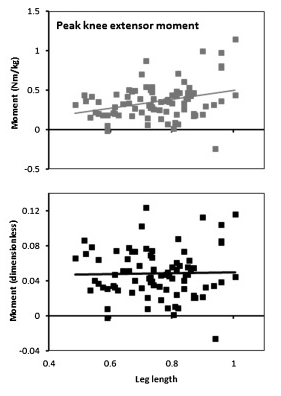
This isn’t quite the whole story, however, because even when you remove the systematic effects of height and weight (this is the primary purpose of normalisation) there is still a lot of scatter in the data. The figure below shows the relationship of peak knee extensor moment with leg length for conventional (top) and non-dimensional (bottom) normalisation. The slope on the line of regression is reduced to almost zero with non-dimensional normalisation but there is minimal effect on the scatter of data points about this line.
Pinzone2

Peak knee extensor moment plotted against leg length for conventional (top) and non-dimensional (bottom) normalisation.

It is difficult to compare this variability with that present in kinematic data because the nature of the data is so different but the impression I get is that the variability in the kinetic data is even greater than that in the kinematic data. I’ve commented in two earlier posts (here and here) that I think the assumption that we all walk similarly, an assumption on which all clinical gait analysis is based, needs to be re-examined. The most obvious conclusion from this dataset is that many of us, even in the absence of pathology, walk very differently.

Sense of satisfaction

Modern academic research is largely a rather slow process taking small incremental steps. I’ve vented my frustration before about how dispiriting it can be to get lost in a fog of low-level research projects which often leave us more confused rather than enlightened. I thus feel I want to celebrate a rare occasion when I do feel a sense of completion of a substantial programme of research.

I was lucky enough to move to Belfast  shortly after Kerr Graham and Aidan Cosgrove  had completed their early work demonstrating the efficacy of Botulinum toxin injections first in hereditary spastic mice and then in children with cerebral palsy. Kerr had departed for Melbourne by the time I arrived but left Niall Eames, an orthopaedic surgeon, lined up to do some research to try and better understand the effect of the toxin. Given that the problem in CP is that the muscles are too short and that Botulinum toxin, by reducing the neural input to the muscle, allows them to elongate, we decided that we should do this by looking at the changes in muscle length. We thus started with some, by modern standards extremely crude, muscle length modelling of the gastrocnemius.

Niall graph

Response to botulinum toxin plotted against the pre-operative dynamic component (taken from Eames et al. 1999)

Having developed the model we applied it to a cohort of children with cerebral palsy having Botulinum toxin injections and were able to demonstrate that the action of the toxin was to reduce the “dynamic component” of reduced muscle length (see figure above). This makes a lot of sense as it is this component that is affected by the neural input to the muscle. The “fixed component” (contracture) is largely a consequence of changes to the composition and structure of the muscle and is unlikely to be affected by the toxin. The research also allowed us to understand that the variable response was largely due to children having a different dynamic component rather than of the toxin acting differently and led to reasonably simple prescription guidelines. Botulinum injections to the calf are most likely to be beneficial if the child has a large dynamic component (good range of passive dorsiflexion during physical examination but walking up on their toes). It further explained that the different response in children with diplegia  and hemiplegia was also attributable to them having different magnitudes of dynamic component.

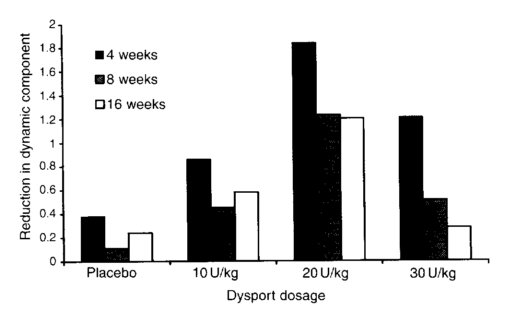
Armed with this understanding I was then able to work with the pharmaceutical company Ipsen to set up a cliniucal trail to establish the most appropriate dose of the toxin. We couldn’t find enough children to study in the UK so had to extend the study to five centres in Poland. We divided children into one of four groups and injected them with either a placebo or one of three different doses. We used the same modelling technique which we had developed for the earlier study to analyse the results and came to  the conclusion that placebo didn’t work (very much) and that the middle dose was the most effective (see figure below). It was interesting that the biomechanical modelling came to clear logical conclusions whereas doctors’ subjective opinions were that the placebo was very nearly as effective as the drug and that they were so impressed by the “improvement” after placebo injection that they would have recommended repeating the process for two thirds of the children! (despite biomechanical evidence that the placebo had had no effect).

Baker graph

Reduction in dynamic component as a function of different doses of Botulinum toxin at 4, 8 and 16 weeks (Baker et al. 2002)

Having established the most appropriate dose on a single occasion the most obvious remaining question is, “How often should those injections be repeated?”. I’d moved to Melbourne to join Kerr by then and we applied to the Australian National Health and Research Council to fund a clinical trial to compare injections delivered either annually or every four months over a  two year period. Reflecting on the biomechanics we recognised that the long term goal of the injections had more to do with preventing the development of secondary fixed contractures than on the immediate effect on the dynamic component. We would have to measure relatively small changes over a two year time span and thus devised a method to standardise the measurement of passive dorsiflexion range as much as possible.

Which brings me to the stimulus for writing this post in that the results of that study have just been published . The first conclusion is that passive range of dorsiflexion was maintained over the two year period by both injection regimes. We had no true control, because by this stage it wasn’t considered ethical to inject placebo over such a long period, but these measurements were taken over an age range in a child’s life during which preserving dorsiflexion range would be extremely unlikely without injections. The second conclusion was that the more regular injections where only slightly more effective in preserving dorsiflexion range and therefore that there doesn’t appear to be any particular benefit in injecting more regularly than once a year.

Thus after nearly twenty years of research based on the application of thoughtful biomechanics to a clinical problem we finally have clear evidence of which children to inject, how much toxin to inject and how often to repeat this. As one leader of the western world was once heard to comment under less auspicious circumstances, “Mission accomplished!”

Footnote

Trials like this take so long to organise that we were not actually the first group to complete a study to establish the most appropriate injection frequency. This was actually published about 5 years ago. It was a very similar study (it had been sponsored by Ipsen as a follow-on our to earlier work and I’d had some involvement in its planning before I left for Australia) and arrived at a very similar result. Rather than feeling that there was competition here though it highlights the scientific importance of repeating studies to confirm results. With such an emphasis on innovation in modern clinical research the need to repeat and confirm earlier results, which is an important part of the scientific process, can very often be overlooked.


Learning opportunities at the University of Salford

An occasion post publicising some of the learning opportunities on offer at the University of Salford.

Virtual Classroom – Kinematic models for clinical gait analysis

Dec 2015 virtual classroomTuesday 1st December 2015, 7:00-8:00pm UK time.
This is a virtual classroom from the masters programme in Clinical Gait Analysis on the subject of Kinematic models for clinical gait analysis that is open to anyone anywhere. Register, join our regular students, find out what a virtual classroom is like and learn about such models. To receive details on how to access the event please register by e-mail using this link (not text is necessary the automatically generated subject is sufficient).

Clinical Gait Analysis – an impairment focussed approach

Manual pictureWednesday 11th – Friday 13th May 2016

This is a three day course in clinical gait analysis focussing on the interpretation and reporting of data following an impairment based approach. It builds on the success of a similar course held in June last year. We’ll be working again with local partners from Oswestry and Sheffield. It is a mix of lectures, workshops and group case studies designed to empower you to write better gait analysis reports. To learn more and register follow this link. (Note full programme will not be available until January).

Masters Programme in Clinical Gait Analysis

This is a three year part-time work-based programme delivered by distance learning. There is no requirement to come to Salford at all if you don’t want to. It is designed to equip individuals from either a clinical or technical skills to develop the full range of competencies required of a clinical gait analyst. It is part of the CMAster collaboration which will enable students to undertake a shorter full-time research project at VU Amsterdam or KU Leuven in place of the normal one year part-time research project in the final year.

The programme commences in late September each year but we welcome enquires at any time and can provide recommendations to prepare yourself in advance of enrolling. To find out more including details of how to apply use this link.

Customised gait courses

We are happy to offer gait courses tailored to the specific demands of small groups to be delivered either in Salford or in your own locality. So far we’ve delivered such courses for groups from Russia, Thailand, Denmark, South Africa and the UK. To make enquiries please e-mail me directly.

Postgraduate Research Studentships

We can offer both MSc and PhD by research. Most of our students study on-site full-time but it is possible to study by distance learning part-time. Unfortunately we only have a very small number of funded studentships which are advertised as they become available. We are always willing to consider potential students who are able to fund their own studies either personally or with a grant from a third party. To make enquiries please e-mail me directly.

Learning resources

We maintain another web-site www.gaitcourses.com with details of all our courses and other learning activities. It includes full schedules to all previous courses and access to a range of learning materials used on them (some are password protected to restrict access to people who have paid to come on the courses).

Don’t forget the resources that are available on this blog-site as well. Explore the menu bar under the banner above.

What is the opposite of compensatory?

I’ve recently been preparing some teaching material for a one day course on observational gait analysis which we are running this Friday. I got to the part where I normally introduce the concept of primary, secondary and tertiary abnormalities of gait. As outlined by Jim Gage (The Identification and Treatment of Gait Problems in Cerebral Palsy, 2009),   primary effects are those regarded as a the direct effects of the original brain injury. He gives loss of selective motor control, balance impairments and abnormal muscle tone as example. Secondary effects are those that are not part of the original brain injury but develop as a consequence of it. Bony torsional malalignment and muscular contractures might be seen as examples. Finally tertiary effects are those resulting from an individual’s efforts to compensate for the consequences of the injury. Vaulting, circumduction and hyperflexion of the hip are all cited as examples of compensations for a foot drop which may be a consequence of weakness of the dorsiflexors or tightness in the plantarflexors.

Although the term effects is used when first introducing these concepts the subsequent sections are headed primary gait abnormalities and secondary gait abnormalities. The terms effects and abnormalities appear to be used interchangeably in this context.

I was struggling to incorporate this into the approach that I’ve called impairment focussed interpretation. This assumes that the aim of clinical gait analysis is to identify the impairments that are most likely to be affecting the patient’s ability to walk by linking them to observed features in the gait data. This follows the WHO definition of an impairment as “a problem in body structures or functions such as significant deviation or loss” (WHO, International classification of functioning, disability and health. 2001) and my own definition of a feature as something of clinical relevance that you can see on a gait graph (or on a video).

How I wondered do my impairments and features relate to Gage’s primary, secondary and tertiary effects or abnormalities?

I’ve come to the conclusion that Gage’s primary and secondary effects are generally impairments (as the WHO has defined them). They are things that are wrong with the underlying body structures and functions and are not necessarily related to gait. His tertiary effects, by contrast, are generally features.  They are changes to the way a person walks.

It also occurs to me that the primary, secondary, tertiary terminology implies a progression from one to the next in sequence. It doesn’t take too long, however, to realise that some tertiary compensations are a direct result of a primary impairment without the requirement for a secondary intermediary.  Thus vaulting might be a direct consequence of plantarflexor spasticity, a primary impairment.

To tidy things up therefore it makes sense to me to preserve the terms primary and secondary but restrict these to impairments, and to drop the term tertiary in favour of compensation whilst restricting its use to the description gait features. The question that is now puzzling me though is, what is the best name for a feature that is the opposite of a compensation? If a compensation is an alteration to of the gait pattern in response to an impairment which makes walking easier, what do you call the an alteration to the gait pattern which is a consequence of an impairment that makes walking more difficult?

Do feel free to leave your answers as comments to this post.

Choosing your moment

Hi, sorry its been so long since I posted but I’ve been reinvigorated by this year’s ESMAC conference here in Heidelberg. Earlier in the week I had the pivilege of sitting in on a session of the ESMAC gait course. Julie Stebbins had arranged a short quiz to start people thinking on Wednesday morning and the last question caught my attention. It’squite simple. There are four sets of kinematics along the top and four of kinetics along the bottom labelled A to D. What order do the kinetic datasets need to be arranged in to match the kinematic graphs (and why)? (You should be able to get a bigger view by double clicking on the picture.

choosing your moment