Preparing a good looking Movement Analysis Profile (MAP) in Excel

Last week I invited anyone to join our current masters students for a virtual classroom on the subject of gait indices this coming Wednesday (click the link for more details including how to register).

In doing so I thought that it might be useful to prepare a brief video on how to prepare a good looking Movement Analysis Profile in Excel. If you want to download the Excel spreadsheet I used in the demonstration you can  do so here.

The one thing I forgot to add at the end of the video is that because you’ve actually got two charts on top of each other you’ll have to use a screen dump (ALT+PRTSC) to copy and paste it somewhere else as a picture. If you select the chart  and try and copy it then you’ll only copy the top chart.

This video has now been added to the video page for this blog-site.

Validate, validate, validate …

I had a query recently from a researcher who devised a variant of the GPS to incorporate trunk data. He’d submitted it for publication but the reviewer asked for evidence that the scale had been validated and he wanted to know how to respond. It made me stop and think about the whole process of validation. It’s one of those areas in which the concepts evolved within psychometrics, where they are relevant, have been allowed to spill over into other areas, where they are not.

Chibi_Dalek_Thay_by_jinkies36

For the uninitiated the field appears complex. I remember a PhD student once who we asked to validate a scale coming back a week later completely confused – she did master it eventually but there was a steep learning curve. Read the relevant chapter in Portney and Watkins for example and you are conducted on a whistle-stop tour of face, content, criterion-related and construct validity in 20 pages. Altman and Bland (direct link to article) whip through these even more quickly and add in internal consistency for good measure.

I don’t have enough space in a blog article to go into why this is all necessary (Altman and Bland provide a succinct summary) but I do want to explore when it is necessary which I feel is very poorly understood. Stating it rather boldly, validation of a scale is required when we don’t know what we are measuring. Psychometrics evolved to support psychologists and behavioural scientists who wanted to quantify concepts such as happiness or anxiety. Neither happiness nor anxiety is defined in terms of numbers so the researcher has to go through a process of convincing her or his peers that the scale she or he has devised is a valid measure of what the rest of us understand by the terms. In our own, field health related quality of life or patient satisfaction or even general terms like gross motor function or mobility are similar qualitative terms. If we want to assign a numerical value to these then we need to go through the same process. As our understanding of the underlying issues becomes more sophisticated then so does the battery of different types of validity that we need to establish in order to convince others that our scale is represents what we say it represents.

By contrast, however, such a process of validation is not required if we do know what we are measuring. If we are measuring length, time, speed or joint angle, moment and power then there are very precise definitions of the terms we are seeking to measure and there is absolutely no need to go through this full validation process. The question we need to ask is whether the tests are accurate rather than whether they are valid. This requires a completely different set of techniques. The GPS is a derivative of joint angle measurements and I would argue that a consideration of accuracy is required rather than one of validity.

Of course there is a subsequent question which is whether any measurement is useful. Just because a variant of the GPS including trunk data is well defined and accurate doesn’t necessarily mean it is useful in any particular context. That, however, is yet another and different question.

Learning opportunities at the University of Salford

An occasion post publicising some of the learning opportunities on offer at the University of Salford.

Virtual Classroom – Gait Indices

Wednesday 17th December 2014, 7:00-8:00pm UK time.

This is a virtual classroom from the masters programme in Clinical Gait Analysis on the subject of Gait Indices that is open to anyone anywhere. Register, join our regular students, find out what a virtual classroom is like and learn about gait indices (GGI, GDI, GPS, MAP, MDP). To receive details on how to access the event please register by e-mail using this link (not text is necessary the automatically generated subject is sufficient).

Clinical Gait Analysis – an impairment focussed approach

Wednesday 20th – Friday 22nd May 2015

This is a three day course in clinical gait analysis focussing on the interpretation and reporting of data following an impairment based approach. It builds on the success of a similar course held in June last year. We’ll be working again with local partners from Oswestry and Sheffield. It is a mix of lectures, workshops and group case studies designed to empower you to write better gait analysis reports. To learn more and register follow this link. (Note full programme will not be available until January).

Masters Programme in Clinical Gait Analysis

This is a three year part-time work-based programme delivered by distance learning. There is no requirement to come to Salford at all if you don’t want to. It is designed to equip individuals from either a clinical or technical skills to develop the full range of competencies required of a clinical gait analyst. It is part of the CMAster collaboration which will enable students to undertake a shorter full-time research project at VU Amsterdam or KU Leuven in place of the normal one year part-time research project in the final year.

The programme commences in late September each year but we welcome enquires at any time and can provide recommendations to prepare yourself in advance of enrolling. To find out more including details of how to apply use this link.

Customised gait courses

We are happy to offer gait courses tailored to the specific demands of small groups to be delivered either in Salford or in your own locality. So far we’ve delivered such courses for groups from Russia, Thailand, Denmark, South Africa and the UK. To make enquiries please e-mail me directly.

Postgraduate Research Studentships

We can offer both MSc and PhD by research. Most of our students study on-site full-time but it is possible to study by distance learning part-time. Unfortunately we only have a very small number of funded studentships which are advertised as they become available. We are always willing to consider potential students who are able to fund their own studies either personally or with a grant from a third party. To make enquiries please e-mail me directly.

Learning resources

We maintain another web-site www.gaitcourses.com with details of all our courses and other learning activities. It includes full schedules to all previous courses and access to a range of learning materials used on them (some are password protected to restrict access to people who have paid to come on the courses).

Don’t forget the resources that are available on this blog-site as well. Explore the menu bar under the banner above.

No comment

I’ve just been invited to write a “Commentary” for Developmental Medicine and Child Neurology. This is one of those journals that publishes brief articles (I’ve been offered a 650 word and 5 reference limit) commenting on a recently accepted paper. For this particular journal the practice would appear to be to ask one of the reviewers to write the commentary. My first reaction was to feel flattered and start writing immediately … but then I remembered that I often read similar articles written by other people with a sense of annoyance and even indignation.

It takes a lot of hard work to conduct research and write it up to the point of acceptance for a major journal. I remember reading somewhere (haven’t a clue where I’m afraid) that the average clinical paper costs more than a £100,000 to produce once you factor in full direct and indirect costs. Teams of authors spend a considerable time analysing the data and preparing and discussing successive drafts of their manuscripts. The final draft is then subject to cautious scrutiny through peer review to ensure that the resulting product is a fair and considered report of the study and its implications. Given the effort that goes into the article itself I’m not particularly comfortably with the idea that a single individual who’s probably only spent a couple of hours reviewing at the submitted version is given the platform of expounding their views alongside those of all the individuals who have done the real work. That individual is often granted considerably more freedom than the original authors to comment about what he or she likes whereas the original authors are constrained to comment only on the evidence provided within the paper. All in all it just doesn’t feel right.

I’ve held this opinion for some time but was particularly stung last year when we published a paper reporting a substantial clinical trial into the effects of progressive resistive strength training (PRST) on walking and mobility related function in children with cerebral palsy (Taylor et al., 2013). This was the culmination of 7 years work on a project that recruited 44 participants to one of the largest randomised clinical trials recorded of any physical intervention for cerebral palsy. Obtaining the quarter of a million dollar grant from the Australian National Medical Health and Research Council before we started was a substantial achievement in itself. The results were clear (if disappointing for clinicians) that whilst PRST results in stronger muscles it doesn’t appear to lead to any improvements in gait or other measures of mobility. Not only were the findings of that study unambiguous but they substantiated the findings of the three previous (smaller) randomised clinical trials that had been published investigating similar interventions.

The published commentary, however, chose to damn the article with faint praise of its strengths and a focus on minor limitations. It went on to conjecture that the problem was that, although we had put in place a rigorous PRST programme, we hadn’t specifically “trained gait”. Whilst I can’t argue with this, I feel incensed that conjecture about what might work has been used to trump evidence of what clearly doesn’t. The commentary’s conclusion that that, “therapists who look to evidence in the literature to design their interventions will not find this article useful”, is particularly galling. Even if the author of the commentary is correct, that a combination of gait training and strength training is required for functional improvement, it must still be useful to know that strength training alone will not achieve this.

The situation is often exacerbated when the evidence in a paper goes against what the clinical community wants to hear. In the example I’ve cited we would all love to believe that adolescents with cerebral palsy can make substantial functional gains by going to the gym. As optimistic human beings (rather than dispassionate scientists) that’s what our team hoped we were going to provide evidence of when we embarked on the research. For similarly enthusiastic clinicians reading the two articles side by side it will be all too easy to allow the optimism of the conjecture to displace the reality of the evidence.

A particular problem of having commentary published alongside research articles in this fashion is that it can be cited in exactly the same manner. The informed reader will be suspicious of papers that are just one or two pages in length, but not everyone is an informed reader and considerable caution is required to prevent “expert” conjecture entering the evidence base on the same terms as genuine research results. There is also the issue that the model of publishing is of peer review. Inviting one of those peers (equals) to write a commentary implicitly elevates them to quite a different status. The invitation I received referred to an “authoritative background piece by an expert“.

Of course I can be fairly criticised for writing similar opinion pieces in this blog. My only defence is that this is very clearly a blog – it doesn’t make any pretence to be anything else. The banner picture across the top shouts out that these are “personal reflections”. I don’t suppose anyone has ever tried to cite what I’ve written for a journal article but if they do it will be very clear from the citation that these are no more than the ramblings of a bigoted biomechanist.


Rockers or rollers?

Writing about the movement of the hind-foot the a couple of weeks ago and about projection angles last week has led me to reflecting a little on Jacquelin Perry’s rockers. As with many of the concepts that we have in gait analysis, the rockers can give us some really useful insight into how we walk but can also prove misleading if we don’t remain conscious of their limitations.

I don’t recognise the word “rocker” as meaning anything in particular in this context and had assumed it was an American word meaning pivot or fulcrum. I happened to mention this to a couple of American colleagues a couple of years ago, however, and found that they didn’t recognise the word either. It would appear that Perry simply made it up. Not that it matters much, the word seems to get the concepts across readily enough.

The rockers provide mechanisms for the tibia to move forward over the foot and hence for the passenger unit to be carried forward in stance. If we look at the angle the tibia makes to the vertical (above) then we can see that it starts off about 20° behind vertical at foot contact and progresses forwards reasonably steadily (with a bit of a wobble) to reach about 50° in front of vertical at foot off.
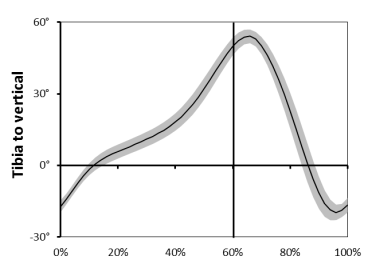
tibial progression

Perry explains this in terms of three rockers.  Early on the whole foot rotates about the heel. Later on the tibia rotates over the foot about the ankle and then finally the whole foot rotates about the forefoot (see below). Easy eh!

rockers

There is no doubt that all three mechanisms make important contributions to tibial progression. I’m not quite so convinced by Perry’s implication that these occur as a sequence of discrete mechanisms. To investigate this we need to look at the dorsiflexion graph which tells us when ankle rocker occurs and the foot projections graph that tells us when the heel and forefoot rockers are active (see graphs below, note that is impossible to distinguish the timing of the rockers from the ankle angle graph alone ).
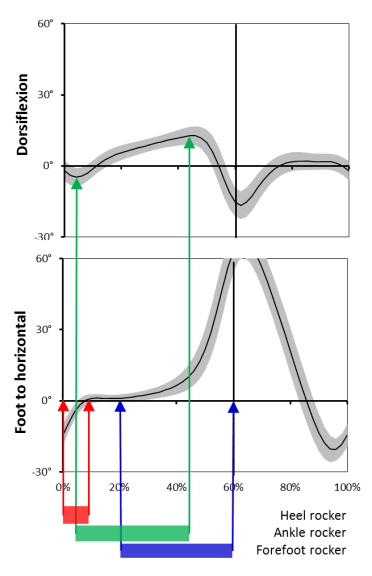
Rocker graphs


Heel rocker starts off at foot contact and proceeds until the foot is flat at about 8% of the gait cycle (in red above). It should be noted that this is considerably longer than the period to maximum plantarflexion in early stance that it is sometimes related to. Ankle rocker is the period over which the dorsiflexion angle increases which we can see from the ankle angle graph is from about 5% of the gait cycle to about 45%. There is thus a short period of overlap when both the heel and ankle rockers are active.

Forefoot rocker starts with heel lift which Perry suggests occurs at mid-stance (30% gait cycle). The data depicted above suggests it might commence even earlier (20%?) and it continues until the end of stance. It is thus clear that there is a considerable period from about 20% of the gait cycle until 45% when both ankle and forefoot rockers and simultaneously active.

The conclusion is that whilst the rockers are undoubtedly the mechanisms which allow the tibia to progress they form an overlapping progression rather than a series of discrete events. Indeed for the majority of stance two rockers are active simultaneously.

Since Perry introduced the concepts there has been some slippage in how the terms have been applied which is best avoided. As far as I can see, Perry always talked about heel, ankle and forefoot rockers and never first, second and third rockers. I think this is good practice as quite a lot of our patients don’t have a first rocker (they make contact with the forefoot rather than the heel). It’s always seemed a little illogical to me for someone to have a second rocker if they’ve never had a first rocker!

The other common misconception is that the rockers are alternative labels for phases of the gait cycle. Again Perry never used them in this sense, for her they are mechanisms that allow the tibia to move forward over the foot not phases of the gait cycle. It is particularly erroneous to apply these terms to phases of pathological gait. Many kids with CP never make heel contact and it is thus completely inappropriate to refer to early stance as the phase of heel rocker.

This reinforces the fact that the rockers are mechanisms of normal gait and great care is required in applying the terms to walking with pathology. If a child with CP makes contact with the toe after which the foot comes flat later in stance then they must use a mechanism that might best be described as a reverse forefoot rocker during which the heel is being lowered to the ground rather than being raised. Similarly if they employ a vault to assist clearance of the swing limb then they will often have a reversed ankle rocker during which plantarflexion (rather than dorsiflexion) increases.

Referring back to the work I described in my blog the week before last strongly suggests to me that, in bare feet, the heel rocker is actually a heel roller with the movement being a rolling on the curved surface of the posterior-distal calcaneus rather than a pivot about a particular point on the heel. On the other hand if walking in a shoe with a reasonably stiff heel it is more likely that a rocker like mechanism does occur. The appropriateness of this terminology may thus depend on footwear as well as gait pathology.

PS. In the second edition of Gait AnalysisPerry and Burnfield describe a fourth toe rocker very late in stance.  This can certainly be seen on slow motion videos but I’m not aware of any detailed studies of its biomechanical significance. It looks to occur very late on and I suspect only after most of the load has been taken off the foot but it would be nice to see a more definitive analysis of this.