Is it all just too bloody complicated?

I’ve just got back from the ESMAC-SIAMOC meeting in Rome. We’ve been entertained royally for three days in the aulas and cloisters of the Thomas Aquinus University. It has once more been a fantastic opportunity to network and exchange ideas and on one level I come back rejuvenated and inspired.

I say “on one level” because on another level I’ve also come back somewhat disappointed – disappointed because there was little in the scientific programme which left me feeling I understood things better than I did before I arrived. A large number of papers could be summed up by the conclusion, “we understand this area less after performing this research than we did before we started”.  I don’t think it is just ESMAC-SIAMC that suffers in this way. I see it at most of the conferences I attend and in a lot of papers that I read (and, if I’m being honest, in some of the papers that I write).

Just two areas illustrate this. One is in the advanced and complex modelling that is so often the focus of contemporary biomechanics. We learnt (or had confirmed) in Rome that the results are highly dependent on the details of how the individual anatomy is parameterised and of the calibration processes used to define joint centres.  The overall conclusion is that we are less confident in the output of our simulations and models after we’ve performed this research than we were before. Of course it is important to know what the limitations of our research. At some stage, however, we will have to acknowledge those limitations and accept the conclusion that the biological complexity of the human neuromusculoskeletal system is just too great for us to stand any chance of applying these techniques usefully (at least not beyond the constraints of healthy people exercising tightly controlled tasks).

The other field is that of measuring spasticity. Seven or eight years ago I was really excited about the prospect of instrumenting clinical tests to quantify spasticity more rigorously. The results I’ve seen reported are really quite disappointing in that it seems that spasticity is a rather complex and badly behaved phenomenon that simply refuses to be measured.  I have little faith any longer that spasticity is a purely velocity dependent response  (Lance, 1980) and the additional complexity that is introduced when displacement, acceleration or even jerk might have to be considered removes any hope that we will ever understand how these components interrelate within the current paradigm.

One of the “advantages” of research leaving us less clear of what is happening than we were before is that it opens up the conclusion that “further research is required to better understand these phenomena”. Research thus begets research and the university departments rub their hands in glee at the prospect of more research grants, papers and citations. For many of us it leads to increased job security. We have a vicious circle that delights and thrives in creating complexity and chaos.

This is particularly bizarre in orthopaedic and rehabilitation fields (and perhaps more widely across health sciences) in that the tools we have to treat our patients are generally extremely blunt. Selective dorsal rhizotomy, intrathecal baclofen and botulinum toxin are the only tools we have to manage spasticity. At a clinical level the only decision we need to make is which, if any, of these to use. If we want our research to be clinically useful we need to concentrate on the simple questions that need to be answered before we turn our focus to the more complicated ones that don’t.

The small number of presentations that did impress me posed a research question in such a way that the answer actually improved my understanding of a given issue. Almost all of these resulted in me having a clearer, simpler view of the world after the presentation. This doesn’t necessarily require simplistic techniques. The walk-DMC scale that Kat Steele and Mike Schwartz proposed in their prize winning paper (page 25 of Abstract Book) uses a sophisticated technique. It is a technique, however, that has been appropriately selected to answer a well posed research question (Can we quantify the effect of disordered motor control on walking in children with cerebral palsy?). Once the appropriate techniques has been selected the answer is simple (Yes, at least on the basis of the preliminary analysis they presented).

One of the most ancient tests of the scientific quality is Occam’s Razor, that science (and our thinking in general) should be as simple possible but no simpler. It would be interesting to perform an audit of the presentations at any contemporary conference against this criterion. I suspect the results would be quite sobering.

.

Lance, J. (1980). Pathophysiology of spasticity and clinical experience with baclofen. In R. Feldman, R. Young & W. Koella (Eds.), Spasticity: disordered motor control (pp. 485-495). Chicago: Year book medical publishers.
Post-doctoral research opportunity at University of Salford

Sorry to clog up your in-box if you are really happy where you are but we have just announced a 4 year post-doctoral research fellowship in biomechanical modelling for clinical gait analysis. The full blurb reads something like this:

This is one of a small number of highly strategic research career opportunities being funded by the University with the explicit aim of making a significant contribution to the University’s REF2020 submission and to the University’s research income position. 

The primary focus particularly over the first two years is to drive a research programme : Development and validation of a new version of the Conventional Gait Model. This will build on previous work in Salford (Chris Nester and Richard Baker) and at the Royal Children’s Hospital in Melbourne (Richard Baker and Morgan Sangeux) and has financial support from Vicon. It is hoped that the work will involve use of bone pin studies to validate the kinematic aspects of the model (subject to appropriate ethical approvals). 

In the final three years the appointee is expected to develop and source funding for a research programme growing out of this area and in collaboration with other researchers within the University. 

Please visit our web-site for full details and to lodge an application or contact Professor Richard Baker (r.j.baker@salford.ac.uk to discuss informally).

I know her by her gait

Thinking about the range of variation there is within “normal” walking last week has reminded me of a couple of studies that exemplify this.

Male and female walking

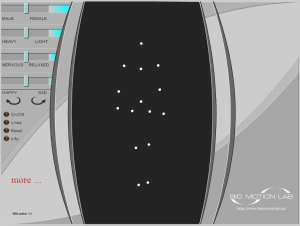
One of the nicest and most fun is from Niko Troje‘s Biomotion lab group at Queen’s University in Kingston, Ontario. Niko recorded the movement of retro-reflective markers on 20 men and 20 women and used a principal component analysis to analyse the data in such a way that it was possible to define the characteristics that differed with gender. He then used this information to to synthesise archetypal movement patterns for males and females. What makes it great fun is that he’s produced a flash demonstration  of this called BMLwalker that allows you to adjust the gender balance and see how the gait pattern changes (click on the picture below, the animation will open in a new tab, and  you can then play with the male/female slider). He also had the people’s weights so you can play with a slider which effectively adjusts the weight of the synthetic person you are looking at.

BMLwalker

In a novel twist Niko then got people to rate the movement patterns on a scale of sad to happy and nervous to relaxed and used the information to create sliders for these as well. The system works in such a way that you can mix these and look at the archetypal gait pattern of a relaxed but sad heavy male if you want to.

The important part of this (for me) is of course that it is all based on an analysis of the variability within the “normal” range of walking patterns (do note that the technique allows for the synthesis of ultra-archetypes that are beyond the normal range but only on the basis of an analysis of the variability within gait patterns that were originally within that range)

Muggability

I’m also reminded of the classic study from the 1980s in which  Grayson and Morris took essentially anonymised videos of 60 individuals and showed these to 53 criminals in a local prison for a range of offences from assault to murder. They asked them which looked more vulnerable and who they might be more likely to mug given the choice. There was reasonable agreement amongst the criminals. About 20 years later Gunns, Johnston and Hudson repeated the work but this time using a point light representation similar to that in the flash animation that you’ve just looked at. They found that vulnerability could be assessed on the pattern of moving lights alone. This demonstrates once again that within the normal range of walking patterns there is considerable variability.

It is actually possible to do this study for yourself because if you look more closely at BMLwalker you’ll see a more button. If you click this then the software will present you with a large number of gait patterns and allow you to grade each one on any scale. I’ve typed in muggability and graded the patterns by whether I think they they look confident and assertive or timid and weak. I graded about 50 patterns (you  just press End experiment when you’ve had enough)  and the software calculated a slider to adjust for muggability. I didn’t think I was doing all that well but when I looked at the results they were really convincing. Try it for yourself and see what you think.

Sex appeal

And here’s a video I just happened to come across while searching the web to find the BMLwalker. I’ll let you judge whether, despite the title, you thinks its science or not!

Video from the Discovery Channel’s Science of Sex Appeal (2009)


I know him by his gait

I was asked to be an expert witness for a court case last week. There was some video footage from a CCTV camera of an individual walking across a street from some distance away and the question I was being asked to provide an opinion on was, “Is it possible to identify the individual on the basis of his gait pattern?“.

There are, of course a number of University departments working on related issues (that within Computer Vision at the University of Southampton is a good example) and some evidence of commercial interest.  Every so often the concept bubbles into the popular science magazines. (There is now even an Android app that claims to be able to identify a person from the accelerometer data from a smartphone carried in their pocket while they are walking, but that’s another story).

I’ve generally been rather dismissive of these claims. I strip people down to a pair of shorts, stick retro-reflective markers over anatomical landmarks, ask the person to move in a particular fashion along a clearly marked walkway and then capture the movements with ten extremely high resolution cameras pointing directly at them. It often amazes me how little evidence there is of difference from normative reference data even for individuals with quite marked pathology. If I can’t detect such clear differences under such standardised conditions using such specialised equipment how can anyone suggest that they can recognise a healthy  individual, presumably with a gait pattern within the normal range, on the basis of a video image of them walking down the street fully clothed?

And yet in Shakespeare’s Julius Caesar, Cassius says to Casca when he sees a figure approaching, “Tis Cinna. I do know him by his gait“.  In Melbourne my office was by a corridor and it was generally possible to identify which of my colleagues was approaching along it by the sound of their footsteps. Our common experience is that we do recognise people at least partly by their gait. If gait patterns are so characteristic why is it so difficult to pick up abnormality in clinical gait analysis.

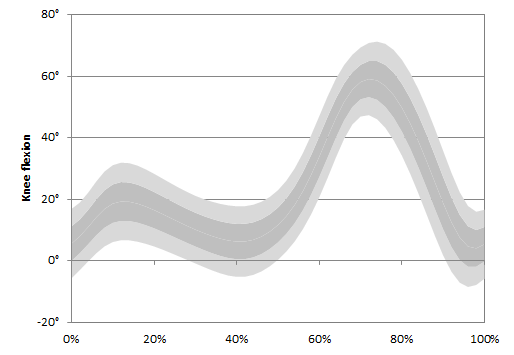
I suspect the answer is partly that gait is so varied and  characteristic. There is much more variability in normal walking than we appreciate. The creation myth of clinical gait analysis is that there is a well-defined pattern of normal walking and that our patients exhibit patterns that differ from this. The longer I think about this idea the less I believe it is true. When we tidy up our normative data by only plotting one standard deviation limits we get reasonably tight normal ranges but this is at the expense of excluding a third of the data (the +/- 1 SD limits only include 67% of the data by definition). If we plot two standard deviations, which represent 95% of the data, then we get much larger bars. Maximum knee extension in stance, for example varies between 5° of hyperextension and 18° of flexion across the healthy population (see figure below).

Knee 2 sd

The reason why it is so difficult to identify gait abnormality among our patients is at least partly because the normal variability between individuals is so large. Maybe on this basis gait as a biometric identifier is not quite so fanciful (although I still have reservations as to whether it will ever work on the basis of CCTV footage recorded in town centres or airports). Perhaps more importantly,  should be studying the characteristics of inter-person variation in gait patterns more closely in order to understand normal walking. In amongst all that variability are there specific characteristics that are invariant? If there are what does that tell us about the requirements of healthy walking? Gait variability within individuals is now seen as providing information about stability and by extension to falls risk (e.g. Callisaya et al. 2011). Maybe we should be paying more attention to gait variability between individuals.

PS Of course the other important factor in recognising people by their gait in every day life is the wide range of information we use to do so. When I recognised people by their footsteps from my office it was probably more to do with the sound that different footwear made as it was to do with temporal-spatial characteristics. One particularly famous CP surgeon was easily identifiable – partly from a mild asymmetry in his footfall pattern but more importantly from the characteristic jangle of coins and or keys in his pocket.

Choosing a clinical gait analysis system

I’ve had a recent query about which gait analysis system I would recommend for a new clinical service. The simple answer is that I wouldn’t recommend any particular system. I only have practical experience of two and it would be silly of me to contrast my in depth experience of those and with my comparative ignorance of their competitors.

I do know that the two systems I currently work with both work well and deliver far higher spatial and temporal resolution than I required for any of the clinical work I am doing at the present. Given that most systems these days deliver more than the general user requires, there is little point in trying to differentiate between them on the basis of their technical performance (unless of course you have some really specific requirement that demands cutting edge equipment).

If it isn’t technical performance that guide’s your choice what should?

Ease of use

Neither of the systems I use delivers data as quickly and efficiently as I think they should for clinical gait analysis purposes (and I haven’t seen any others that do either). Clinical gait analysis must be a large part of the market for new systems in the life sciences field throughout the world. It has fairly tightly defined user requirement and it amazes me that none of the manufacturers has developed a really streamlined workflow for data capture and processing.  It baffles me that they’ve invested so much in getting real-time output for some purposes but that it still seems to take so long and requires so much human interaction to deliver a sheet of graphs for clinical gait analysis purposes.  I’d really encourage any potential purchaser of a new clinical system to ask the manufacturer for a demonstration of how independently (from human interaction), smoothly and quickly it can deliver formatted gait graphs.

Support

For new gait analysis facilities support is a key issue. This links into the point above in that few systems have a clinical gait analysis work-flow so well worked out that you can open the box, plug the components together and start doing clinical gait analysis. You are almost certain to require support to help you to do so and it should really be the manufacturer (or re-seller) that provides this.

Evaluating the support of different manufacturers is interesting. I’ve had excellent support from both manufacturers I deal with – but then I would wouldn’t I – I’m a figure of some influence in the field that writes articles like this! Manufacturers would be daft not to provide high level support to me and my colleagues. (Having said this I’ve always received excellent support – even before my name was so well known). Talking with other gait analysts, however, gives a bewildering range of replies. It amazes me how different users of the same systems can have such radically different opinions of the quality of support that manufacturers deliver. Some will be extremely flattering and can’t recommend a company too highly while others will be extremely negative about the same company.

How can this be? The most obvious reason is that support is delivered by individuals and it is quite possible that different individuals will be more supportive than others within any team. How you rate the support you receive might depend heavily on the individual that delivers it rather than on the company they work for. I also get the feeling that there are geographical variations in how some manufacturers organise and deliver support. In some parts of the world this involves re-sellers being the primary providers of support. My advice here would be to speak to users of systems as close to your locality as possible to see how they rate support services. And remember not to be flattered by the attention you appear to be getting before you sign the cheque. It is the support you get afterwards that counts!

A final point here is that the quality of support is a two way process. Good support requires the gait analysis service to have staff who are capable of asking the right questions, of understanding the replies given and acting appropriately afterwards. I suspect that many (but by no means all) support problems result from local staff not really having the basic competencies to operate systems and trouble shoot problems in the first place.  Every so often I get asked to review plans for a new service and these often include provision for huge amounts of expenditure on new buildings and facilities and equipment and no provision at all for someone genuinely competent to operate the equipment once it is delivered.

Cost

Cost may or may not be an issue. Many hospitals managers don’t understand gait analysis and this can work two ways. Some can be overly conscious of their own ignorance and accept almost any justification for expenditure. Others will insist on the standard three quotations and accept the cheapest regardless of the detailed specifications . In this case it is extremely important that you work to specify the system and (ongoing support) appropriately before asking for quotations in order that only those manufacturers who can genuinely supply what you want are able to tender.

There are a number of very low cost competitors emerging in the movement analysis market. Indications are that the technical performance for relatively undemanding applications such as the recording the kinematics of people with disabilities walking is quite acceptable. If this is all you require then fine. You need to be really careful, however, if you want to integrate force plates, EMG systems or synchronised video that this is possible and straightforward. You also need to be ensure that there is adequate software for processing and presenting the data you have captured. In many parts of the world you will need to ensure that the systems have appropriate registration as medical devices in order that they can legally be used for clinical purposes. Following on from my earlier comments it is important to remember that, although manufacturers of these cheaper systems may be happy to sell to anyone, clinical gait analysis is unlikely ever to be their core market and the quality of their support is likely to reflect this.

A final point is that even the cost of more expensive systems have dropped radically over the last ten years. In the context of the staff and space costs of running a gait analysis service over five or ten years the cost of the equipment is now quite modest. Cutting costs by purchasing a cheaper system which requires higher staffing levels to keep it running is likely to be a false economy.