biomechanics

Just a minute

During a meeting of the CMAS standards meeting last week there was some discussion about how repeatable our measurements need to be. I was struck by  a comment from Rosie Richards from the Royal National Orthopaedic Hospital at Stanmore that six degrees is the angle represented by one minute on a clock (apparently the idea originally came from her colleague Matt Thornton). Her point was that this doesn’t feel like a very big angle and that if we are are working to this sort of accuracy then we are doing pretty well. I’d agree with her and think if there is ever any discussion of just how accurate gait analysis is then using this as an illustration is really powerful.

Corn Exchange clock, Bristol. This clock actually has two second hands. The red one records GMT and the black one the local time in Bristol which is 190 km west of London and thus nine seconds behind! (C) Rick Crowley, Creative commons licence.

The evidence supports this. In our systematic review, Jenny McGinley and I suggested that measurement variability of more than 5 degrees was concerning and showed that most repeatability studies for most joint angles report variability of less than this. They are thus also, of course, within the one minute limit as well.

It’s also interesting to note that the variability within normal gait is generally less than 6 degrees. I’ve tabulated the standard deviations from our recent comparison of normative data below. Hip rotation at one centre pushes above the limit (but this is almost certainly a consequence of measurement error). The only other variable that exceeds this is foot progression (which I’ll return to below). This should be of interest to those who think that they should be able to use differences in gait pattern as a biometric to identify people. To do this successfully would require variability within the 1 minute limit to distinguish between people.  Personally, I think this is a big ask from the CCTV camera footage that the biometricians would like to base their analysis upon.
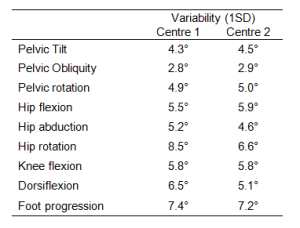
Average standard deviations across gait cycles for different gait variables

This doesn’t mean we should be  complacent, however. In the figure below I’ve compared Verne  in the average normal pose at the instant of foot contact (grey outline) and then increased his leading hip flexion by 6 degrees (and adjusted the trailing foot pitch to bring the foot into contact with the ground again while all the other joint angles remain the same). You can see that this has increased step length by over 10%. If there was an additional 6 degree increase in trailing hip extension as well then this would double. The additive effect of such variability may help explain why foot progression in the table above is a little higher than the other measures in that it can be considered as a combination of the transverse plane rotations at pelvis, hip, knee and ankle rather than a “single” joint angle.

Effect on step length of increasing leading hip flexion by six degrees

In summary the one minute limit seems an extremely useful way of describing how accurate our measurement systems are and we should take considerable confidence from this. On the other hand we shouldn’t be complacent as variability of this level in specific joint parameters can have quite substantial impacts on the biomechanics of walking.

Readers outside the UK may not fully appreciate the title to this blog which is a reference to one of the oldest comedy shows on BBC radio which has been broadcast regularly since 1967. It is one of the purest and most exuberant celebrations of the English language that I know. Episodes are not being broadcast at present but when they are they can be listened to internationally (I think) through the BBC i-player

Getting physical

I had meant to move on from  this issue about the complexity of biomechanics and the quality of the research questions we ask … but then last night, in her comment, Quin drew my attention to a series of articles entitled “Biomedical research – increasing value, reducing waste” that were published in the Lancet in June (these are free to download but you need to register first – also free). They make fascinating reading. If you think I was a bit grumpy and cynical in what I wrote the week before last then you should have a look at what these guys are saying! (The articles are a bit heavy going and an easier and more entertaining alternative is Ben Goldacre‘s book Bad Science, it’s been around long enough that you can pick it up for 1p on Amazon and just pay the postage).

The issue marks the twentieth anniversary of an article, The scandal of poor medical research, written by the statistician Doug Altman in the BMJ which was perhaps the first public recognition of the poor quality of much clinical research with the tag line, “we need less research, better research and research done for the right reasons“. In another commemorative piece, Medical research still a scandal,  Richard Smith, who was editor of the BMJ at the time, laments on how little has changed, despite, perhaps, a wider awareness of the problems.

One of the responses to Bland’s original article which appealed to me has been given the title Theory must drive experiment. In it the author (a JA Morris from the Royal Lancaster Infirmary) attributes the problem of poorly formulated research questions to a failure of clinical scientists to develop an underlying theoretical basis for their experimental observations. This has always puzzled me as well and, over the years, I’ve come to the conclusion that, as someone who trained originally as a physicist, I’ve got a markedly different view of the world to many of my colleagues who trained in medicine or health sciences.

Arthur Eddington, “… do not put too much confidence in experimental results until they have been confirmed by theory”

As a physicist I expect to understand the results of my experiments and to be able to align them with an underlying theory. An understanding of that underlying theory then develops new research questions. My  knowledge continues to develop by the continued construction and refinement of the underlying theory (I’m sure there is a posh name for this in the philosophy of science). Taken to an extreme this results in Eddington‘s warning to the physicist  not to “put too much confidence in experimental results until they have been confirmed by theory“. Whilst at face value this sounds like an injunction against publishing experimental data it is actually a plea for careful consideration of the results in the light of the underlying theoretical framework and a refinement of that framework if  necessary.

Ernest Rutherford, “When it comes to science there is physics and there is stamp collecting”

I wouldn’t claim this as a unique skill of the physicist. Whilst over a hundred years ago Rutherford could quite reasonably(?) claim that “all science is either physics or stamp collecting” , the world has moved on. The rise of anatomy, physiology and particularly biochemical biology since that time mean that there are now underlying theoretical frameworks that we can use to explain the results of clinical and health sciences research.

We very rarely do though and I think this is partly attributable to education of doctors and allied health professionals being rooted in an earlier era. It wasn’t so very long ago that most results of clinical research where, effectively, beyond explanation. There was no point trying to fit those results into any underlying theoretical framework because the basic principles of that framework had not been established.  Knowledge in the clinical domain was essentially phenomenological – a knowledge of what happens rather than why it happens. Education then becomes a matter of teaching the facts rather than the underlying principles that link those facts. Of course if you don’t have an underlying theory to work from then you are going to find it much more difficult to generate sensible questions to drive the next generation of research. This is, of course, exactly the point that Morris was making and links to my post from last week.

As we move out of that era though we’ve got to put a much heavier emphasis on developing the underlying theoretical basis of our subject and using this to drive our research questions. Which leads me to my highlight of the ESMAC-SIAMOC conference which was Adam Shortland’s key-note talk, “The neuromuscular prerequistes of normal walking and the early loss of ambulation in cerebral palsy“. In it he reviewed what is now known about neurophysiological development and laid out a conceptual framework that explains much of what we observe in cerebral palsy and also provides a platform to generate new research questions … but then if you look at his CV you’ll see that he trained first as a physicist as well!


Is it all just too bloody complicated?

I’ve just got back from the ESMAC-SIAMOC meeting in Rome. We’ve been entertained royally for three days in the aulas and cloisters of the Thomas Aquinus University. It has once more been a fantastic opportunity to network and exchange ideas and on one level I come back rejuvenated and inspired.

I say “on one level” because on another level I’ve also come back somewhat disappointed – disappointed because there was little in the scientific programme which left me feeling I understood things better than I did before I arrived. A large number of papers could be summed up by the conclusion, “we understand this area less after performing this research than we did before we started”.  I don’t think it is just ESMAC-SIAMC that suffers in this way. I see it at most of the conferences I attend and in a lot of papers that I read (and, if I’m being honest, in some of the papers that I write).

Just two areas illustrate this. One is in the advanced and complex modelling that is so often the focus of contemporary biomechanics. We learnt (or had confirmed) in Rome that the results are highly dependent on the details of how the individual anatomy is parameterised and of the calibration processes used to define joint centres.  The overall conclusion is that we are less confident in the output of our simulations and models after we’ve performed this research than we were before. Of course it is important to know what the limitations of our research. At some stage, however, we will have to acknowledge those limitations and accept the conclusion that the biological complexity of the human neuromusculoskeletal system is just too great for us to stand any chance of applying these techniques usefully (at least not beyond the constraints of healthy people exercising tightly controlled tasks).

The other field is that of measuring spasticity. Seven or eight years ago I was really excited about the prospect of instrumenting clinical tests to quantify spasticity more rigorously. The results I’ve seen reported are really quite disappointing in that it seems that spasticity is a rather complex and badly behaved phenomenon that simply refuses to be measured.  I have little faith any longer that spasticity is a purely velocity dependent response  (Lance, 1980) and the additional complexity that is introduced when displacement, acceleration or even jerk might have to be considered removes any hope that we will ever understand how these components interrelate within the current paradigm.

One of the “advantages” of research leaving us less clear of what is happening than we were before is that it opens up the conclusion that “further research is required to better understand these phenomena”. Research thus begets research and the university departments rub their hands in glee at the prospect of more research grants, papers and citations. For many of us it leads to increased job security. We have a vicious circle that delights and thrives in creating complexity and chaos.

This is particularly bizarre in orthopaedic and rehabilitation fields (and perhaps more widely across health sciences) in that the tools we have to treat our patients are generally extremely blunt. Selective dorsal rhizotomy, intrathecal baclofen and botulinum toxin are the only tools we have to manage spasticity. At a clinical level the only decision we need to make is which, if any, of these to use. If we want our research to be clinically useful we need to concentrate on the simple questions that need to be answered before we turn our focus to the more complicated ones that don’t.

The small number of presentations that did impress me posed a research question in such a way that the answer actually improved my understanding of a given issue. Almost all of these resulted in me having a clearer, simpler view of the world after the presentation. This doesn’t necessarily require simplistic techniques. The walk-DMC scale that Kat Steele and Mike Schwartz proposed in their prize winning paper (page 25 of Abstract Book) uses a sophisticated technique. It is a technique, however, that has been appropriately selected to answer a well posed research question (Can we quantify the effect of disordered motor control on walking in children with cerebral palsy?). Once the appropriate techniques has been selected the answer is simple (Yes, at least on the basis of the preliminary analysis they presented).

One of the most ancient tests of the scientific quality is Occam’s Razor, that science (and our thinking in general) should be as simple possible but no simpler. It would be interesting to perform an audit of the presentations at any contemporary conference against this criterion. I suspect the results would be quite sobering.

.

Lance, J. (1980). Pathophysiology of spasticity and clinical experience with baclofen. In R. Feldman, R. Young & W. Koella (Eds.), Spasticity: disordered motor control (pp. 485-495). Chicago: Year book medical publishers.

Post-doctoral research opportunity at University of Salford

Sorry to clog up your in-box if you are really happy where you are but we have just announced a 4 year post-doctoral research fellowship in biomechanical modelling for clinical gait analysis. The full blurb reads something like this:

This is one of a small number of highly strategic research career opportunities being funded by the University with the explicit aim of making a significant contribution to the University’s REF2020 submission and to the University’s research income position. 

The primary focus particularly over the first two years is to drive a research programme : Development and validation of a new version of the Conventional Gait Model. This will build on previous work in Salford (Chris Nester and Richard Baker) and at the Royal Children’s Hospital in Melbourne (Richard Baker and Morgan Sangeux) and has financial support from Vicon. It is hoped that the work will involve use of bone pin studies to validate the kinematic aspects of the model (subject to appropriate ethical approvals). 

In the final three years the appointee is expected to develop and source funding for a research programme growing out of this area and in collaboration with other researchers within the University. 

Please visit our web-site for full details and to lodge an application or contact Professor Richard Baker (r.j.baker@salford.ac.uk to discuss informally).

Push off push-off

Sheila from Dundee dropped me an e-mail: 

In your meanderings around the subject of gait have you come across any definitive descriptions of push-off i.e. at what time in the cycle does it start? Or do you have any thoughts on the matter yourself?

Having replied it struck me that others may be interested in this topic.

As far as I’m aware “push-off” is only used loosely to describe a phase of the gait cycle. I’ve never seen a definition in terms of where it starts and where it ends. My preference is to describe the phases based on single and double support and swing (with single support and swing divided into three equal parts). This intentionally avoids labelling any particular phase as having any particular function (push-off, shock-absorption etc.) partly because people often get these functions wrong when describing walking and partly because patients may not achieve such functions at the same phase of the gait cycle as the able-bodied.

“Push-off” is particularly problematic. How usefully it describes the late stance phase depends both on whether you are considering the whole body or just the leg and the direction you are talking about. During late stance the centre of mass is moving downwards and forwards. The downward motion is being resisted. From this perspective late stance is a phase of deceleration and the term “push-off” is inappropriate. The segments in the limb however are moving in different directions, the foot, ankle and tibia are being “pushed up” whereas the femur is actually moving downwards with the centre of mass.

Looking in the horizontal direction both the centre of mass and the limb are being accelerated forwards. There is a relatively small acceleration of the centre of mass (but this affects a large mass) and a rapid acceleration of the limb (which has a much smaller mass). In this context “push-off”  does appear an appropriate descriptor at first.

Focussing first on the centre of mass movement though – if you model the whole body as an inverted pendulum with mass and leg length matching the human body you find that the entirely passive mechanism (no muscle activity) develops an anterior component of a ground reaction in late stance that is very similar in magnitude to that of the ground reaction at this phase of healthy walking. This force arises because of the relative alignment of the centre of mass, limb and foot and suggests that the muscles need only preserve this alignment to generate it. “Push-off” suggests something much more active and may be misleading.

If we focus on the limb – there has been a debate for nearly 200 years about whether it is being pushed forwards by the action of the plantarflexors pushing against the ground or pulled forwards by the hip flexors. I think it very likely that both are important. It’s tempting to think that some insight into this can be gained from looking as the joint power graphs. They show power generation at both hip and ankle which tends to confirm that both are important. Power, however, is a scalar quantity (it is not associated with any particular direction) representing the rate at which energy is supplied to or removed from the whole body by the muscles acting across a particular joint. Given this it is very difficult to come to any rigorous conclusions about the relationship between the power generated at the joints and the movement in a particular direction of the segments of the limb being “pushed-off”  (to say nothing of complications when power may actually be being generated by muscles spanning more than one joint). To answer the problem categorically would require some form of induced acceleration analysis as to what particular muscles are acting to accelerate the segments during late stance. I’m not aware of anyone having done this (perhaps readers can let me know if they are).

Going back to the original question. I’d maintain my suggestion that we avoid “push-off” as a term. It’s an easy label to apply that makes us think we understand something that many of us don’t (and I’d include myself in this).