gait analysis

Shear pedantry

I criticised a colleague the other day for using “shear force” to refer to the horizontal component of force measured by a force plate. He asked me “why?”  Apart from me being a miserable old pedant who’s got nothing better to do than be annoying, the simple answer is that someone did the same to me a long time ago (it might have been Chris Kirtley, but then again it might not).
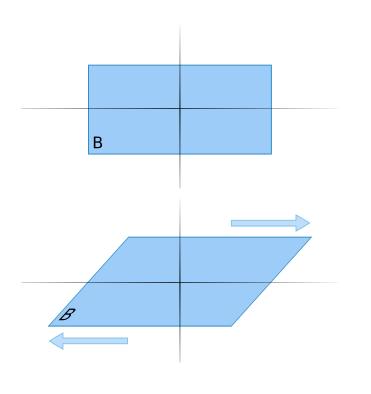
I don’t always trust Wikipedia but think it is quite good in distinguishing between shear forces which occur when forces are unaligned and cause a shear deformation (see figure above) and compressive forces when they are aligned and lead to pure compression or elongation.  To distinguish between these you need to know how and where the balancing force is applied. The force plate only measures the ground reaction and I’d argue can’t therefore distinguish between shear and compressive forces. What it can do is resolve the overall force into components in different directions. I’d thus prefer to describe the components in terms of the direction in which they are acting rather than the assumed effect they are having on tissue.

If I was being really really pedantic I’d probably say that shear forces exist within a material rather than being applied to it. In most biomechanics it is actually the shear and compressive  stresses and strains that are more important. These are caused by the external forces exerted on the material but are conceptually quite different being within the material. Generally speaking the vertical component of the ground reaction will give rise to compressive stresses. Given the complex arrangements of soft tissues in the foot and the irregular shape of the bones, however, it will also cause some some shear stress. Similarly although horizontal forces will result primarily in shear they will exert some compressive (and occasionally tensile) stresses as well.

Or am I being too pedantic? Anyone like to defend the use of shear force to describe what a force plate measures? It’s certainly very common usage.

Gait graphs for beginners

I’m teaching about gait to the undergraduate physios next week. Its the first lecture I’ve given at this level trying to emphasise the approach I’ve developed in the Why we walk the way we do videos. The colleague who’s delivering the previous lecture – which included a first introduction to gait graphs – wanted to use the same format as I use which started a conversation about what aspects of walking we’d like those graphs to emphasize.

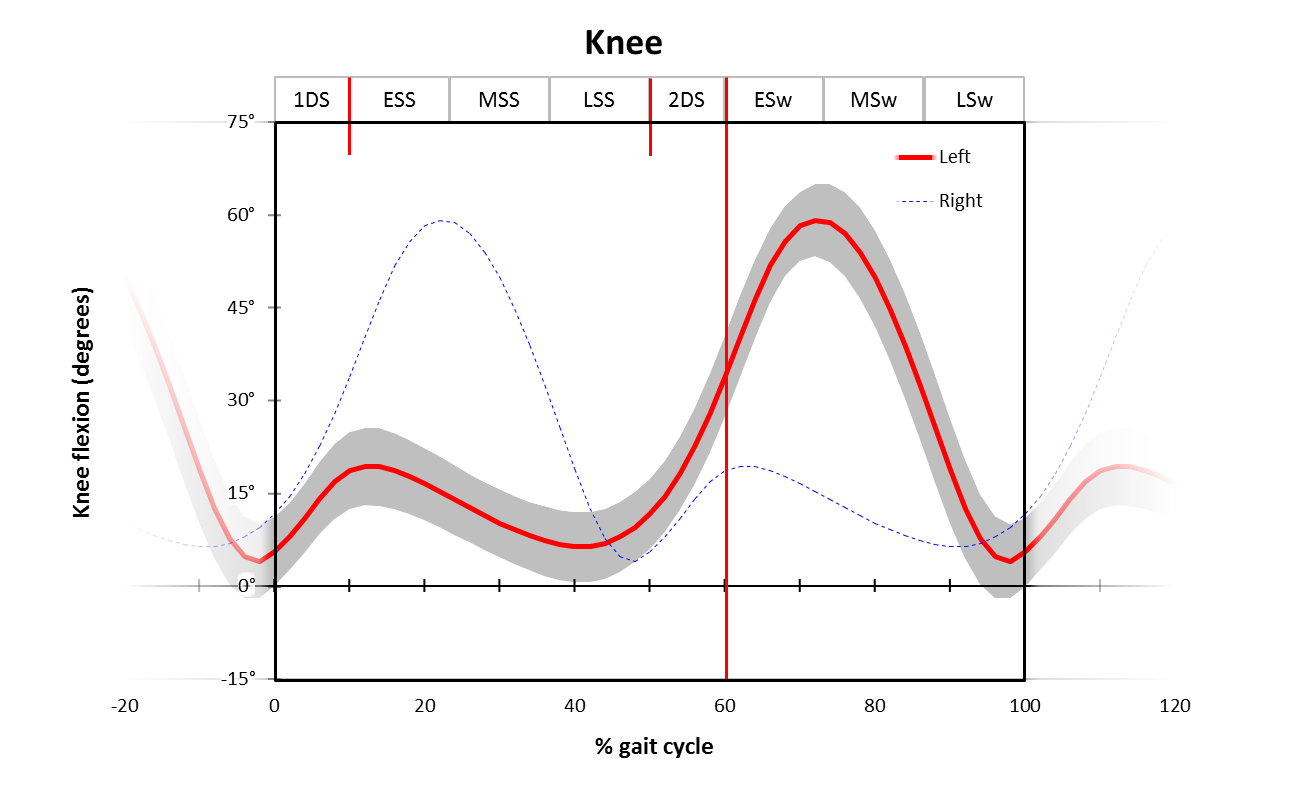
Knee graph

I’m pretty keen on fixed aspect ratios and scaling so that you can forget about those issues when you are actually looking at data – so we’ve fixed that.  We wanted also wanted to reinforce the terminology for different phases that I’ve described in a previous post – so we’ve put those abbreviated names across the top.

I also like to represent the continuity of the gait cycle – it amazes me how many people I come across who don’t seem to realise that point on the far left of the graph is the same as the point on the far right hand side (give or take a little stride to stride variability). It’s also not uncommon to spot data in the literature where values of gait variables at 0% and 100% are different but not commented upon. Various people in the past have tried plotting more than a single stride to try and emphasize continuity. I know Jurg Baumann was an advocate of this but can’t find easily get my hands on a sample. At Hof also used it – his 2002 paper on the speed dependence of EMG profiles is an example – but it has never really caught on. In this format I’ve tried to capture the point by allowing the gait curves to fade away to nothing outside the graph. It’s a bit messy if you’ve got a whole array of graphs but I kind of like it in the context of an introduction at this level.

I’m also very keen on getting students to appreciate what the right leg is doing plotted on the same time scale as the left leg. I know this insenses people who are paranoid about the importance of symmetry in gait but it’s a hell of a lot easier to explain the biomechanics if you look at the data this way. It’s unconventional of course so I’ve chosen to represent this as a much fainter line.

There was another question mark over the hip angle. As gait analysts most of us assume that this should be measured relative to a pelvic axis represented by the line from PSIS to ASIS and thus biasing the hip graph towards flexion. In assessing gait by observation, however, physios almost always consider the angle with the vertical which might be more relevant for daily practice. In the end we decided to stick with the gait analysis approach and just make sure we explain this very clearly.

Anyone got any additional features they like to add?

.

Hof, A. L., Elzinga, H., Grimmius, W., & Halbertsma, J. P. (2002). Speed dependence of averaged EMG profiles in walking. Gait Posture, 16(1), 78-86.

Making attractive gait graphs in Polygon

Not a proper post this one and only of interest to Vicon users but, prompted by one of the students on our Masters Programme in Clinical Gait Analysis,  I’ve created a video to illustrate how to create nice gait graphs within Polygon. It also shows how you can export these easily to Word and the data to Excel (then you can look at an earlier post to see how to create yet another set of graphs!) .  I’ve used Polygon 4 to create the video but I know there are still many Polygon 3 users out there. The interface looks a little different but the basic process is exactly the same. The main difference is that there is no Attributes panel in Polygon 3. In most cases you have to right click on an object (graph, graph axis etc) and select one of the options on the menu that then appears.


Analysing analysis

What do we mean by clinical gait analysis? Most of you reading this blog will assume it requires a kinematic measurement system, a couple of force plates and possibly an EMG system. For the vast majority of clinicians across the world, however, it means looking at how their patients walk without even the benefit of a video camera. In my book I suggest that what we call clinical gait analysis should really be called instrumented clinical gait analysis. I then pointed out that this is rather cumbersome and that I’d use the term clinical gait analysis anyway!

OGA Rancho

The team at Rancho Los Amigos used the term Observational Gait Analysis as long ago 1989 when they published their Handbook. The photo below is the cover of the 4th edition from 2001. The most recent edition is an app for the iPhone which you can get download from iTunes (doesn’t seem to be any Android equivalent yet unfortunately). Brigitte Toro picked up on observational gait analysis (OGA) and introduced video-based observational gait analysis (VOGA) in a review article a few years ago now (2003). If we used these terms carefully there would be clear ground between them and clinical gait analysis which could be reserved for the instrumented approach.

I was, however, interested by the comments of Professor Phil Rowe from Strathclyde University speaking at one of the satellite events orbiting ESMAC in Glasgow this year and focussing on the word analysis. His point was that analysis is a process of thinking which requires some data.  It is thus not possible to perform a clinical gait analysis without some sort of instrumentation to provide those data. On this basis it would be inappropriate to refer to clinical observation of walking (either direct or through video recordings) as analysis. Perhaps clinical or observational gait assessment  are more appropriate terms (although we then end up with the same acronym, CGA). The surgeons in Melbourne also used to talk about gait by observation which seems another sensible alternative. As an engineer I quite like Phil’s line of reasoning and think a distinction between a true analysis of data and an observation of patterns is useful.

But maybe things aren’t so clear cut. Wikipedia defines analysis as the process of breaking down a complex topic into smaller parts to gain a better understanding of it. This definition doesn’t actually require any data.  It’s also true that whenever I’ve heard observational gait assessment being taught the focus has been on breaking down the overall gait pattern into smaller parts, either by plane or level, or both, to aid understanding. Maybe I’m being over-protective in trying to restrict the term analysis to instrumented processes. Any comments?

.

Toro, B., Nester, C., & Farren, P. (2003). A review of observational gait assessment in clinical practice. Physiotherapy Theory and Practice, 19(3), 137-149.

What is normal walking?

In the last post I commented on the recent paper by Dall et al. (2013) and the context of its publication. As commented on by the author in response to that post, some of the results are interesting in their own right. (I was going to paste a couple of figures from the paper into this article but the publishers require a payment of over $300 to do this legally so you’ll have to download a copy of the paper yourself if you want to see the evidence.)

Figure 1 shows the frequency distribution of minute epochs during which walking was recorded at various cadences. The mean cadence was 76 steps per minute with a cadence of less than 100 steps per minute in about 80% of the minutes during which any walking was recorded. When healthy adults walk at “self-selected” speed in the gait lab they tend to walk at cadences of well over 100 steps per minute (A brief review of the previous literature in Winter (1991) suggests values between 100 and 120). We can thus see that cadence in everyday activity is very different to that during walking in the laboratory.

The paper also includes a second graph (Figure 4) showing the same data but for the sub-set of minutes when the participants walked for the full minute. This shows a mean value of 109 (±9) steps per minute which is in much better agreement with the self-selected walking speeds recorded in the laboratory. The most obvious explanation of these two graphs together is that when we walk for short bouts we do so at much slower cadences than we tend to look at in the laboratory but when we walk continuously for a minute or more that we appear to walk at similar speeds (although the graphs tends to suggest that there is more variability in this in real life than I’d expect in the laboratory).

This can be put together with the data from Orendurff et al. (2008) that shows that 90% of bouts of walking are for less than 100 steps and 75% are less than 40 steps to suggest that the walking we investigate in the gait laboratory is quite different to the walking the we use most frequently in our everyday lives. This worries some people but this misses the reason for performing clinical gait analysis as we do. We use level walking at self-selected speed because it is a well-defined stereotypical movement that we understand reasonably well. We hope that analysing it will give clinical insights into impairments of neurological, muscular or skeletal function. The ultimate hope is that if we base treatment on the results of this analysis then we will improve function in “laboratory walking” and in every day walking as well. I hope you can see that this line of reasoning does not necessarily require laboratory walking to be representative of everyday walking.

.

Dall, P. M., McCrorie, P. R., Granat, M. H., & Stansfield, B. W. (2013). Step Accumulation per Minute Epoch Is Not the Same as Cadence for Free-Living Adults. Med Sci Sports Exerc.

Orendurff, M. S., Schoen, J. A., Bernatz, G. C., Segal, A. D., & Klute, G. K. (2008). How humans walk: bout duration, steps per bout, and rest duration. J Rehabil Res Dev, 45(7), 1077-1089.

Winter, D. (1991). The biomechanics and motor control of human gait: Normal, Elderly and Pathological (2nd ed.). Waterloo:: Waterloo Biomechanics.