biomechanics

Walking with pathology

One of our students studying for the MSc in Clinical Gait Analysis recently wrote an essay of “The role of gait analysis in  spina bifida” (myelomeningocele) which reminded me about work we did about 15 years ago when I was in Belfast (unfortunately it only ever got written up in Michael Eames’ MD thesis). At the time we were doing some modelling to look at how people with this condition walk. This young man has got a lesion at lower lumbar level (L4/L5) which means he’s got marked weakness in a range of lower limb muscles including plantarflexors, hip extensors and hip abductors. (He’s walking with the help of solid AFOs although you don’t see these on the “skeleton”). Importantly he retains function in his quadriceps (which are innervated from above this level).

This is a classic gait pattern for a person with this condition. It shows the trunk moving considerably from side to side. It looks clumsy and uncontrolled and its extremely tempting to make straightening him up an aim of therapy.

But the data were collected as part of a study into how the centre of mass moves. If you look carefully you’ll see there appears to be a blue ball moving around within the pelvis. This is the centre of mass, the point at which all the body’s weight can be assumed to act. It appears to be moving a lot from side to side confirming how much the trunk is moving around. If you hover your mouse pointer over it, however, you’ll find this is an optical illusion. The ball itself is moving very little from side to side, it only appears to be moving because of the larger movements of the trunk and especially the pelvis which your eye tends to follow. When we calculated the excursion from side to side it was very little more than the excursion that you or I use when walking around.

So what we might be seeing is not clumsy and uncontrolled gait but an exquisitely controlled gait that keeps his centre of mass pretty much in the same place whilst there is all that trunk movement going on around it. This is particularly amazing given that he has no functioning in his abductor muscles which are those that are primarily responsible for medio-lateral control. What we found is that his trunk moves so far that, at the end of the range of movement when control is required, the adductor muscles, which are preserved at this level, are able to provide this control. An alternative way of looking at this gait pattern is as the central nervous system is doing an amazing job in optimising the way he walks taking into account his neuromuscular deficits. If you try and train him to walk more upright the chances are he’ll walk a lot less efficiently and perhaps less functionally. I’m not even sure he could walk at all without the trunk sway (and without walking aids). If you want the optimum gait pattern given his impairments maybe you should leave the gait training to the central nervous system!

It’s for this reason that I prefer to talk about walking with pathology rather than pathological walking. I suspect that most of our patients are walking as optimally as they can given their impairments (which might included impairments to the central nervous system). Their walking is anything but pathological.

Of course the gait pattern may place abnormal stresses on various structures which may cause degenerative changes. This needs to be factored into any management plan but it should also be remembered that people with gait patterns like this quite often do not walk very much and the potential detrimental effects of high loading during walking may be offset to some extent by its limited duration.
More on muscle

In his comment to my last post BJ said, “I think our field needs some general physiological principles (such as “muscles generate very little passive force during walking”) to help improve the accuracy of our muscle force estimation process”. In his book Rick Lieber states, ” It is difficult to hypothesise, a priori, the ‘best’ sarcomere length operating range of muscle”. So there’s a challenge!

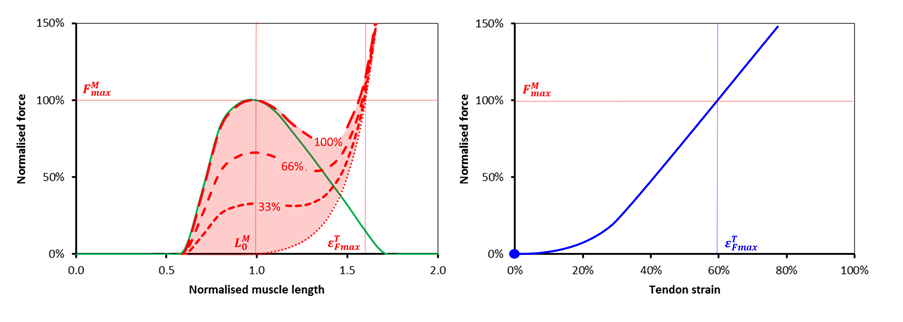
In looking at the issues I realise that I’ve never really seen a simple analysis of how a muscle and tendon work together in series (most I’ve looked at get very complicated very quickly, e.g Winters as quoted by Thelen). So let’s take the well known properties of the force length curves for muscle and tendon (see Figures below) and try and consider how they would lead a simple musculotendinous unit to behave.

Muscle and tendon

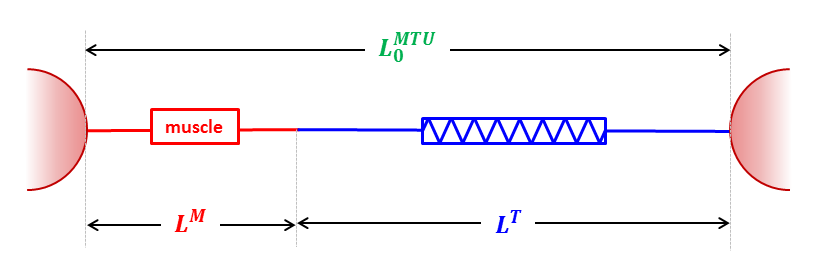
Let’s assume the simplest possible arrangement of these as two elements in series held at fixed length. Let’s start off by analysing what happens when this fixed length is what I call musculotendinous unit slack length. This is the minimum separation of origin and insertion at which both the inactive muscle and tendon generate no tension (muscle at optimal length, tendon at tendon slack length to use the jargon).

MTU

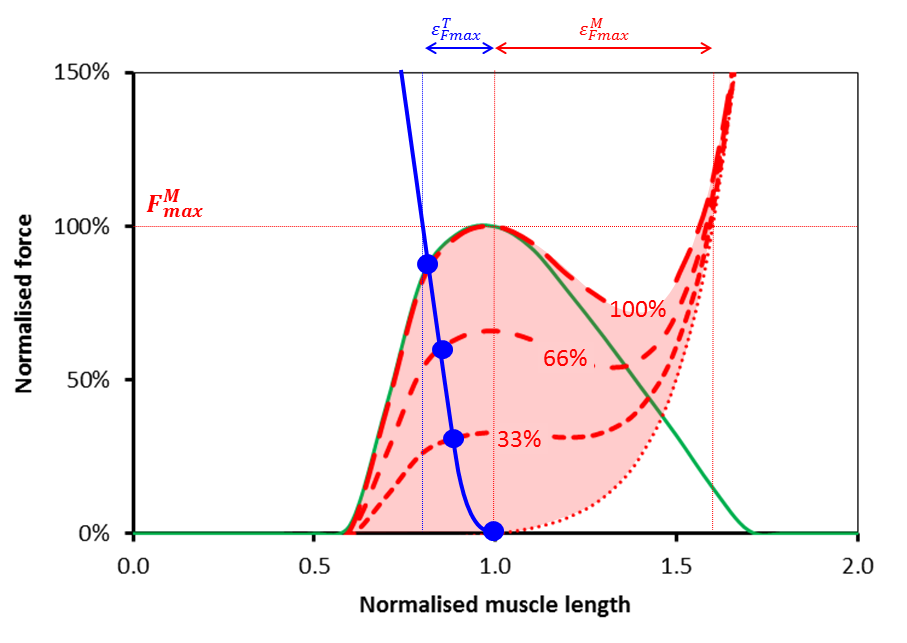
Its obvious that together the length of the muscle and tendon must equal the fixed length we’ve chosen so it becomes possible to plot the force generated in the tendon as a function of muscle length on the same graph as that for the muscle (see Figure below). It looks steeper because the horizontal scales of the two graphs above are different and it appears to be the wrong way round because as the muscle get’s longer the tendon will get shorter.

MTU graph

Now if any two mechanical elements are in series like this we know that the same force must pass through both (these are the laws of physics and we can’t do anything about them). We can thus say that the force generated by the musculotendinous unit as a whole must be equal to that at the point at which the red line and the blue lines cross for a given level of activation (represented by the blue dots for 0, 33%, 66% and full activation). You’ll see that as the muscle get’s more activated this point moves up and to the left. The tension in the musculotendinous unit increases as the muscle shortens (and hence the tendon lengthens) which is what you would expect.

Notice however that the force must lie somewhere on the blue curve. This restricts quite severely the range of muscle lengths at which the musculotendinous can generate force. Rather counter-intuitively (at least to my simple mind) the operating length of the muscle as a component of the musculotendious unit appears to be more dependent on the force-length characteristics of the tendon than those of the muscle. Notice also that the maximum force that the unit can generate (the point at which the blue line and maximum activation curve for the muscle intersect) is less than that for the muscle acting in isolation.

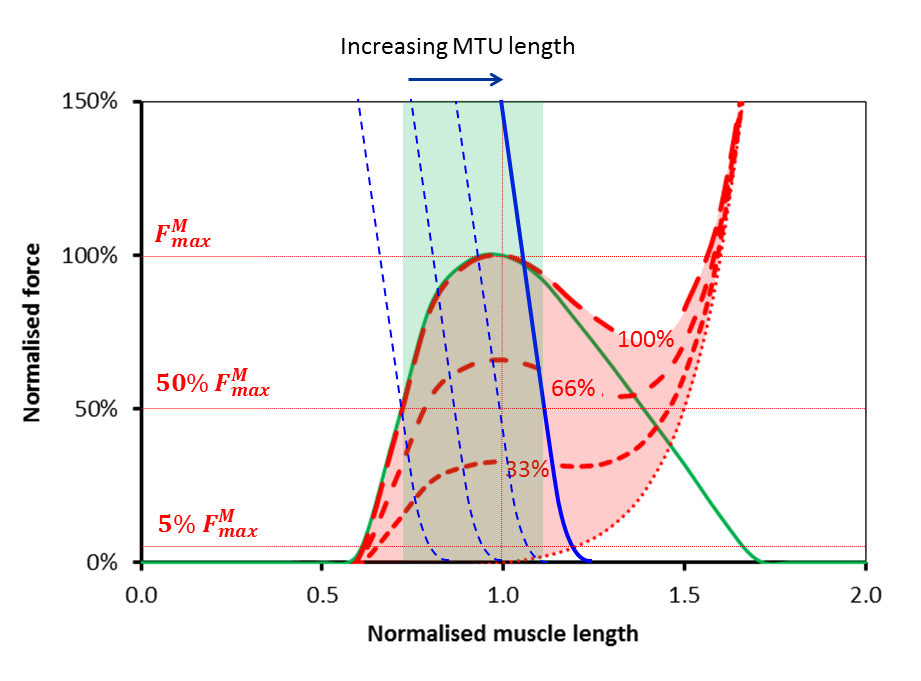
At musculotendinous unit lengths the only change in the graph is that the blue line will move to the right (if the unit gets longer) or to the left (if the unit gets shorter). An interesting observation here is that if the blue curve moves too far to the right then there will come a point at which there is a minimum force that the unit can generate as well as a maximum. This makes sense in that if you stretch the musculotendinous unit too far you will be stretching the passive parallel component in the muscle regardless of whether it is activated or not.

But let’s take that in combination with the observation I focussed on in last week’s post that when we move the joints passively (through much more than the  range of movement required for walking) during a physical examination of a healthy adult we encounter minimal resistance. This suggests that there must be a limit to how far to the right that blue line can be during walking. If we assume the resistance to passive stretch over the range of movement required for walking is less than 5% of the maximum force that the muscle can generate isometrically (I think this is quite a reasonable constraint to impose) then the most right-ward position of the solid blue line is that illustrated in the figure below. You can see that this restricts the operating range of the muscle even more than the logic I applied last week. Last week I argued that the muscle cannot be operating on the passive arm of the the force-length curve.  This week I’m suggesting that it cannot be operating on much of the descending arm either.

MTU graph (max)

The thinner dashed curves show the behaviour of the system when the musculotendinous unit is shorter. As well as a line at 5% of maximum muscle force I’ve drawn another in at 50%.  The green region is thus intended to show the range of muscle lengths over which the musculotendinous unit is capable of generating this level of force. It suggests that in order for effective force generation by the musculotendinous unit the muscle lengths must lie between about 70% and 110% of optimum length.

The curves, particularly that for tendon, will vary from muscle to muscle (and maybe from individual to individual). The data illustrated here are those use to describe the lateral gastrocnemius in the Gait2392 model which is available through the OpenSim web-site (although I’ve tweaked the characteristics of active muscle force generation to match the widely accepted work of Gordon et al.). I’ve tried it with a semimembranosus as well and get a slightly steeper tendon curve (when scaled to optimum muscle length) but broadly the same conclusions. The analysis assumes isometric contractions of the muscle but given that most of the conclusions are dependent on the characteristics of the force-length curve for tendon rather than that for muscle I can’t see how consideration of the force-velocity characteristics of muscle can make that much difference.

I’d be particularly interested to know if anyone has seen a similar analysis in print anywhere. Have I just been looking in the wrong places?


Generating patterns

I’ve only fairly recently come across the videos of the results of the OpenSim dynamic walker competition on the OpenSim YouTube channel. The OpenSim team made the basic models available and challenged people to see how far they could make the models walk. Although you are too late to participate in the competition all the material is still available on their web-site to allow you to prepare a late entry. There are really two challenges, one is to design the model and the other is to work out exactly how to “push” it to get it started. The three best results are linked to in the video below.

Dynamic walkers are simple mechanical structures with a small number of links which, when pushed in a particular way to get started, will walk down a slope (they have to walk down a slope because they lose some energy whenever the foot collides with the ground). They were pioneered by Tod McGeer over twenty years ago and this video shows him explaining the principles. The field has grown quite markedly since and there is an annual Dynamic Walking conference (the last was in Zurich).

It seems obvious that we can learn  about the mechanics of walking using these models (although it is also important not to over emphasize the similarities – all passive walkers used a locked knee during stance, for example, whereas most of us walk in a little knee flexion which is not inherently stable and requires muscle activity). It stuck me looking at these videos that walkers may also be able to tell us something about neurology – principally because they don’t have any. These walkers are simple assemblies of passive mechanical components and without any control mechanisms at all.

What interests me is that a lot of people in the field of motor control seem to assume that if a complex cyclic pattern is observed then there must be something in the central nervous system generating it. Perhaps the most commonly cited example is the decerebrate cat. If you are careful, you can take the brain (cerebrum) out of a cat, place it on a treadmill and it will walk, and may trot and gallop as the speed increases (you can see a short video here – but you don’t have to if you object to this sort of animal experimentation). This is not the only evidence that is cited in support of the assumption that walking is driven by central pattern generators in the spinal cord (see the first two sections of this this paper for example) but it is the most graphic.

The passive dynamic walkers, however, do not have any control system for generating patterned movement and still exhibit complex cyclic patterns of movement.  It seems clear to me that whilst the basic gait pattern might be a consequence of pattern generating neurons somewhere in the central nervous system it doesn’t necessarily have to be. I’m not an expert in the field but I’d guess that the most likely explanation is that there is an interaction between the basic mechanical behaviour of the system and the neural control which is rarely discussed. This is supported by recent work from Gottschall and Nichols which shows that, however the decerebrate cat is generating cyclic movement, the walking pattern is influenced by head position, indicating that it is modulated by either vestibular or proprioceptive input.  As Art Kuo pointed out some years ago control systems incorporating proprioceptive feedback are likely to be more stable than those driven purely by pattern generators (feed-forward control).


Rockers or rollers?

Writing about the movement of the hind-foot the a couple of weeks ago and about projection angles last week has led me to reflecting a little on Jacquelin Perry’s rockers. As with many of the concepts that we have in gait analysis, the rockers can give us some really useful insight into how we walk but can also prove misleading if we don’t remain conscious of their limitations.

I don’t recognise the word “rocker” as meaning anything in particular in this context and had assumed it was an American word meaning pivot or fulcrum. I happened to mention this to a couple of American colleagues a couple of years ago, however, and found that they didn’t recognise the word either. It would appear that Perry simply made it up. Not that it matters much, the word seems to get the concepts across readily enough.

The rockers provide mechanisms for the tibia to move forward over the foot and hence for the passenger unit to be carried forward in stance. If we look at the angle the tibia makes to the vertical (above) then we can see that it starts off about 20° behind vertical at foot contact and progresses forwards reasonably steadily (with a bit of a wobble) to reach about 50° in front of vertical at foot off.

tibial progression

Perry explains this in terms of three rockers.  Early on the whole foot rotates about the heel. Later on the tibia rotates over the foot about the ankle and then finally the whole foot rotates about the forefoot (see below). Easy eh!

rockers

There is no doubt that all three mechanisms make important contributions to tibial progression. I’m not quite so convinced by Perry’s implication that these occur as a sequence of discrete mechanisms. To investigate this we need to look at the dorsiflexion graph which tells us when ankle rocker occurs and the foot projections graph that tells us when the heel and forefoot rockers are active (see graphs below, note that is impossible to distinguish the timing of the rockers from the ankle angle graph alone ).

Rocker graphs


Heel rocker starts off at foot contact and proceeds until the foot is flat at about 8% of the gait cycle (in red above). It should be noted that this is considerably longer than the period to maximum plantarflexion in early stance that it is sometimes related to. Ankle rocker is the period over which the dorsiflexion angle increases which we can see from the ankle angle graph is from about 5% of the gait cycle to about 45%. There is thus a short period of overlap when both the heel and ankle rockers are active.

Forefoot rocker starts with heel lift which Perry suggests occurs at mid-stance (30% gait cycle). The data depicted above suggests it might commence even earlier (20%?) and it continues until the end of stance. It is thus clear that there is a considerable period from about 20% of the gait cycle until 45% when both ankle and forefoot rockers and simultaneously active.

The conclusion is that whilst the rockers are undoubtedly the mechanisms which allow the tibia to progress they form an overlapping progression rather than a series of discrete events. Indeed for the majority of stance two rockers are active simultaneously.

Since Perry introduced the concepts there has been some slippage in how the terms have been applied which is best avoided. As far as I can see, Perry always talked about heel, ankle and forefoot rockers and never first, second and third rockers. I think this is good practice as quite a lot of our patients don’t have a first rocker (they make contact with the forefoot rather than the heel). It’s always seemed a little illogical to me for someone to have a second rocker if they’ve never had a first rocker!

The other common misconception is that the rockers are alternative labels for phases of the gait cycle. Again Perry never used them in this sense, for her they are mechanisms that allow the tibia to move forward over the foot not phases of the gait cycle. It is particularly erroneous to apply these terms to phases of pathological gait. Many kids with CP never make heel contact and it is thus completely inappropriate to refer to early stance as the phase of heel rocker.

This reinforces the fact that the rockers are mechanisms of normal gait and great care is required in applying the terms to walking with pathology. If a child with CP makes contact with the toe after which the foot comes flat later in stance then they must use a mechanism that might best be described as a reverse forefoot rocker during which the heel is being lowered to the ground rather than being raised. Similarly if they employ a vault to assist clearance of the swing limb then they will often have a reversed ankle rocker during which plantarflexion (rather than dorsiflexion) increases.

Referring back to the work I described in my blog the week before last strongly suggests to me that, in bare feet, the heel rocker is actually a heel roller with the movement being a rolling on the curved surface of the posterior-distal calcaneus rather than a pivot about a particular point on the heel. On the other hand if walking in a shoe with a reasonably stiff heel it is more likely that a rocker like mechanism does occur. The appropriateness of this terminology may thus depend on footwear as well as gait pathology.

PS. In the second edition of Gait AnalysisPerry and Burnfield describe a fourth toe rocker very late in stance.  This can certainly be seen on slow motion videos but I’m not aware of any detailed studies of its biomechanical significance. It looks to occur very late on and I suspect only after most of the load has been taken off the foot but it would be nice to see a more definitive analysis of this.

Projection angles

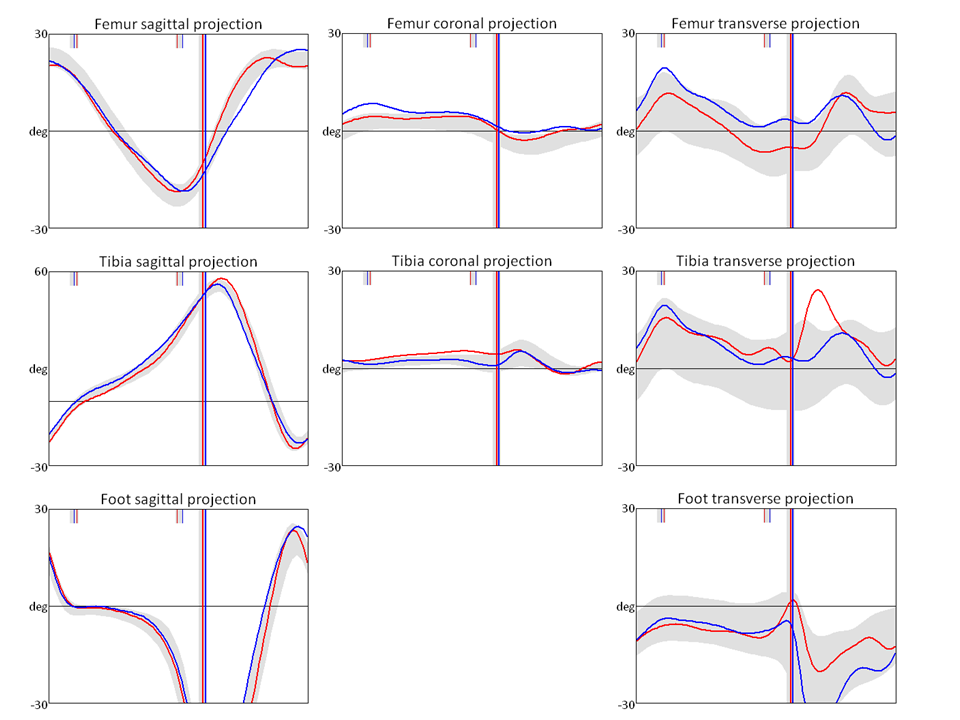
I’ve had some feedback from Vicon support that people have been asking them how to calculate what I’ve called projection angles on page 138 of my book. These are graphs that look a bit like joint kinematics but represent how each of the segments is aligned with respect to the global axis system rather than to the proximal segment. Two of the femur projection angels thus show how the long axis of the femur is tilted with respect to the vertical in the global sagittal and coronal planes. The third angle shows how the femur is rotated about this axis (projected onto the transverse plane).

projection angles


I first plotted these graphs as a quality assurance tool in that they represent what you should see on  a video recording of the person walking (as long as you take into account parallax effects if the person is not in the centre of the screen or the camera is not directed exactly along one of the principal axes of the global coordinate system). Thus the femur transverse projection tells you whether you should be seeing the femur as internally or externally rotated as viewed by a camera towards which the person is walking. It avoids the need to perform a mental sum of pelvic rotation and hip rotation to assess which is required otherwise. In the example above, at foot contact the left thigh (red) is facing directly ahead and the right thigh is internally rotated by about 5°. You probably won’t be see such a small difference but if the right limb looked to be externally rotated at this instant you might want to question the alignment of thigh markers or knee alignment devices.

Since starting to plot the angles, however, a range of other uses have emerged. The tibia and femur sagittal projections, for example, are essentially what Elaine Owen refers to as segment to vertical angles when tuning ankle foot orthoses.

The foot transverse plane angle is what many of us already plot out routinely and call foot progression. The corresponding angle in the sagittal plane, however, is very rarely plotted but gives a direct appreciation of whether the foot is flat or not. In the example above the foot makes contact at an angle of about 15° to the ground and rotates to become flat on the floor (0°) during about the first 8% of the gait cycle (Perry’s heel rocker). It then remains flat until about 40% of the gait cycle (ankle rocker) after which heel rise causes the foot to start tilting forwards (negative angle, representing toe rocker). If distinguishing between the rockers is important to you then using a graph like this is about the only way to do it. I’ve referred in a previous post to how useful I find this information can be.

I’ve not plotted the pelvic graphs because, if you calculate them using the correct rotation sequence, then they are virtually identical to the pelvic joint angles.

The main reason for this post is thus to make the model that I wrote many years ago to calculate this widely available (click here to go to the download page). Unfortunately it is written in Vicon’s BodyLanguage so will only be directly useful for Vicon users (please note that it requires plugin Gait to have been run first). The accompanying description of exactly what the angles represent should, however, allow any reasonably competent clinical engineer to calculate the equivalents in any other programming/modelling language.