biomechanics

What are the hip adductors for?

Various things have made me think about muscles this week and an issue that’s puzzled me for some time. Why do we have such big hip adductors? Edith Arnold’s paper (2010) is probably the most authoritative we have on the relative strengths of muscles based on muscle volume and fibre length measurements from 21 cadavers. I’ve tabulated the data below. It’s got a few surprises. The gluteus maximus is the largest muscle but several others are considerably greater capacity to generate force (because they have more shorter fibres), the soleus, for example, has nearly twice the force generating capacity.
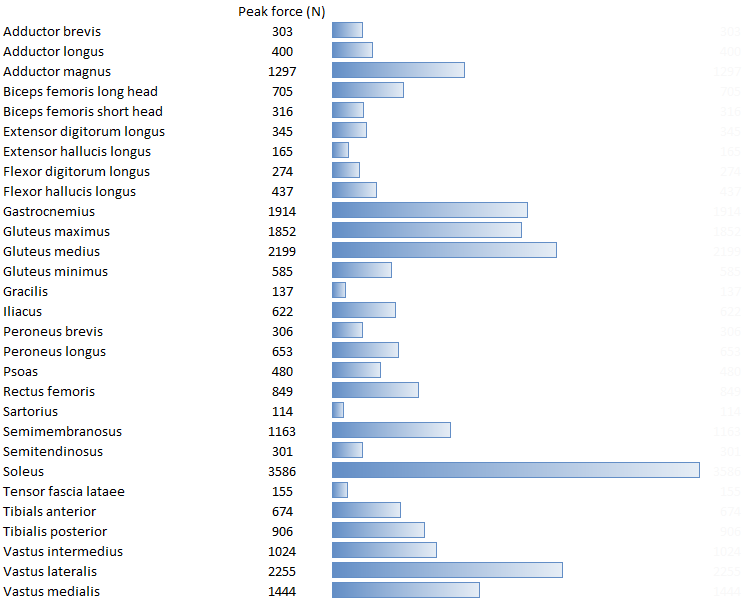
Muscle strength

Adapted from data contained in: Arnold, E. M., Ward, S. R., Lieber, R. L., & Delp, S. L. (2010). A model of the lower limb for analysis of human movement. Annals of Biomedical Engineering, 38(2), 269-279.

What I want to focus on today though is the force generating capacity of the adductors. Summing the peak forces we get 2000N for adductors brevis, longus and magnus working together which is considerably greater the gluteus maximus and up there with the other big muscles. Of course the purpose of muscles is to generate moments and we have to take the moment arm into account as well. The adductors have some of the largest moment arms in the lower limb so their moment generating capacity is even larger than the simple peak force might suggest.

But why do they need to be so large? In both walking (Schwartz, 2008, see figure below) and running (Novacheck 1998) at a range of speeds there is a continuous abductor moment at the hip throughout stance. Indeed because the hip joint is so lateral with respect to the centre of mass of the trunk its very difficult to see how there can be anything other than an internal abductor moment at the hip.
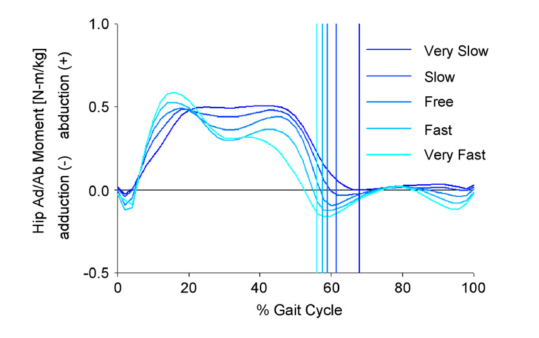
hip adductor moment

Schwartz, M. H., Rozumalski, A., & Trost, J. P. (2008). The effect of walking speed on the gait of typically developing children. J Biomech, 41(8), 1639-1650.
Anderson and Pandy (2001) in their simulation of human walking found low levels of activation in the adductor magnus. This was confined to a short period  around foot contact presumably to supply the small adductor moment immediately after heel contact as seen above. Unsurprisingly in later analysis  (2003) of the same data they concluded that the adductors make a negligible contribution to the vertical component of the ground reaction. Liu et al. (2006) who were tracking real data, found that the adductors don’t make any contribution to the vertical or fore-aft component of the ground reaction either at normal walking speed (2006) or a range of walking speeds  (2008). 

So what’s going on? The adductor magnus is the seventh biggest muscle in the human body and yet it doesn’t seem to do anything during walking or running. There is absolutely no doubt of course that it does come into action during a range of 0ther activities, especially in sport, but how much?  Taking the argument above that it is most likely to be needed when the centre of mass of the trunk is lateral to the hip joint then  there will be relatively few occasions when this occurs in most sports (and I’d suspect even fewer in  non-sporting activities). To get to the size they are the hip adductors must have conferred some evolutionary advantage – but what?

Having written this I’ve been out for a 15km run and guess what – it is my groin (adductors) that is aching. Something really doesn’t add up!

.

Anderson, F. C., & Pandy, M. G. (2001). Dynamic optimization of human walking. J Biomech Eng, 123(5), 381-390.

Anderson, F. C., & Pandy, M. G. (2003). Individual muscle contributions to support in normal walking. Gait Posture, 17(2), 159-169.

Arnold, E. M., Ward, S. R., Lieber, R. L., & Delp, S. L. (2010). A model of the lower limb for analysis of human movement. Annals of Biomedical Engineering, 38(2), 269-279.

Liu, M. Q., Anderson, F. C., Pandy, M. G., & Delp, S. L. (2006). Muscles that support the body also modulate forward progression during walking. J Biomech, 39(14), 2623-2630.

Liu, M. Q., Anderson, F. C., Schwartz, M. H., & Delp, S. L. (2008). Muscle contributions to support and progression over a range of walking speeds. J Biomech, 41(15), 3243-3252.

Novacheck, T. F. (1998). The biomechanics of running. Gait Posture, 7(1), 77-95.

Schwartz, M. H., Rozumalski, A., & Trost, J. P. (2008). The effect of walking speed on the gait of typically developing children. J Biomech, 41(8), 1639-1650.

Lost in translation

Before I start just to note the typo in the last post Elsevier make a profit of £700 million (roughly $1 billlion) each year not £700,000 as I first wrote! Also like to say that I’ve now got a Twitter account @RichardBakerUS. Not sure exactly how I’m going to use it but it is useful for correcting mistakes like these. Now back to biomechanics …

I thought I might share one particular issue that I’ve never really understood to see if anyone can help me. The issue is how we describe joint translations. If you look at the original ISB recommendations  for joint co-ordinate systems (JCS) they propose a system for describing translations as well as rotations. Co-ordinate systems (CS) are chosen in the proximal and distal segments in such a way that, in the joint’s neutral position, the origins of these two systems are coincident. Translation is then defined as the movement of the distal CS origin in the CS of the proximal segment. The ISB suggested that this should be described in terms of three components along the axes of the joint co-ordinate system (rather than the co-ordinate system of either segment).

The problem with this that I don’t think I’ve ever read any discussion of (maybe people think it obvious) is that the measured translations will depend critically on the point chosen for the CS origin. Take the sagittal plane view of the femur (above) and consider the movement of the tibia relative to this. Let’s assume that the tibia rotates about a fixed point within the distal femur (don’t worry too much about whether it does or not in reality as this example is merely to illustrate a point). It makes sense to choose this fixed point as the origin of the CS for both the femur and the tibia. By definition there is then no translation of the joint. But then look at the blue point on the articular surface of the tibia and you can see that this is clearly translating with respect to the femur. No translation of the joint centre – considerable translation at the articular surfaces.

If we look in the transverse plane things become even more perplexing. Here I’m assuming that we have pure internal and external rotation of the tibia on the femur about a  point fixed in both bones. Again, mathematically, there is no joint translation, but again at the joint surface there is considerable translation of points on the articular surface. Not only is there considerable translation but this varies with the distance from the joint centre. You can even see that the green point on the medial side of the joint translates in the opposite direction to the yellow point on the lateral side.

This final example takes things one stage further and demonstrates how the translations depend on the location of the joint centre. The small transverse plane rotations of the knee that do occur (I’ve exaggerated the range of movement in these illustrations for clarity) are probably about a point in the centre of the medial epicondyle as in the figure above. If this is the case then you’ll see that there is virtually no translation at the green point close to that centre of rotation but there is even more translation on the yellow point on the lateral epicondyle.

Use your imagination to scale these up to three dimensional examples and you can see that although there will be a mathematical relationship between the translation at the articular surface and that of the coordinate systems this is extremely complex and dependent on the size and anatomy of the joint. In short although you can measure joint translation using the ISB  proposal it is extremely difficult to interpret what the measurements mean. As a simple minded gait analyst I’ve given up at this point and decided that I’ll stick to the 3 degree of freedom (DoF) joints that my mind can cope with rather than worry about 6 DoF movements that some biomechanists claim we can measure. Measure maybe but make useful clinical inferences from – I’m not so sure.

PS if you want to see a practical application of this you can look at a paper we published quite a long time ago that suggested that wear rates in total hip prostheses can be associated with the pattern of movement of points on the femoral head over acetabulum.

Why we walk the way we do

This isn’t really a proper post. It’s just a notification that I’ve finally recorded the last screencast in the current Why we walk the way we do series. This series of videos now forms what I see as a complete and biomechanically rigorous explanation of healthy human walking (at least for kinematics in the sagittal plane – adding kinetics, muscle activation and the other planes is a future project). In thinking these through over the last four years I’ve turned up a few surprises and I’m now convinced that there are serious flaws in most of the published explanations of walking. This latest video is no exception. It looks at the nature of the transition from swing to stance and argues that David Winter’s early view (1992) that the foot is placed “gently” is more appropriate than more recent theories that view foot contact more as a “collision”. Please leave a comment if you find the video useful or equally if you want to argue against my ideas – they are just ideas.

I’ve now tidied up the videos page on this blog-site so the videos are much easier to view from there. Alternatively you can find them on my YouTube channel.

Over the weekend I’ve also added tidied up the Resources page and made a GPS/MAP calculating spreadsheet available as well as the muscle length modelling software (for Vicon systems only) that is already there.

.

Winter, D. A. (1992). Foot trajectory in human gait: a precise and multifactorial motor control task. Phys Ther, 72(1), 45-53; discussion 54-46.

Shear pedantry

I criticised a colleague the other day for using “shear force” to refer to the horizontal component of force measured by a force plate. He asked me “why?”  Apart from me being a miserable old pedant who’s got nothing better to do than be annoying, the simple answer is that someone did the same to me a long time ago (it might have been Chris Kirtley, but then again it might not).

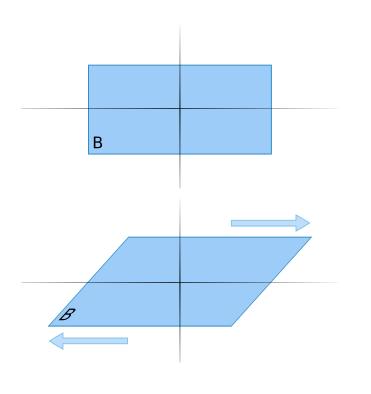
I don’t always trust Wikipedia but think it is quite good in distinguishing between shear forces which occur when forces are unaligned and cause a shear deformation (see figure above) and compressive forces when they are aligned and lead to pure compression or elongation.  To distinguish between these you need to know how and where the balancing force is applied. The force plate only measures the ground reaction and I’d argue can’t therefore distinguish between shear and compressive forces. What it can do is resolve the overall force into components in different directions. I’d thus prefer to describe the components in terms of the direction in which they are acting rather than the assumed effect they are having on tissue.

If I was being really really pedantic I’d probably say that shear forces exist within a material rather than being applied to it. In most biomechanics it is actually the shear and compressive  stresses and strains that are more important. These are caused by the external forces exerted on the material but are conceptually quite different being within the material. Generally speaking the vertical component of the ground reaction will give rise to compressive stresses. Given the complex arrangements of soft tissues in the foot and the irregular shape of the bones, however, it will also cause some some shear stress. Similarly although horizontal forces will result primarily in shear they will exert some compressive (and occasionally tensile) stresses as well.

Or am I being too pedantic? Anyone like to defend the use of shear force to describe what a force plate measures? It’s certainly very common usage.

Taking it slowly

Hi, I’m back, refreshed from a family holiday in France and Spain and invigorated by an excellent ESMAC conference in Glasgow. Thanks to so many people that used the opportunity to say how much they liked the blog – I suppose I better keep going. The view counter passed 10,000 earlier today so let’s see if we can keep it ticking over.

I’ve no doubt that, for clinical gait analysts, the most important paper published over the last decade is Mike Schwartz’ study on the effect of walking speed on gait variables (2008). It’s the only paper that I maintain a link to on my desktop and I rarely interpret any patient data without referring to it. If you haven’t already done so then download it now and do the same (let’s see if we can knock Tom Novacheck’s [1998] review of running biomechanics off the top of the Gait and Posture most downloaded papers table and replace it with a genuine scientific study!).

walking speed

In the study quite a lot of kids were asked to walk at a range of walking speeds. The resulting gait trials were divided up into five groups by walking speed and the average gait variables for the different groups were calculated. The darker the blue in the figure above the faster the walking with the middle trace representing self-selected walking speed. You can see that the gait traces change quite considerably with walking speed even when there is nothing wrong with the child.

We were looking at data from a patient with a rare genetic disorder today. I think if I’d looked at the same data ten years ago I’d have made all sorts of pronouncement on his gait impairments. Now I just look at Mike’s paper and can say, “Yep, he’s walking slowly”, not only that but, “he’s walking slowly in exactly the same way as anyone else would walk slowly”.  It might be worth trying to work out why he’s walking slowly but there is no evidence in the gait data of any specific impairment that is affecting his walking.

I was chatting about this in the group and talking about how we walk with different gait patterns at different speeds and one of my colleagues asked quite, “Why?”. It’s one of those simple questions that caught me completely unawares and started me thinking.

Kinematically, there is absolutely no reason why anyone shouldn’t walk more slowly by having exactly the same pattern of movement but simply going through that pattern more slowly. You could thus walk slowly in a way that gives exactly the same gait graphs (after time normalisation, see previous post on this). The answer of course is that walking is not primarily driven by the kinematics but the kinetics. The way that energy flows between the segments and the way this is mediated by muscle activity depends very much on how fast the segments move. Kinetic energy is proportional to the square of speed and forces and moments act to produce accelerations.  Walking slowly efficiently requires quite different dynamic mechanisms to walking quickly efficiently.

Although this answers the question at one level it only does so partially. What would be really interesting would to be to look at how the curves change with speed from the context of how we understand the process of normal walking and see if we can explain why the gait pattern varies the way it does. Anyone who can do this easily and comprehensively has a better understanding of normal walking than I do. I’m going to have to go away and think about this.

One thing that I think would be quite instructive would be to try and do this practically. Stick some markers on yourself and record yourself walking normally. Then try and see if you can walk slowly but in the same kinematic pattern (after time normalisation). I wouldn’t mind betting that it’s not possible. Even if it is possible to match the kinematics this will require quite different kinetics and muscle activations. You may even be able to feel which muscles you are having to use differently. I suspect there’s be  a huge amount to learn from such an exercise.

 .

Novacheck, T. F. (1998). The biomechanics of running. Gait Posture, 7(1), 77-95.

Schwartz, M. H., Rozumalski, A., & Trost, J. P. (2008). The effect of walking speed on the gait of typically developing children. J Biomech, 41(8), 1639-1650.