Normative databases: Part 1 – the numbers game

I get quite a few queries from people asking about how they should construct normative databases with which to compare their measurements. The first question to address is what you want the normative database for. As you’ll read in my book or in a paper that has just been accepted for Gait and Posture (based on the paper I presented at GMCAS last year)  I’m not convinced by the traditional arguments that we all have different ways of doing things and that we need to compensate for this by comparing clinical data to our own normative data. The whole history of measurement science, which really started at the time of the French revolution, has been about standardisation and the need to make measurements the same way. I don’t see any reason why gait analysts should be allowed to opt out of this.

I’d suggest that the main reason for collecting normative data should be to demonstrate that our measurement procedures are similar to those used in other labs rather than to make up for the idiosyncrasies that have developed for whatever reasons. Our paper shows that there are very small differences in normative data from two of the best respected children’s gait analysis services on different sides of the planet (Gillette Children’s Speciality Healthcare in Minneapolis and the Royal Children’s Hospital in Melbourne). The paper should be available electronically very soon (a couple of weeks) and will include the two normative datasets (mean and standard deviations) for others to download and compare with.

There are two important elements for comparison. Differences between the mean traces of two normative datasets will represent a combination of systematic differences between the participants and between the measuring techniques in different centres. If you find large differences here you should compare detailed description of your technique with that from the comparison centre and try and work towards more consistent techniques. Differences in the standard deviations represent differences in variability in the participants and in the measurement techniques. High standard deviations are likely to represent inconsistent measurement techniques within a given centre and require work within the centre to try and reduce this.

Having defined why we want to collect the data you can then think about how to design the dataset. The most obvious question is how many participants to include? The 95% confidence limits of the mean trace are very close to twice the standard error of the mean which is the standard deviation divided by the the square root of the sample size. I’ve plotted this on the figure below (the blue line). Thus if you want 95% confidence that your mean is within 2° of the value you have measured you’ll need just under 40 in the sample. If you want to decrease this to 1° you’ll need to increase the number to about 130. I’d suggest this isn’t a very good return for the extra hassle in including all those extra people.

sample size for normative data collection

Calculating confidence limits on the standard deviations is a little different (but not a great deal more complicated) because they are drawn from a chi-distribution rather than a normal distribution (see Stratford and Goldsmith, 1997). We’re not really interested in the lower confidence limit (how consistent our measurements might be in a best case scenario) but on the upper confidence limit (how inconsistent they might be in the worst case). We can plot a similar graph (based on the true value of the standard deviation being 6°). It is actually quite similar to the mean with just over 30 participants required to have 95% confidence that the actual SD is within 2 degrees of the measured SD and just under a hundred to reduce this to 1°.

In summary aiming to have between 30 and 40 people in the normative dataset appears to give reasonably tight confidence intervals on your data without requiring completely impractical numbers for data collection. You should note from both these curves that if you drop below about 20 participants then there is quite high potential that your results will not be representative of the population you have sampled from.

That’s probably enough for one post – I’ll maybe address some of the issues about the population you should sample from in the next post.

Just a note on the three day course we are running in June. Places are filling up and if you want to book one you should do so soon.

.

Stratford, P. W., & Goldsmith, C. H. (1997). Use of the standard error as a reliability index of interest: An applied example using elbow flexor strength data. Physical Therapy, 77, 745-750.



“Normal” amputee gait?

Sorry its been so long since I’ve posted – I must try and get into the habit again. Particularly as I’ve had my 200th follower sign up this week.

This post is prompted by an e-mail from Rene van Ee in Nijmegen in the Netherlands. He wrote asking my opinions about using gait indices in amputees. We’re working on collaborative research with Headley Court in Surrey with some of the recent amputees from conflicts in Iraq and Afghanistan so the issue is quite pertinent to us at the moment as well.

amputee markerset

The GGI, GDI and GPS/MAP are all essentially measures of deviations from the average healthy gait pattern. It is assumed that big deviations represent a poor quality gait and small deviations represent a high quality gait. The fundamental question is “Does this apply to amputees?”

In big picture terms, and particularly from a cosmetic point of view, I think the answer is almost certainly “yes”. We want amputees with reasonably “normal” gait patterns and big deviations from this can probably be seen as a bad thing. Many amputees, particularly young and otherwise fit soldiers with state of the art prostheses, however, walk extremely well nowadays. In this category, and particularly if you start considering the biomechanics, then the answer becomes less clear. The best way for a trans-femoral amputee to walk may not be to mimic “normal” walking as closely as possible.

My gut feeling is thus that any of the indices (they all measure deviation from normal in one way or another) will probably be useful measures of gait quality within the less able amputees but may become less useful with the better amputees. Our application is with some military amputees with very high levels of function so this is a big issue for us.

There is an argument that the human body has evolved for the joint to move in particular patterns during walking and that moving through other patterns may be detrimental. In this case measuring the deviation of the sound joints from normal may have some merit. I’d see this as a real advantage of the MAP. It allows you to see the different levels of deviation at the different joints. After that you could take the (RMS) average of the sound joints and create an index that effectively measures how well the movements of the anatomical joints mirror normal walking.

As an engineer, however, I’d expect abnormal joint loading to be at least as important as abnormal joint movement so maybe applying similar techniques to joint kinetics is more appropriate. There’s nothing to stop anyone extending the MAP to kinetics as well as kinematics. Adam and Mike have already proposed this for the GDI (Rozumalski & Schwartz,2011).

The problem with all these ideas is that they are quite complex and dependent on accepting a particular justification for any type of analysis. What I particularly like about the GPS and MAP are their simplicity and this just gets lost. There’s nothing wrong – it just doesn’t really appeal to me.

There is another way of looking at this that might have some merit. We tend to think of the control group used for the indices as “normal” walkers but an alternative would be to think of them as “optimal” walkers. In the healthy population it seems reasonable to just think of the “normal” gait pattern as optimal. It is quite possible that there is an optimal gait for amputees (if there is then there are probably several depending on the level of amputation). If you could select the optimal walkers out at each level then you could base a GPS/MAP/GDI/GGI style comparison against their data rather than against healthy “normal” walkers.

Of course you’d have to come up with some way of identifying the “optimal” walkers at each level. This might require some consideration of whether “optimal” varies with prosthetic componentry as well as amputation level. Perhaps I’ll leave that as a challenge for my readers.

Rozumalski, A., & Schwartz, M. H. (2011). The GDI-Kinetic: a new index for quantifying kinetic deviations from normal gait. Gait Posture, 33:730-732.

Three day gait course in June

Hi, I’m struggling to find time to write proper blog articles at the moment but readers may be interested to know that one of the projects that is taking up my time is a new three day clinical gait analysis course that we will be hosting in Salford from 4-6 June this year.

I’m quite excited by it. It builds on very successful courses I was involved in developing while I was in Melbourne based around the impairment focussed approach to interpretation and reporting of clinical gait analysis data that I’ve been working on for the last ten years or so. I hope what will differentiate our course form other similar courses is this strong over-arching framework within which all material will be presented. Certainly the feedback we got from clinicians who attended its predecessors was very positive.

It’s really designed for health professionals (from any background) either working in clinical gait analysis services or referring patients to them. The approach has been developed for children with cerebral palsy and the case exercises will focus on these. We’ll spend some time towards the end of the course, however, discussing how the techinques can be adapted for other patient groups.

If you are interested in coming then look at the University of Salford web-site for further details.

Shockingly wrong?

Hi, sorry I’ve been away for so long. How very Australian of me to take all of January off!

We’ve started a new semester on the MSc programme its called “Healthy walking” and for this two weeks the students are working through my video series “Why we walk the way we do“. I’ve also been preparing some study material to support this. In doing this I’ve become even more convinced than ever that the conventional understanding of first double support as a phase of shock absorption is wrong.

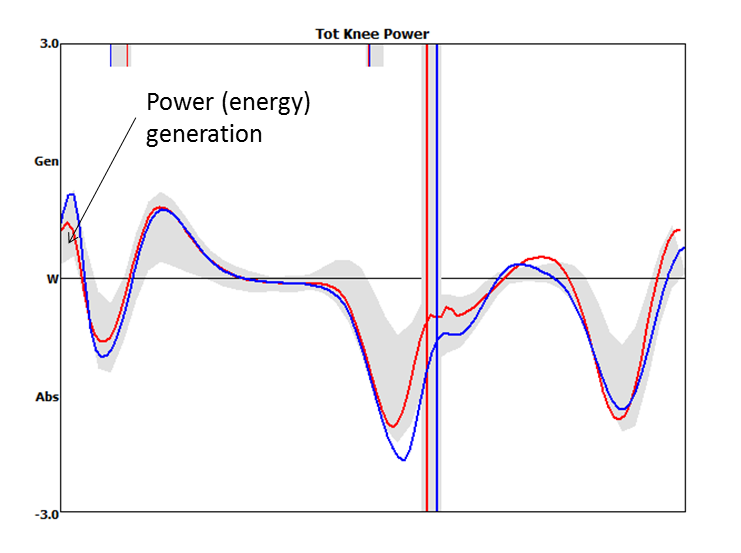
Of course one of the old chestnuts that follow from that theory is that stance phase knee flexion is a mechanism to absorb the shock of impact. I’ve been thinking about this for sometime but it wasn’t until I was preparing this material last week that it struck me that it would be useful to look at the knee power graph. Why? – because if there is one thing that shock absorbers do it is absorb energy. You can make an argument that this is all they do. So if the knee is a shock absorber and we look at the knee power graph immediately after foot contact we should expect to see power absorption.Knee powerIf you look at the graph you’ll see quite the reverse. Immediately after foot contact the knee is generating power – this is not the action of a shock absorber.

In case anyone thinks this is just my data we can go to David Winter’s book (1991, figure 4.34b):

Winter knee

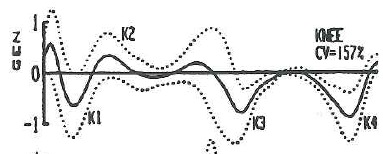
This is interesting because the early power generation peak is definitely there but Winter seems to ignore it. He starts numbering at the power absorption peak in late double support that extends into early single support (K1). Its almost as if he can’t bring himself to admit that it’s there – perhaps he was a shock absorption theorist and this didn’t fit in with his world view?

Kirtley (2006) admits the peak is there and even labels it Ko. He claims however that it is an artefact of the filtering. This claim is unreferenced but I think refers to the work of Bisseling and Hof (2006) which was drawn into a discussion on K0 on the old CGA web-site. I’m not convinced. I don’t think anyone doubts that the ground reaction is anterior to the knee in the first half of double support and the knee is clearly flexing at this point. The inevitable consequence of the combination of these two observations is that power (moment . joint velocity) must be generated. The knee is not acting as a shock absorber.

Putting it another way the knee moment graph clearly shows that the knee flexors are the dominant muscle group at the knee for the first half of double support whereas the knee extensors would have to be dominant for knee flexion to have the capacity to absorb shock.

Of course from about half-way through double support power is absorbed at the knee but this is about 50msec after foot contact which is too long after contact for this to be a consequence of a mechanical “shock” at the time of contact.

On the balance of evidence I’m more and more convinced that stance phase knee flexion is not a shock absorbing mechanism. But if it’s not to absorb shock – what is it for?

.

Bisseling, R. W., & Hof, A. L. (2006). Handling of impact forces in inverse dynamics. J Biomech, 39(13), 2438-2444.

Kirtley, C. (2006). Clinical gait analysis (1st ed.). Edinburgh: Elsevier.

Winter, D. (1991). The biomechanics and motor control of human gait: Normal, Elderly and Pathological (2nd ed.). Waterloo:: Waterloo Biomechanics.

Winter, D. A. (1992). Foot trajectory in human gait: a precise and multifactorial motor control task. Phys Ther, 72(1), 45-53; discussion 54-46.

GPS and/or GDI? Part 4 – the equations

I’ve just been reviewing some of my earliest posts from when I first started this blog which were a discussion of the relative merits of the GDI and GPS and recognise that there is a little unfinished business. In the last of those posts I talked of the equations that allow a conversion between GPS and GDI that Mike Schwartz and I were intending to present at  GCMAS last year. I didn’t include them in the blog at the time because it seemed appropriate to make the conference presentations first. In fact we presented similar papers at both GCMAS and ESMAC.

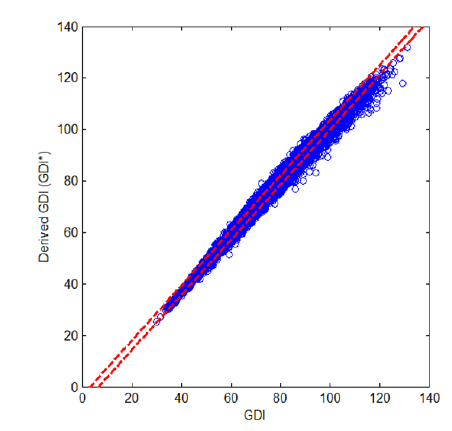
The basis of this is to acknowledge that both GPS and GDI are essentially measures of the RMS difference between two traces. GPS is a direct calculation and GDI first expresses the data as a linear combination of gait features. If this was all that was done then the RMS difference would be identical but the GDI uses only the first 15 features which results in a small difference. If we used the direct RMS differences between the two curves but applied the same scaling as the GDI we would have another measure which we’ll call GDI* which is very close in value to the actual GDI. You can see how close the agreement is from the figure below.

GDI-star

Scatter plot of derived GDI (GDI*) against original GDI. GDI* = -6.6+1.1*GDI, r2=0.996.
A new method for computing the Gait Deviation Index and Motion Analysis Profile, Schwartz MH, Rozumalski A, Baker, R. Proceedings of the Gait and Clinical Movement Analysis Society, Cincinnati, 2013.

If we do this then we can also write down equations that allow a conversion from GDI* to GPS which will also be a very good approximation to the relationship between GDI and GPS. These are:

GDI - GPS equations

where A=mean(ln(ΔRMS)) and B=sd(ln(ΔRMS)) calculated over the control group used for the computation. In this case the values are A=1.677 and B=0.263. So there you go. If you want to compare your results for GDI and GPS you can now just use these equations to convert one to the other.

As a final note for Visual3D users you might be interested to know that the C-Motion web-site now includes a tutorial on how to create a pipeline to calculate the GPS. It’s all gobbledygook to me. I’d be interested to hear of anyone who may have used it though.

Have a happy Christmas. I think its unlikely I’ll get another post out before next Wednesday now and even less likely that anyone will be interested in reading it if I did.