What are the hip adductors for?

Various things have made me think about muscles this week and an issue that’s puzzled me for some time. Why do we have such big hip adductors? Edith Arnold’s paper (2010) is probably the most authoritative we have on the relative strengths of muscles based on muscle volume and fibre length measurements from 21 cadavers. I’ve tabulated the data below. It’s got a few surprises. The gluteus maximus is the largest muscle but several others are considerably greater capacity to generate force (because they have more shorter fibres), the soleus, for example, has nearly twice the force generating capacity.
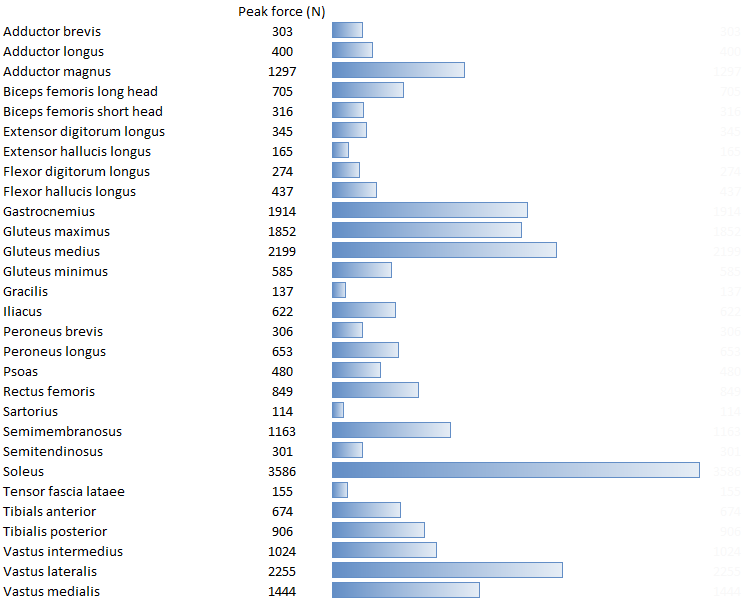
Muscle strength

Adapted from data contained in: Arnold, E. M., Ward, S. R., Lieber, R. L., & Delp, S. L. (2010). A model of the lower limb for analysis of human movement. Annals of Biomedical Engineering, 38(2), 269-279.

What I want to focus on today though is the force generating capacity of the adductors. Summing the peak forces we get 2000N for adductors brevis, longus and magnus working together which is considerably greater the gluteus maximus and up there with the other big muscles. Of course the purpose of muscles is to generate moments and we have to take the moment arm into account as well. The adductors have some of the largest moment arms in the lower limb so their moment generating capacity is even larger than the simple peak force might suggest.

But why do they need to be so large? In both walking (Schwartz, 2008, see figure below) and running (Novacheck 1998) at a range of speeds there is a continuous abductor moment at the hip throughout stance. Indeed because the hip joint is so lateral with respect to the centre of mass of the trunk its very difficult to see how there can be anything other than an internal abductor moment at the hip.
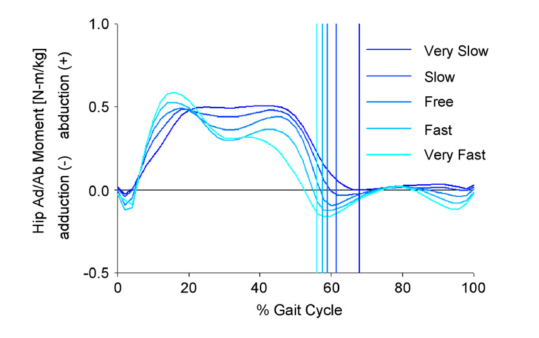
hip adductor moment

Schwartz, M. H., Rozumalski, A., & Trost, J. P. (2008). The effect of walking speed on the gait of typically developing children. J Biomech, 41(8), 1639-1650.

Anderson and Pandy (2001) in their simulation of human walking found low levels of activation in the adductor magnus. This was confined to a short period  around foot contact presumably to supply the small adductor moment immediately after heel contact as seen above. Unsurprisingly in later analysis  (2003) of the same data they concluded that the adductors make a negligible contribution to the vertical component of the ground reaction. Liu et al. (2006) who were tracking real data, found that the adductors don’t make any contribution to the vertical or fore-aft component of the ground reaction either at normal walking speed (2006) or a range of walking speeds  (2008). 

So what’s going on? The adductor magnus is the seventh biggest muscle in the human body and yet it doesn’t seem to do anything during walking or running. There is absolutely no doubt of course that it does come into action during a range of 0ther activities, especially in sport, but how much?  Taking the argument above that it is most likely to be needed when the centre of mass of the trunk is lateral to the hip joint then  there will be relatively few occasions when this occurs in most sports (and I’d suspect even fewer in  non-sporting activities). To get to the size they are the hip adductors must have conferred some evolutionary advantage – but what?

Having written this I’ve been out for a 15km run and guess what – it is my groin (adductors) that is aching. Something really doesn’t add up!

.

Anderson, F. C., & Pandy, M. G. (2001). Dynamic optimization of human walking. J Biomech Eng, 123(5), 381-390.

Anderson, F. C., & Pandy, M. G. (2003). Individual muscle contributions to support in normal walking. Gait Posture, 17(2), 159-169.

Arnold, E. M., Ward, S. R., Lieber, R. L., & Delp, S. L. (2010). A model of the lower limb for analysis of human movement. Annals of Biomedical Engineering, 38(2), 269-279.

Liu, M. Q., Anderson, F. C., Pandy, M. G., & Delp, S. L. (2006). Muscles that support the body also modulate forward progression during walking. J Biomech, 39(14), 2623-2630.

Liu, M. Q., Anderson, F. C., Schwartz, M. H., & Delp, S. L. (2008). Muscle contributions to support and progression over a range of walking speeds. J Biomech, 41(15), 3243-3252.

Novacheck, T. F. (1998). The biomechanics of running. Gait Posture, 7(1), 77-95.

Schwartz, M. H., Rozumalski, A., & Trost, J. P. (2008). The effect of walking speed on the gait of typically developing children. J Biomech, 41(8), 1639-1650.

Formatting spreadsheets to make your life easier

Hi,

This is another short video blog describing how you can format Excel spreadsheets when analysing gait data which uses the spreadsheet template for calculating GPS, MAP and GDI that you can find on the Resources page of this blog-site as an example.

In summary:

  • Put the data in columns on one worksheet, one column for each gait cycle.
  • Put any analysis that operates on data for individual gait cycles on  another worksheet arranged in columns in the same order.
  • Put any analysis that works across gait cycles in a further worksheet.
  • Put tables and graphs of output in this or another worksheet.
  • Label the worksheets sensibly and put in a logical order.
  • If you want other people to use the spreadsheet put instructions on the left-most tab.
  • Save the document looking as you want it to look when the next person opens it up.

If the analysis gets too complex then learn a programming language, it’s generally much more efficient than using spreadsheets!

Lost in translation

Before I start just to note the typo in the last post Elsevier make a profit of £700 million (roughly $1 billlion) each year not £700,000 as I first wrote! Also like to say that I’ve now got a Twitter account @RichardBakerUS. Not sure exactly how I’m going to use it but it is useful for correcting mistakes like these. Now back to biomechanics …

I thought I might share one particular issue that I’ve never really understood to see if anyone can help me. The issue is how we describe joint translations. If you look at the original ISB recommendations  for joint co-ordinate systems (JCS) they propose a system for describing translations as well as rotations. Co-ordinate systems (CS) are chosen in the proximal and distal segments in such a way that, in the joint’s neutral position, the origins of these two systems are coincident. Translation is then defined as the movement of the distal CS origin in the CS of the proximal segment. The ISB suggested that this should be described in terms of three components along the axes of the joint co-ordinate system (rather than the co-ordinate system of either segment).

The problem with this that I don’t think I’ve ever read any discussion of (maybe people think it obvious) is that the measured translations will depend critically on the point chosen for the CS origin. Take the sagittal plane view of the femur (above) and consider the movement of the tibia relative to this. Let’s assume that the tibia rotates about a fixed point within the distal femur (don’t worry too much about whether it does or not in reality as this example is merely to illustrate a point). It makes sense to choose this fixed point as the origin of the CS for both the femur and the tibia. By definition there is then no translation of the joint. But then look at the blue point on the articular surface of the tibia and you can see that this is clearly translating with respect to the femur. No translation of the joint centre – considerable translation at the articular surfaces.

If we look in the transverse plane things become even more perplexing. Here I’m assuming that we have pure internal and external rotation of the tibia on the femur about a  point fixed in both bones. Again, mathematically, there is no joint translation, but again at the joint surface there is considerable translation of points on the articular surface. Not only is there considerable translation but this varies with the distance from the joint centre. You can even see that the green point on the medial side of the joint translates in the opposite direction to the yellow point on the lateral side.

This final example takes things one stage further and demonstrates how the translations depend on the location of the joint centre. The small transverse plane rotations of the knee that do occur (I’ve exaggerated the range of movement in these illustrations for clarity) are probably about a point in the centre of the medial epicondyle as in the figure above. If this is the case then you’ll see that there is virtually no translation at the green point close to that centre of rotation but there is even more translation on the yellow point on the lateral epicondyle.

Use your imagination to scale these up to three dimensional examples and you can see that although there will be a mathematical relationship between the translation at the articular surface and that of the coordinate systems this is extremely complex and dependent on the size and anatomy of the joint. In short although you can measure joint translation using the ISB  proposal it is extremely difficult to interpret what the measurements mean. As a simple minded gait analyst I’ve given up at this point and decided that I’ll stick to the 3 degree of freedom (DoF) joints that my mind can cope with rather than worry about 6 DoF movements that some biomechanists claim we can measure. Measure maybe but make useful clinical inferences from – I’m not so sure.

PS if you want to see a practical application of this you can look at a paper we published quite a long time ago that suggested that wear rates in total hip prostheses can be associated with the pattern of movement of points on the femoral head over acetabulum.

Who profits from academic publishing?

Apologies for following up the last post so quickly particularly as the theme is a little away from the biomechanics of walking but Jon’s comment to my last entry has prompted some web surfing that leaves me feeling really angry. I remain suspicious of producer pays publishing but realise that the open/closed debate is all a bit of a diversion when you look at the role of the commercial publishers in all this.

I now know that academic publishing is dominated by three companies Elsevier, Springer and John Wiley who between them handle 42% of all papers published. Elsevier publish Gait and Posture and the Journal of Biomechanics which are two of the most influential journals in gait biomechanics so I’ll focus the rest of this post on them but I suspect the others are not much better. Elsevier is part of Reed Elsevier. The academic publishing arm (which includes journals and text books is listed as “scientific, technical and medical” within the company accounts and reports) publishes a third of a million research articles each year in 2,00o journals with 700 million downloads last year.

All well and good but if you look at their financial statement you’ll see that over the last two years (2011 and 2012) they had an annual turnover of just over £2 billion (yes billion) and an operating profit of around £700 million. That’s a profit of about 35% of turnover (click here for similar figures for other publishers).

This is a business that publishes other peoples products. They don’t pay the authors anything for the content they publish (indeed the gold open access deal is that authors will pay them about £3,000 per article) and they don’t pay reviewers anything for peer review. I’m not sure what the Editor of Gait and Posture get’s paid but I’m an Associate Editor and receive about  £1,500 per year (half the open access fee for just one article – and will probably handle about 100 papers this year). The £700 million that Elsevier’s shareholder receive each year is thus essentially a product of the academic community’s good will. 

Like any responsible multinational Elsevier are engaged in political lobbying to protect their profits. They have been strong supporters of three bills (Stop on line piracy [SOPA], Protect intellectual property  [PIPA] and the Research Works Acts) presented to the US government. Whilst all have positive sounding names and objectives they are essentially bills that protect the vested interests of holders of copyright. In Elsevier’s case this is particularly outrageous as the copyright they hold stems from other people’s intellectual endeavour.

I’m not the only one to feel unsettled by this. George Monobiot is a campaigning journalist who put’s the case against the publishing cartel very strongly.  In January 2012 mathematician Sir Tim Gowers called for a boycott of Elsevier  which has given rise to the Cost of Knowledge movement that now  lists over 14,000 academics who have chosen to boycott Elsevier’s activities in one way or another. 

I find this really challenging. I probably regard Gait and Posture and Journal of Biomechanics as the two premier journals in my field but  I feel really angry about the size of the profits that someone is generating from my labour. Any suggestions?

Producer pays publishing

In UK Higher Education research quality is assessed every four or five years through the Research Excellence Framework (REF). We have  just finished our submission to REF 2014 and it won’t be until late next year that we receive our results. Already, however,  the government’s plans for the next REF are starting to emerge. The latest communication was an indication that only journal articles made available for open access are likely to be accepted.

The drive is now well and truly on for open access publishing. If public bodies or charities have funded research then surely the results should be open to everyone. I feel a bit like Canute in arguing against the tide, but then again I feel like Canute quite a lot of the time.

The most obvious point to make is that most journal articles are open to everyone already. If you log on to any of the big publisher’s web-sites you can buy a copy of any journal article you like (cost is typically about £30).  The issue isn’t whether articles are open or not, it is what they cost. Most universities and academics are happy to supply copies of individual articles free if you just e-mail a specific request. “Green” publishing effectively formalises this process.

The argument that the research has been funded by governments or charities is still relevant but it is not clear cut. There are many instances where governments invest money but expect the user to contribute at point of use. I’m sitting on a train at the moment that benefits from considerable public subsidy but I still expect to buy a ticket for each individual journey. Even where freedom of information legislation applies there is generally a charge for that information being made available.

The research paper is a product. It’s a product that, if it is useful, someone should be prepared to buy. The general rule for pricing is that the value is determined by what the consumer is prepared to pay.  Open access publishing, at least in the “Gold” form where a fee is charged to the publishing institution, is moving to a model where the producer is required to pay. I can’t think of any other product whose cost is charged to the producer – it runs counter to the logic of the market economy.

The problem with shifting to a producer pays model is that the economics of the system becomes driven by the need to produce rather than any consideration of whether the product is of any value. Most of us in academia are not challenged by the scarcity of data out there – we are overwhelmed by the quantity of it, particularly that which is of low quality.  There is a real risk that by removing demand side drivers and increasing supply side drivers the quality sieve will become coarser, not more refined and there are indications that we are beginning to see this already.

Of course the elephant in the room, and it is a very big elephant, is the academic publishing industry. Its initial reluctance to embrace open access publishing now appears only to have represented the thinking space required to work out a business model to exploit it most productively. Having established this, the big publishers are wading in with “open” arms. It’s a reflection of their inertia that they’ve taken so long to realise that this is a licence to print money. They can now charge the consumer (academic institutions are continuing to pay large fees to have ready access to content) and the producer. Over time the balance will shift from the former to the latter but it is becoming increasingly apparent that publishing a product whose value is set by the producer is a much more attractive proposition than one whose value is set by the consumer.