Projection angles

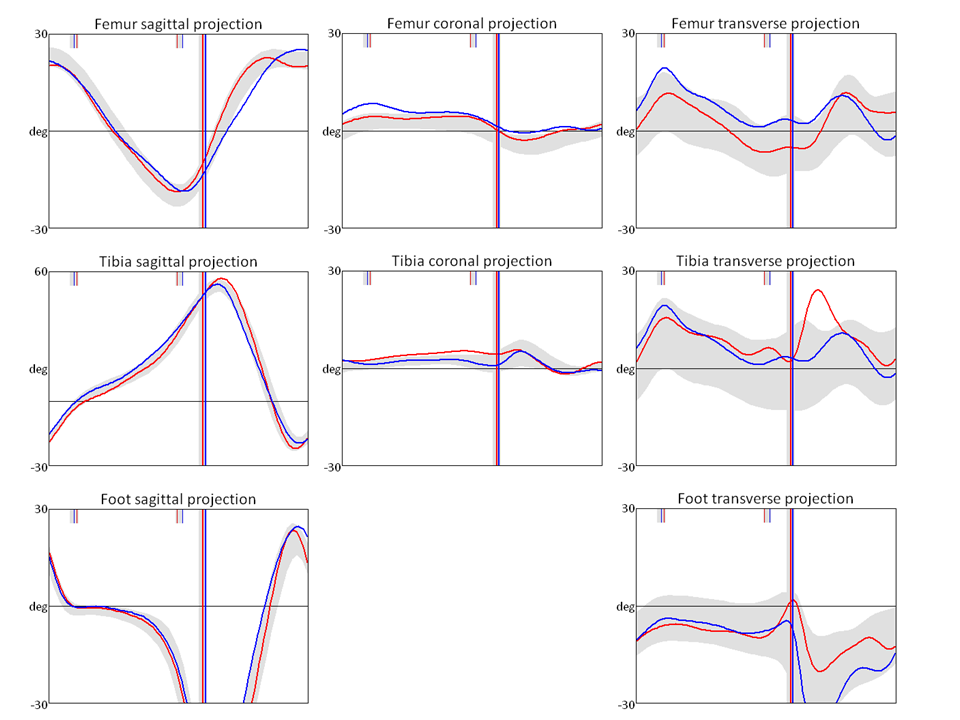
I’ve had some feedback from Vicon support that people have been asking them how to calculate what I’ve called projection angles on page 138 of my book. These are graphs that look a bit like joint kinematics but represent how each of the segments is aligned with respect to the global axis system rather than to the proximal segment. Two of the femur projection angels thus show how the long axis of the femur is tilted with respect to the vertical in the global sagittal and coronal planes. The third angle shows how the femur is rotated about this axis (projected onto the transverse plane).
projection angles


I first plotted these graphs as a quality assurance tool in that they represent what you should see on  a video recording of the person walking (as long as you take into account parallax effects if the person is not in the centre of the screen or the camera is not directed exactly along one of the principal axes of the global coordinate system). Thus the femur transverse projection tells you whether you should be seeing the femur as internally or externally rotated as viewed by a camera towards which the person is walking. It avoids the need to perform a mental sum of pelvic rotation and hip rotation to assess which is required otherwise. In the example above, at foot contact the left thigh (red) is facing directly ahead and the right thigh is internally rotated by about 5°. You probably won’t be see such a small difference but if the right limb looked to be externally rotated at this instant you might want to question the alignment of thigh markers or knee alignment devices.

Since starting to plot the angles, however, a range of other uses have emerged. The tibia and femur sagittal projections, for example, are essentially what Elaine Owen refers to as segment to vertical angles when tuning ankle foot orthoses.

The foot transverse plane angle is what many of us already plot out routinely and call foot progression. The corresponding angle in the sagittal plane, however, is very rarely plotted but gives a direct appreciation of whether the foot is flat or not. In the example above the foot makes contact at an angle of about 15° to the ground and rotates to become flat on the floor (0°) during about the first 8% of the gait cycle (Perry’s heel rocker). It then remains flat until about 40% of the gait cycle (ankle rocker) after which heel rise causes the foot to start tilting forwards (negative angle, representing toe rocker). If distinguishing between the rockers is important to you then using a graph like this is about the only way to do it. I’ve referred in a previous post to how useful I find this information can be.

I’ve not plotted the pelvic graphs because, if you calculate them using the correct rotation sequence, then they are virtually identical to the pelvic joint angles.

The main reason for this post is thus to make the model that I wrote many years ago to calculate this widely available (click here to go to the download page). Unfortunately it is written in Vicon’s BodyLanguage so will only be directly useful for Vicon users (please note that it requires plugin Gait to have been run first). The accompanying description of exactly what the angles represent should, however, allow any reasonably competent clinical engineer to calculate the equivalents in any other programming/modelling language.

Just a minute

During a meeting of the CMAS standards meeting last week there was some discussion about how repeatable our measurements need to be. I was struck by  a comment from Rosie Richards from the Royal National Orthopaedic Hospital at Stanmore that six degrees is the angle represented by one minute on a clock (apparently the idea originally came from her colleague Matt Thornton). Her point was that this doesn’t feel like a very big angle and that if we are are working to this sort of accuracy then we are doing pretty well. I’d agree with her and think if there is ever any discussion of just how accurate gait analysis is then using this as an illustration is really powerful.

Corn Exchange clock, Bristol. This clock actually has two second hands. The red one records GMT and the black one the local time in Bristol which is 190 km west of London and thus nine seconds behind! (C) Rick Crowley, Creative commons licence.

The evidence supports this. In our systematic review, Jenny McGinley and I suggested that measurement variability of more than 5 degrees was concerning and showed that most repeatability studies for most joint angles report variability of less than this. They are thus also, of course, within the one minute limit as well.

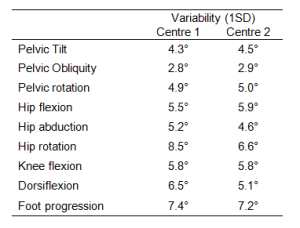
It’s also interesting to note that the variability within normal gait is generally less than 6 degrees. I’ve tabulated the standard deviations from our recent comparison of normative data below. Hip rotation at one centre pushes above the limit (but this is almost certainly a consequence of measurement error). The only other variable that exceeds this is foot progression (which I’ll return to below). This should be of interest to those who think that they should be able to use differences in gait pattern as a biometric to identify people. To do this successfully would require variability within the 1 minute limit to distinguish between people.  Personally, I think this is a big ask from the CCTV camera footage that the biometricians would like to base their analysis upon.

Average standard deviations across gait cycles for different gait variables

This doesn’t mean we should be  complacent, however. In the figure below I’ve compared Verne  in the average normal pose at the instant of foot contact (grey outline) and then increased his leading hip flexion by 6 degrees (and adjusted the trailing foot pitch to bring the foot into contact with the ground again while all the other joint angles remain the same). You can see that this has increased step length by over 10%. If there was an additional 6 degree increase in trailing hip extension as well then this would double. The additive effect of such variability may help explain why foot progression in the table above is a little higher than the other measures in that it can be considered as a combination of the transverse plane rotations at pelvis, hip, knee and ankle rather than a “single” joint angle.

Effect on step length of increasing leading hip flexion by six degrees

In summary the one minute limit seems an extremely useful way of describing how accurate our measurement systems are and we should take considerable confidence from this. On the other hand we shouldn’t be complacent as variability of this level in specific joint parameters can have quite substantial impacts on the biomechanics of walking.

Readers outside the UK may not fully appreciate the title to this blog which is a reference to one of the oldest comedy shows on BBC radio which has been broadcast regularly since 1967. It is one of the purest and most exuberant celebrations of the English language that I know. Episodes are not being broadcast at present but when they are they can be listened to internationally (I think) through the BBC i-player

Well-heeled?

We’ve recently been doing some work to try and understand the transition between late swing and early stance to try and provide a better evidence base for my Why we walk the way we do video series. We’d been meaning to focus on late swing to start off with but some apparent artefacts in the data compelled us to look at what was happening in early stance.

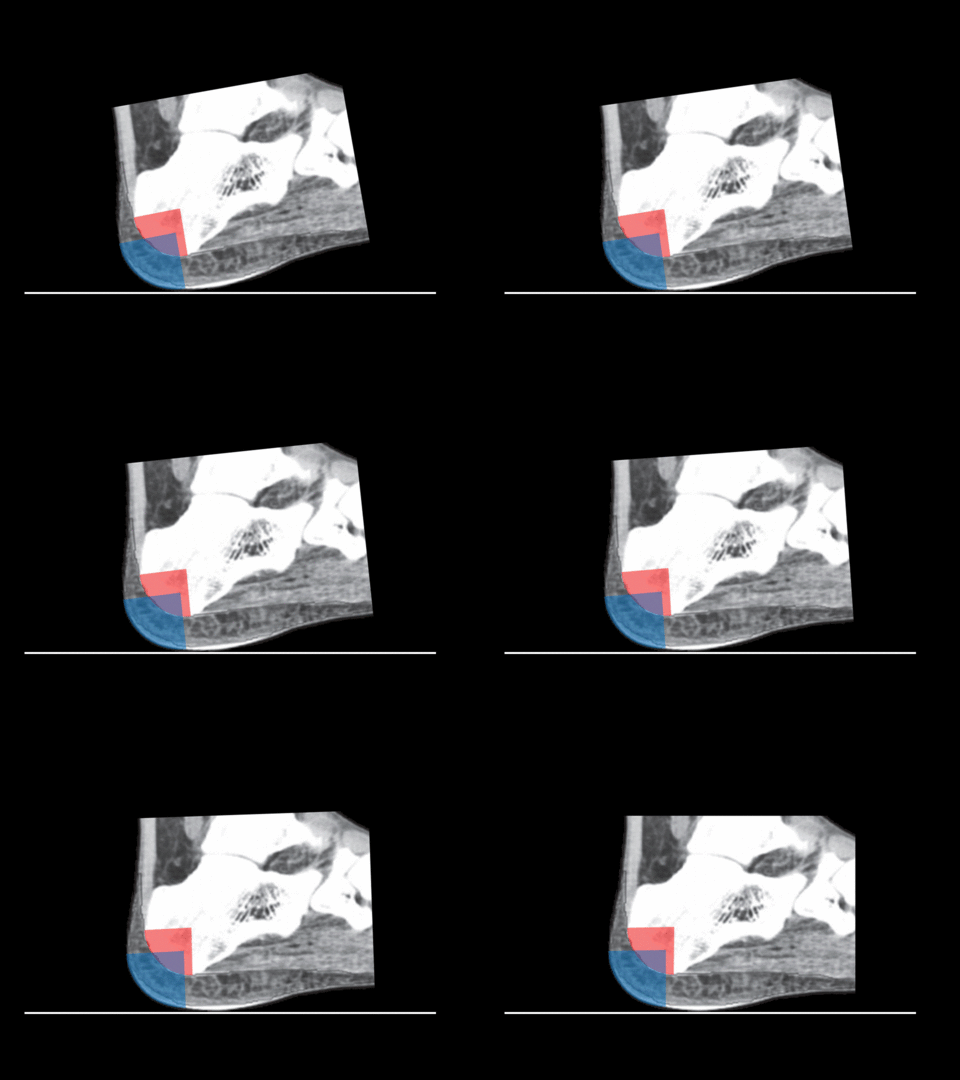
After quite a lot of head scratching we found out that the artefact (in how markers on the medial, posterior, and lateral calcaneus move) can be explained quite easily if the calcaneus rolls forward in the first 50ms or so of stance (and takes the rest of the foot with it). This makes quite a lot of sense as the foot is rotating quite fast (approx. 200°/s) immediately before foot contact and we know that the foot is lowered to the floor over approximately this period. When I went and looked at a few x-rays this seems to relate very well to the functional anatomy of the calcaneus which has an almost circular posterior-distal aspect in the sagittal plane (red quarter circle in animation below). A recent paper on the anatomy of the heel pad confirms that it too wraps around onto the posterior aspect of the calcaneus which would allow cushioning of the calcaneus throughout any such rolling motion (blue quarter circle in animation below). I’ve not seen this mechanism described in exactly this way before but it is, of course, very similar to the Perry’s first rocker of stance.

Illustrative animation of rolling hindfoot (not-based on measurements)

Illustrative animation of rolling hind-foot (inspired by rather than based on our  measurements!)


We’re just about to submit the paper and I don’t want to write too much about it before it is fully peer reviewed but the results have made me to wonder why on earth we wear heels. Placing a heel of rectangular cross section under the calcaneus would pretty much destroy the potential for this rolling mechanism that the calcaneus appears to have evolved for. So why do we wear them?

It turns out that heels as an integral component of shoes are a relatively recent invention. As far as I can gather for most of history (and in most places on the globe) shoes had flat (no) heels (see pictures below).

Authentic reconstructions of 15th typical 15th century shoes

Authentic reconstructions of typical 15th century shoes

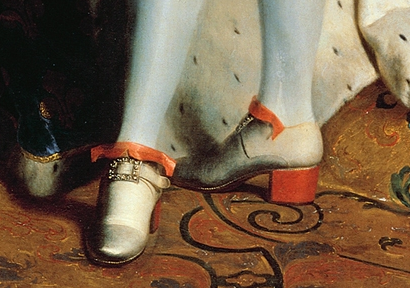
Heels first started to appear on riding boots in Europe in the 16th Century. Their role was not to help with walking but to retain the boot in the stirrup (and possibly to provide an anchor for spurs). Later on in the century  heels to started be incorporated in shoes worn at court particularly by rulers of short stature such as Queen Elizabeth I in England and Louis XIV in France (see picture below).

High red heels of Louis XIV from portrait by Hyacinthe Rigaud

High red heels of Louis XIV from portrait by Hyacinthe Rigaud

Once the monarch had adopted the practice of course it spread rapidly amongst the courtiers. For a large part of the 17th century relatively high heels were popular amongst both male and female members of the aristocracy.  There were even rules in France restricting the wearing of coloured heels to particular ranks within the aristocracy. During this period heels were essentially an indication of wealth and status and in English the term “well-heeled” is now used to refer to someone who is wealthy rather than someone who wears a particular style of footwear. During the French revolution there was a reaction against wearing heels as they were associated with the decadence of the pre-revolution court. Through much of the first half of the 19th Century heels were a comparative rarity. High heels never did take off for again men but returned in the mid-19th century for women particularly in Paris and New York

It is much less clear when the modern low heel came to be adopted as an integral part of the shoe for the ordinary (poor) people nor what its purpose is. Looking at the pictures on various web-sites suggests that the practice probably became common in the mid 18th century.   There is some suggestion that most of the wear on a shoe occurs under the calcaneus and that incorporation of a heel reinforces the sole in this area and can also be easily replaced if that wear becomes excessive. It wasn’t however until the mid 19th century that shoemaking started to become mechanised and modern footwear started to become affordable. Since this time the classic western male shoe has evolved very little. Almost all shoes these days have a heel even though materials are available which wear very little and shoe repair is becoming a rarer and rarer procedure.

Which all tends to make me think that in the modern world there isn’t any particular reason for heeled shoes and I wonder if we’d be better off without them. (Of course I could talk start talking about minimal shoes for running or negative here but that is a completely different subject).

Note: I’ve been quite dependent on a number of different web-sites for this information. It’s very difficult to determine quite how reliable those sites are but there does seem to be a general consensus on the salient points. 

Getting physical

I had meant to move on from  this issue about the complexity of biomechanics and the quality of the research questions we ask … but then last night, in her comment, Quin drew my attention to a series of articles entitled “Biomedical research – increasing value, reducing waste” that were published in the Lancet in June (these are free to download but you need to register first – also free). They make fascinating reading. If you think I was a bit grumpy and cynical in what I wrote the week before last then you should have a look at what these guys are saying! (The articles are a bit heavy going and an easier and more entertaining alternative is Ben Goldacre‘s book Bad Science, it’s been around long enough that you can pick it up for 1p on Amazon and just pay the postage).

The issue marks the twentieth anniversary of an article, The scandal of poor medical research, written by the statistician Doug Altman in the BMJ which was perhaps the first public recognition of the poor quality of much clinical research with the tag line, “we need less research, better research and research done for the right reasons“. In another commemorative piece, Medical research still a scandal,  Richard Smith, who was editor of the BMJ at the time, laments on how little has changed, despite, perhaps, a wider awareness of the problems.

One of the responses to Bland’s original article which appealed to me has been given the title Theory must drive experiment. In it the author (a JA Morris from the Royal Lancaster Infirmary) attributes the problem of poorly formulated research questions to a failure of clinical scientists to develop an underlying theoretical basis for their experimental observations. This has always puzzled me as well and, over the years, I’ve come to the conclusion that, as someone who trained originally as a physicist, I’ve got a markedly different view of the world to many of my colleagues who trained in medicine or health sciences.

Arthur Eddington, “… do not put too much confidence in experimental results until they have been confirmed by theory”

As a physicist I expect to understand the results of my experiments and to be able to align them with an underlying theory. An understanding of that underlying theory then develops new research questions. My  knowledge continues to develop by the continued construction and refinement of the underlying theory (I’m sure there is a posh name for this in the philosophy of science). Taken to an extreme this results in Eddington‘s warning to the physicist  not to “put too much confidence in experimental results until they have been confirmed by theory“. Whilst at face value this sounds like an injunction against publishing experimental data it is actually a plea for careful consideration of the results in the light of the underlying theoretical framework and a refinement of that framework if  necessary.

Ernest Rutherford, “When it comes to science there is physics and there is stamp collecting”

I wouldn’t claim this as a unique skill of the physicist. Whilst over a hundred years ago Rutherford could quite reasonably(?) claim that “all science is either physics or stamp collecting” , the world has moved on. The rise of anatomy, physiology and particularly biochemical biology since that time mean that there are now underlying theoretical frameworks that we can use to explain the results of clinical and health sciences research.

We very rarely do though and I think this is partly attributable to education of doctors and allied health professionals being rooted in an earlier era. It wasn’t so very long ago that most results of clinical research where, effectively, beyond explanation. There was no point trying to fit those results into any underlying theoretical framework because the basic principles of that framework had not been established.  Knowledge in the clinical domain was essentially phenomenological – a knowledge of what happens rather than why it happens. Education then becomes a matter of teaching the facts rather than the underlying principles that link those facts. Of course if you don’t have an underlying theory to work from then you are going to find it much more difficult to generate sensible questions to drive the next generation of research. This is, of course, exactly the point that Morris was making and links to my post from last week.

As we move out of that era though we’ve got to put a much heavier emphasis on developing the underlying theoretical basis of our subject and using this to drive our research questions. Which leads me to my highlight of the ESMAC-SIAMOC conference which was Adam Shortland’s key-note talk, “The neuromuscular prerequistes of normal walking and the early loss of ambulation in cerebral palsy“. In it he reviewed what is now known about neurophysiological development and laid out a conceptual framework that explains much of what we observe in cerebral palsy and also provides a platform to generate new research questions … but then if you look at his CV you’ll see that he trained first as a physicist as well!


Training our PhD students to ask questions

This afternoon I give an annual lecture about what a PhD is. It is designed as part of the orientation for new PhD students and as a time for reflection to those already well established in their studies. It’s interesting for me to think about this talk after my post last week about how few of the papers I read or hear presented advance my understanding of a particular area.  Another way of looking at this is to comment on the number of papers and particularly conference presentations I see which don’t, to me, appear to contain a clearly formulated or insightful research question. Clearly if your research isn’t driven by a clear question then it is extremely unlikely that it is going to deliver a clear answer.

As research progresses, the fields within which we all function get more specialised and complex. Most of the obvious, simple questions have already been asked. This leads to a large choice of less obvious, derivative questions. Not only does productive research need to ask a relevant and interesting question but it needs to ask one that has the potential to be answered by the techniques that are available. As science progresses there are more and more techniques to choose from and more skill required in selecting the correct one (as in Kat Steels’ prize winning paper at ESMAC). In summary it would be quite reasonable to state that the principle skill that a research leader needs in the modern environment is the ability to think up well-formulated, interesting and answerable research questions

A PhD is many things but amongst these it serves as an entry level qualification for our future research leaders. The process  has changed markedly since I obtained mine (awarded almost exactly twenty years ago). I was chatting about this the other day with a colleague who was remembering completing hers with an absolute minimum of supervision. She commented on how this equipped her with a degree of self-sufficiency and independence that the current system doesn’t always deliver. I shared that experience, and on the one hand agree that it nurtured (inflicted?) independence. On the other, it meant that there are whole areas that I now consider essential for a PhD student to master that I didn’t even touch. No-one ever suggested I should have a systematic approach to searching the literature (at that time there wasn’t a great deal of literature to search). I don’t remember any consideration of the ethics of my research despite the fact that I was modifying external fixation frames that were being applied to patients in the local fracture clinic. There is no statistical analysis anywhere in my thesis. None of it ever got published. Perhaps most importantly of all, given the focus of this post, there is no formal statement of a specific research question. I’m glad that the 30 year old me didn’t have the 50 year old me as a PhD examiner, because I would have failed.

Given the complexity of research in the modern world, I don’t think we have any choice but to have highly structured PhD programmes. There simply isn’t time to allow students to do their own thing anymore. But there is a danger that, in cramming a PhD syllabus full of all the detail of how to systematically review, apply for ethics, master complex measurement techniques, perform rigorous statistical analyses and submit papers, we lose focus on the core research skill of asking a relevant,  insightful and answerable question.

This can be exacerbated by many PhD studentships these days being offered on the basis of funding to conduct a particular project. In these the research question may have been decided before the student even arrives. Sometimes only a general area has been identified, but even then supervisors will often have very strong views about the direction that research should take. I must admit to being guilty of this myself. If I’ve worked hard to get money to support a PhD studentship or am investing my time in supervision, I want to be certain that the resulting research answers the questions that I’m interested in rather than dreaming up their own.

And then of course there are pressures from the system. Universities in the UK are now judged, in part, by how many PhD students complete within the equivalent of 4 years full time study. To ensure this my own University asks the student to submit a Learning Agreement within 3 months, an Interim Assessment within one year and an Internal Evaluation including substantial drafts of thesis chapters before the end of the second year. The pressure is for them to hit the deck running. By far the easiest way to ensure this is to tell students what their research question is and let them to get on with it.

The one thing that is perhaps helping is the drift away from the classic PhD, which reported one large study, to the modern standard which reports several smaller ones. On this model the student gets the opportunity to design a number of studies. Each one will give practice in formulating a relevant, insightful and answerable research question. I wish students who are facing this challenge well and look forward to hearing them present their answers at the future conferences I attend.